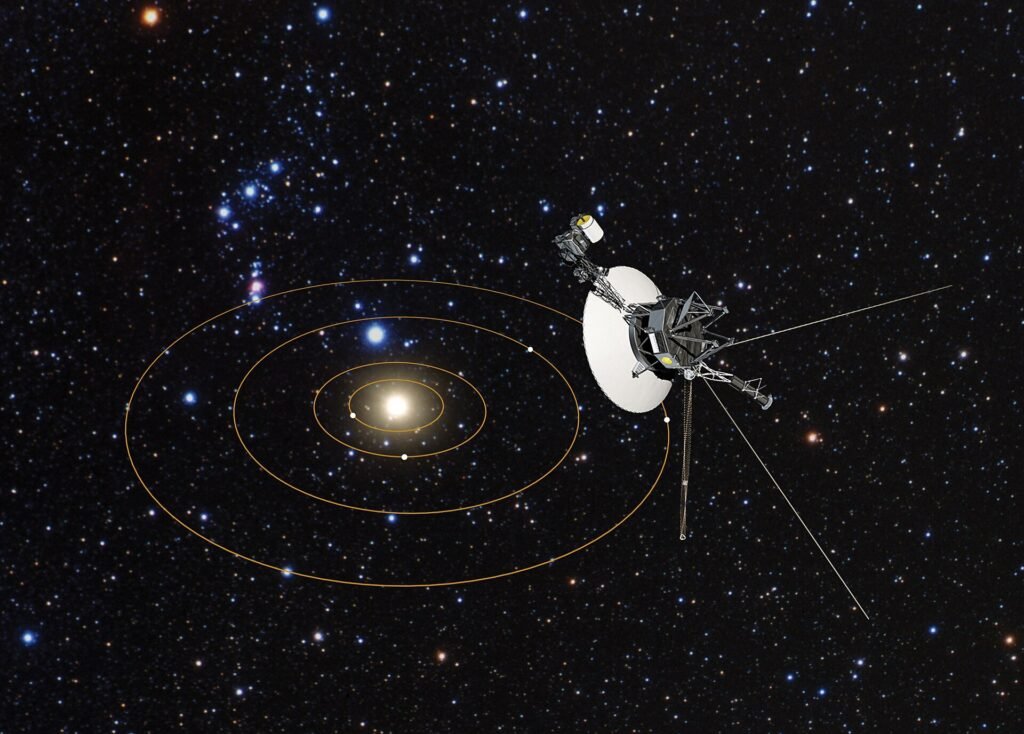
On November 18, 2026, NASA’s Voyager 1 spacecraft is scheduled to reach a distance of one light-day from Earth, which is the distance light travels in 24 hours. NASA’s Voyager tracking page puts that distance at 16.094 billion miles (25.902 billion kilometers). This article explains what a light-day is, what the milestone means for communication and which instruments are still working.
What is a light-day?
A light-day is the distance light travels in 24 hours. NASA’s page defines it that way. Astronomers use units such as the light-day and the light-year because ordinary miles and kilometers produce numbers that are hard to read. Radio signals are a form of light, so they travel at the same speed as visible light. Our concept entry on the speed of light covers the physics behind that limit.
When does Voyager 1 reach one light-day?
NASA lists the moment as Wednesday, November 18, 2026, at 2:16:07 a.m. Pacific Standard Time, which is 5:16:07 a.m. Eastern time. At that moment NASA gives the distance from Earth as 16.094 billion miles (25.902 billion kilometers). Some news reports give a different clock time, so we follow NASA’s own page and have not recomputed the trajectory ourselves. Because the event is still ahead as this article is written, the exact second depends on NASA’s tracking and could be refined.
What does one light-day mean for communication?
Once the spacecraft is one light-day away, a radio signal needs 24 hours to cross the gap in a single direction. By our own arithmetic, a command sent from Earth and a reply received would take about 48 hours round trip, before counting any processing time on board or on the ground. NASA’s page does not state the signal time directly. The figure follows from its definition of a light-day, so treat it as our calculation rather than a NASA quotation.
Which instruments are still working?
NASA’s page lists two Voyager 1 instruments as on: the magnetometer (MAG) and the Plasma Wave Subsystem (PWS). All other instruments on Voyager 1 are listed as off. For Voyager 2, the page lists the Cosmic Ray Subsystem (CRS), the magnetometer and the Plasma Wave Subsystem as on, with the rest off. A magnetometer measures magnetic fields, and a plasma wave instrument detects waves in ionized gas. Those two definitions are general explanations and are not quoted from NASA.
What about Voyager 2?
NASA says Voyager 2 launched in 1977 and left Earth for its Grand Tour of Jupiter, Saturn, Uranus and Neptune, then headed for interstellar space. The page does not give a current distance for Voyager 2 in text and instead links to a 3D visualization of its position. We therefore do not state a number for it here.
How to read the distance numbers
A light-day is a distance, not a time, and the two NASA figures can be checked against each other. Light travels about 299,792 kilometers per second, and a day has 86,400 seconds. By our own arithmetic, 299,792 multiplied by 86,400 is about 25.9 billion kilometers, which matches NASA’s 25.902 billion. The speed of light is a general constant and is not quoted from NASA’s page. The same check works in miles: 16.094 billion miles is the same distance expressed in the other unit.
For scale, the average distance between Earth and the Sun is about 149.6 million kilometers, a general figure that defines the astronomical unit. By our own arithmetic, dividing 25.902 billion by 149.6 million gives roughly 173 astronomical units. That means Voyager 1 will be about 173 times farther from Earth than the Sun is.
Why does this milestone matter?
The one light-day mark is a round number, not a new discovery, and no new science result is attached to it. Its value is as a reminder of how far a spacecraft launched in 1977 has traveled and how long its signals now take. It also shows how a mission can keep returning data from a small number of instruments after most have been switched off. For contrast at the other extreme of the solar system, our article on Parker Solar Probe’s record pass covers the closest approach any spacecraft has made to the Sun. Our piece on interstellar comet 3I/ATLAS covers another visitor from beyond the solar system.
Glossary
- Light-day: the distance light travels in 24 hours, as defined by NASA
- Astronomical unit (AU): the average Earth-Sun distance, about 149.6 million kilometers
- Magnetometer: an instrument that measures magnetic fields
- Plasma: ionized gas made of charged particles
- One-way light time: how long a signal takes to cross a distance in one direction
The astronomical unit, magnetometer, plasma and light-time entries are general definitions and are not quoted from the NASA page.
What is not covered on the NASA page?
The page gives only the year of launch for the Voyagers and does not give an exact launch date, a current speed, the power level or the year Voyager 1 crossed into interstellar space. We have left those out rather than filling them from memory. Readers who want the full mission history should consult NASA’s mission pages directly.
Key facts at a glance
- Milestone: one light-day from Earth
- Date and time per NASA: November 18, 2026, 2:16:07 a.m. PST
- Distance at that moment: 16.094 billion miles (25.902 billion kilometers)
- Voyager 1 instruments on: magnetometer and Plasma Wave Subsystem
- Voyager 2 instruments on: Cosmic Ray Subsystem, magnetometer and Plasma Wave Subsystem
Frequently asked questions
When does Voyager 1 reach one light-day from Earth?
NASA lists November 18, 2026, at 2:16:07 a.m. Pacific Standard Time.
How far is a light-day?
NASA gives 16.094 billion miles, or 25.902 billion kilometers.
How long will a signal take to reach Voyager 1?
About 24 hours in one direction at that distance, by our own arithmetic from NASA’s definition.
Which Voyager 1 instruments are still on?
NASA lists the magnetometer and the Plasma Wave Subsystem as on.
Is the milestone a scientific discovery?
No. It is a distance marker, and NASA’s page does not attach a new science result to it.