Specialty Digest

DISCOVER IDEAS THAT SHAPE OUR WORLD

Section

Nature

The latest Specialty Digest coverage in Nature.

Nature

Business
World in a Day cover, Thursday, September 3, 2026

World in a Day: Thursday, September 3, 2026

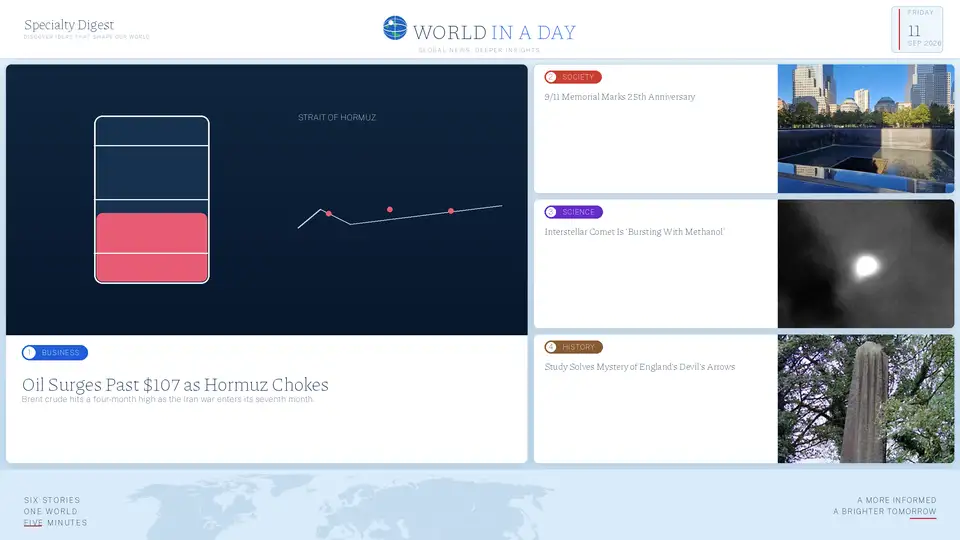
WORLD IN A DAY · THURSDAY, SEPTEMBER 3, 2026 Six stories worth five minutes: Nvidia makes its biggest acquisition ever, a UN report concedes the world’s flagship climate target will likely be missed, and a Bronze Age Egyptian official’s tomb resurfaces after four thousand years underground. Technology Nvidia to Buy Hugging Face for $12.9 Billion […]

World in a Day: Thursday, September 3, 2026 Read More »

Nature
Glowing blue bioluminescent waves crashing on a dark beach at night, caused by light-producing marine plankton

Why Do Some Animals Glow in the Dark?

A firefly blinking in a summer backyard and an anglerfish dangling a lure in the pitch-black deep sea are doing the exact same trick: making their own light. So why do some animals glow in the dark? It comes down to a chemical reaction called bioluminescence, and animals have evolved to use it for everything

Why Do Some Animals Glow in the Dark? Read More »

Bioluminescence lets fireflies find mates and anglerfish lure prey — all from the same chemical trick.

Nature
The deep-sea submersible Limiting Factor floating on the ocean surface after a research dive into a deep trench

How Deep Is the Ocean, Really?

The ocean covers most of the planet, but its depth is easy to underestimate. So how deep is the ocean, really? On average, it’s about 3,682 meters — roughly 12,080 feet, or more than two miles down, according to NOAA. But that number hides an enormous range, from shallow continental shelves you could wade into

How Deep Is the Ocean, Really? Read More »

From the sunlit surface to the crushing dark of the Challenger Deep, the ocean's average depth alone is more than two miles.

Nature
A bright double rainbow arcing across a stormy sky, showing the curved band of colors that gives rainbows their shape

Why Are Rainbows Curved?

Stand in the right spot after a storm, with the sun at your back and rain still falling ahead of you, and you’ll see it: a perfect, glowing arc stretching across the sky. But why are rainbows curved rather than straight, or shaped like something else entirely? The answer comes down to simple geometry —

Why Are Rainbows Curved? Read More »

Every rainbow is really a full circle in the sky — the ground is what turns it into the arc we see.

Nature
Arctic ground squirrel standing alert near its burrow before entering hibernation for the winter

How Do Animals Hibernate?

Every autumn, a handful of animals pull off one of the strangest tricks in biology: they shut their bodies down almost to the point of death, then flip the switch back on months later with no apparent harm. So how do animals hibernate, exactly? The short answer is that true hibernators reduce their metabolism, heart

How Do Animals Hibernate? Read More »

From supercooled squirrels to lightly dozing bears, hibernation is really a spectrum of extreme metabolic slowdowns.

Nature
Molten lava from a Hawaiian volcano glowing as it flows into the Pacific Ocean.

How Do Volcanoes Actually Form?

Roughly 1,350 volcanoes around the world are considered potentially active, and about 500 of them have erupted in just the last century, according to the U.S. Geological Survey. That is a lot of mountains built from the inside out. Every one of them, from a snow-capped stratovolcano in the Cascades to a lava-spitting island in

How Do Volcanoes Actually Form? Read More »

From colliding plates to stationary hotspots, here is the geology behind where volcanoes form and why they erupt so differently.

Nature
A vivid green aurora borealis display glowing across a dark night sky.

What Causes the Northern Lights?

On a clear, dark night at high latitude, the sky can suddenly start to move: ribbons of green, sometimes edged in pink or purple, rippling overhead like a curtain in the wind. The aurora borealis looks otherworldly because, in a sense, it is. What you are seeing is the tail end of a journey that

What Causes the Northern Lights? Read More »

The aurora is solar wind, Earth's magnetic field, and 44-million-mile-per-hour electrons colliding, all lighting up the sky.

Nature
A flock of migratory birds flying in a V formation against a blue sky.

Why Do Birds Migrate?

Every spring and fall, an invisible river of birds flows across the sky. On a good autumn night over the United States, an estimated one billion birds can be airborne at once, most of them traveling after dark when the air is calmer and predators are fewer. They are not fleeing the cold, at least

Why Do Birds Migrate? Read More »

Billions of birds fly thousands of miles each year, guided by daylight, hunger, and a compass built into their own eyes.

Nature
Honey bees densely covering a wild honeycomb as they process nectar into honey.

How Do Bees Actually Make Honey?

A jar of honey looks simple: golden, sweet, shelf-stable for years. What it took to get there is anything but. Making honey requires a relay of dozens of bees, a body part built like a second stomach, an enzyme that rewrites sugar at the molecular level, and thousands of tiny wingbeats working as a dehumidifier.

How Do Bees Actually Make Honey? Read More »

It takes a relay of bees, one wild enzyme, and thousands of fanning wings to turn flower nectar into honey.