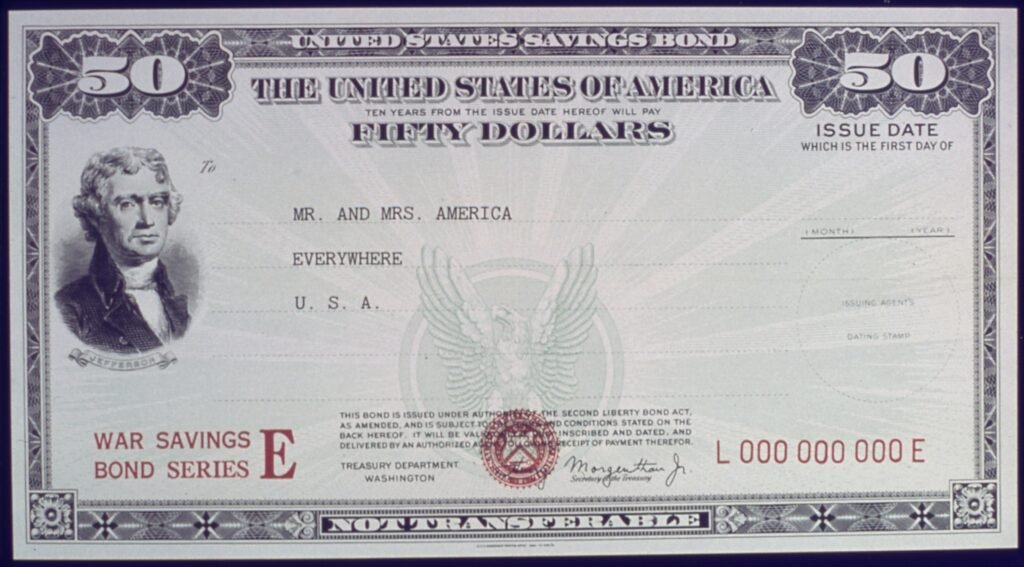
A bond is a fixed-income financial instrument representing a loan made by an investor to a borrower, typically a corporation or a government. In exchange for the loan, the issuer promises to pay periodic interest, called a coupon, and to repay the bond’s face value, also called par value, when the bond reaches its maturity date.
Basic mechanics
A bond is defined by several key terms: the face value is the amount repaid at maturity; the coupon rate is the interest rate paid on that face value, usually on a fixed semiannual or annual schedule; and the maturity date is when the issuer must repay the principal in full. An investor who buys a bond is effectively lending money to the issuer and earns income through the coupon payments until the bond matures.
Government and war bonds
National governments have long used bonds to finance spending, particularly during wartime. The United States issued patriotic war bonds during both World War I and World War II, marketed heavily to ordinary citizens through public campaigns as a way to fund the war effort while giving savers a relatively safe place to park money. These campaigns combined genuine financial instruments with strong appeals to civic duty, and they remain a widely cited historical example of mass-market government borrowing.
Corporate bonds versus stock
Corporations raise capital either by issuing bonds, which creates a debt obligation to repay, or by issuing stock, which sells an ownership stake rather than creating a repayment obligation. Bondholders are creditors with a legal claim to fixed payments and are generally repaid before shareholders in the event of bankruptcy, but they do not share in a company’s profits beyond their fixed coupon rate. Shareholders take on more risk but have unlimited upside if the company’s value grows.
Credit ratings and risk
Independent rating agencies assess the creditworthiness of bond issuers and assign ratings that indicate the likelihood of default. Bonds rated at the higher end of the scale are often called investment grade, while those rated lower are called high-yield or junk bonds, and typically must offer higher coupon rates to compensate investors for the additional default risk. A downgrade in an issuer’s credit rating generally causes the price of its existing bonds to fall, since the market demands a higher yield to compensate for the newly perceived risk.
The inverse relationship between rates and bond prices
Bond prices and prevailing interest rates move in opposite directions. When market interest rates rise, newly issued bonds offer higher coupons, making existing bonds with lower, fixed coupons less attractive, so their market price falls to compensate buyers with a higher effective yield. When market interest rates fall, existing bonds with higher fixed coupons become more attractive, and their price rises. This relationship is central to how bond investors and central banks think about the bond market’s reaction to monetary policy changes.
Zero-coupon bonds
Not all bonds pay periodic interest. Zero-coupon bonds are sold at a discount to their face value and pay no periodic coupon at all; the investor’s entire return comes from the difference between the discounted purchase price and the full face value paid at maturity. These instruments are often used for specific future financial goals, such as funding a known future expense, because their single payout date and amount are known with certainty at purchase.
Municipal bonds
State and local governments issue municipal bonds to fund public projects such as schools, roads, and utilities. In many countries, interest earned on municipal bonds receives favorable tax treatment compared to other forms of investment income, which can make them attractive to investors in higher tax brackets even when their stated coupon rate is lower than a comparable corporate bond.
Interest rate risk and duration
Bonds with longer maturities are generally more sensitive to changes in interest rates than bonds maturing sooner, a sensitivity measured by a concept called duration. A bond maturing in twenty years will typically see a larger price swing from a given change in interest rates than a bond maturing in two years, which is why investors concerned about interest rate risk often favor shorter-duration bonds during periods when rates are expected to rise.
Bond markets are also considerably larger in total value than stock markets in many countries, since governments and corporations alike rely heavily on debt issuance to fund operations, infrastructure, and long-term projects.
For individual investors, bond funds and bond exchange-traded funds offer a way to hold a diversified basket of many bonds at once, rather than researching and purchasing individual bonds directly.
As with any investment, past performance of a bond or bond fund does not guarantee future results, and rising rates can still cause a bond fund’s price to decline even though the underlying bonds continue paying their stated coupons.
This distinction between an individual bond’s guaranteed repayment at maturity and a bond fund’s fluctuating market price is one of the more commonly misunderstood aspects of fixed-income investing.
FAQs
What is the difference between a bond’s coupon rate and its yield? The coupon rate is the fixed interest rate stated on the bond itself, while yield reflects the actual return an investor earns based on the price paid, which can differ from face value.
Why do bond prices fall when interest rates rise? Existing bonds with lower fixed coupons become less attractive compared to newly issued bonds paying higher rates, so their market price must fall to offer a comparable effective yield.
Key facts
- Governments have issued bonds for centuries to fund operations and wars, with war bonds being a notable example used heavily by the United States during both World War I and World War II to finance military spending while appealing to civilian patriotism; a bond's price moves inversely to prevailing interest rates.
Related concepts
Quick checkWhat are war bonds?Show answer
Government bonds issued specifically to raise money for military spending during wartime, notably used by the United States during both World War I and World War II.
Sources
- Wikipedia (War finance); Corporate Finance Institute on war bonds; US Treasury historical records
Editorially reviewed by Specialty Digest Editorial TeamLast reviewed November 2, 2026Researched and drafted with AI assistanceReport an issue