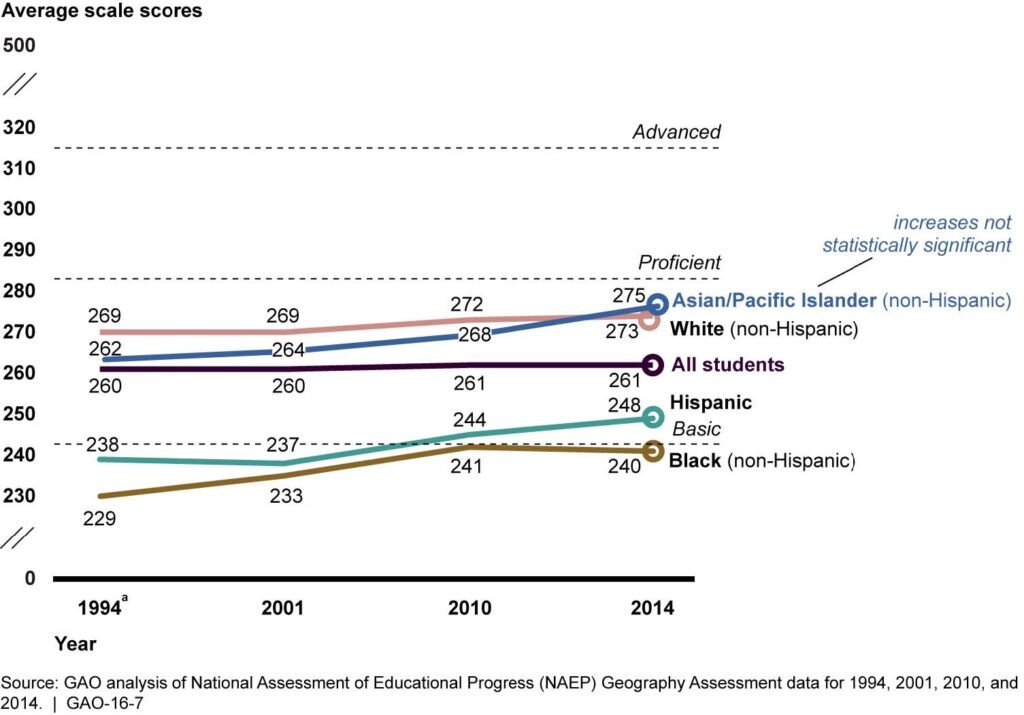
The achievement gap refers to persistent, measurable differences in academic performance, measured through indicators such as standardized test scores, graduation rates, or college enrollment, between different groups of students, most commonly grouped by race, ethnicity, family income, or disability status.
How the gap is measured
Researchers and policymakers typically document achievement gaps by comparing average outcomes on standardized assessments between student subgroups, such as comparing average reading or math scores between higher-income and lower-income students, or between different racial or ethnic groups, often tracking these gaps over time to assess whether specific policy interventions have narrowed or widened them.
Proposed contributing factors
Education researchers have identified a wide range of factors that contribute to achievement gaps, including differences in school funding and resources, access to experienced teachers, early childhood preparation, housing and neighborhood stability, nutrition and healthcare access, and the effects of historical and ongoing discrimination. Most researchers treat the achievement gap as the product of many interacting factors outside school as well as within it, rather than attributable to any single cause.
Policy responses
Policy approaches aimed at narrowing achievement gaps have included targeted funding formulas that direct additional resources to schools serving larger shares of disadvantaged students, early childhood education programs, extended learning time, and accountability systems that specifically track and report subgroup performance rather than only school-wide averages, so that gaps between groups remain visible rather than masked by an overall average.
Debate over terminology
Some researchers and advocates have proposed alternative terms such as opportunity gap, arguing that achievement gap can imply the gap originates primarily from students or families themselves, while opportunity gap more directly emphasizes unequal access to resources and conditions as the root cause of unequal outcomes. Both terms continue to be used in education research and policy discussion, sometimes interchangeably and sometimes to signal a particular framing of the underlying cause.
Historical measurement and trends
The achievement gap in the United States has been tracked for decades using standardized test score data, most prominently the National Assessment of Educational Progress, which allows researchers to compare performance across racial, ethnic, and income groups over time using a consistent measurement. These long-run data show that gaps have narrowed somewhat since the 1970s on some measures, particularly between Black and white students in reading and math at younger grades, but progress has been uneven and gaps widened again in several measures following disruptions such as the COVID-19 pandemic, which interrupted in-person schooling for an extended period.
Researchers studying the gap caution that a single test score snapshot can understate the complexity of the issue, since gaps in school readiness are often visible before children even enter kindergarten, pointing to factors in early childhood environments that predate formal schooling entirely.
Policy responses
Policy responses to the achievement gap have included targeted funding formulas that direct additional money to schools serving larger shares of low-income students, expanded access to high-quality early childhood programs intended to close readiness gaps before kindergarten, and smaller class sizes in early grades. Some districts have also focused on recruiting and retaining experienced teachers in historically underserved schools, since teacher turnover tends to be higher in those schools and has been linked to lower student achievement. Researchers continue to debate how much of the gap reflects factors schools can directly address, such as instructional quality and funding, versus factors rooted in conditions outside the school building, such as housing instability and neighborhood resources.
Some researchers prefer the term opportunity gap over achievement gap, arguing that it more accurately locates the cause in unequal access to resources and experiences rather than implying a deficit in the students themselves.
Gaps beyond race and income
While the achievement gap is most often discussed in terms of race and family income, researchers also document gaps by other factors, including gaps between English language learners and native English speakers, between students with disabilities and their peers, and between rural and urban districts in some regions. Each of these gaps tends to have its own distinct set of contributing causes and policy responses, so researchers generally caution against treating the achievement gap as a single uniform phenomenon with one universal explanation or one universal fix.
Longitudinal studies that follow the same students over many years have become an increasingly important tool for understanding whether early interventions aimed at closing gaps produce effects that persist into later grades or fade over time.
Education researchers often distinguish between the achievement gap measured at a single point in time and the growth gap measured by how much progress different groups of students make over a school year, since the two can tell different stories about where intervention is most needed.
Some school systems now track achievement gap data publicly through annual report cards, a practice intended to increase accountability by making progress, or the lack of it, visible to parents, school boards, and policymakers each year.
International assessments that compare student performance across countries have shown that achievement gaps tied to family income exist in nearly every education system studied, though the size of the gap varies considerably depending on each country’s broader social and economic policies.
FAQs
What groups are achievement gaps most commonly measured between? Groups defined by race, ethnicity, family income, or disability status, most often using standardized test scores or graduation rates.
Why do some researchers prefer the term opportunity gap? Because it emphasizes unequal access to resources and conditions as the root cause, rather than implying the gap originates from students or families themselves.
Key facts
- Achievement gaps are typically measured via standardized test scores, graduation rates, or college enrollment.
- Contributing factors include school funding, early childhood preparation, and effects of discrimination.
- Some researchers prefer the term opportunity gap to emphasize unequal access as the root cause.
Related concepts
Quick checkWhat alternative term do some researchers use instead of achievement gap, and why?Show answer
Opportunity gap, to emphasize unequal access to resources as the root cause rather than implying the gap originates from students themselves.
Sources
- General education policy reference
Editorially reviewed by Specialty Digest Editorial TeamLast reviewed November 2, 2026Researched and drafted with AI assistanceReport an issue