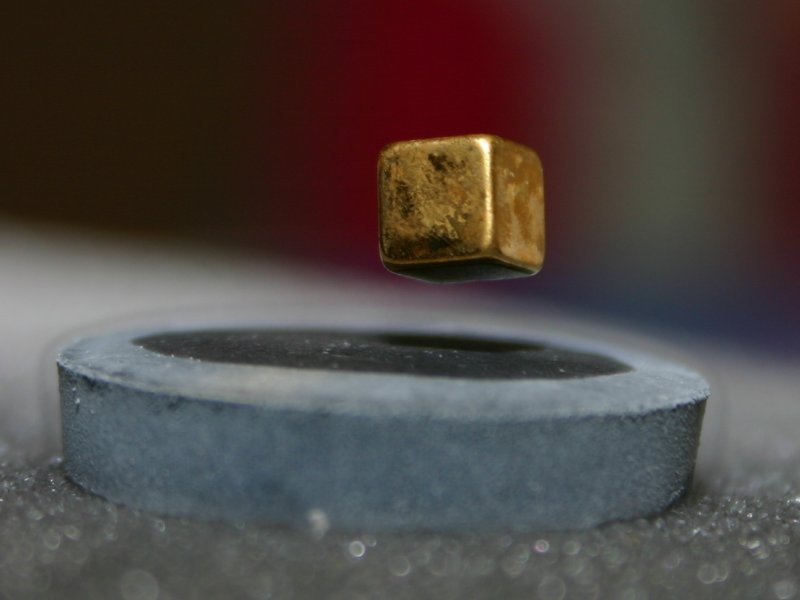
A superconductor is a material that, below a specific critical temperature, conducts electricity with exactly zero electrical resistance and expels magnetic fields from its interior, a phenomenon known as the Meissner effect. Once an electric current is set flowing in a superconducting loop, it can in principle persist indefinitely without any power source driving it, since there is no resistive loss to dissipate the energy as heat. This behavior is fundamentally different from ordinary conductors like copper, which always lose some energy to resistance no matter how pure or well-cooled they are.
Discovery and Early Understanding
Superconductivity was discovered in 1911 by Dutch physicist Heike Kamerlingh Onnes while studying mercury cooled to near absolute zero using liquid helium, observing that its electrical resistance dropped abruptly to an unmeasurable value at 4.2 kelvin. For decades afterward, superconductivity remained a low-temperature laboratory curiosity, since every known superconductor required cooling with expensive liquid helium to function at all. A workable microscopic theory did not arrive until 1957, when physicists John Bardeen, Leon Cooper, and John Schrieffer explained the effect through what became known as BCS theory.
How Superconductivity Works
BCS theory describes how, at sufficiently low temperatures, electrons in certain materials overcome their natural mutual repulsion and pair up into so-called Cooper pairs, mediated by vibrations in the material’s crystal lattice. These paired electrons move through the lattice collectively rather than individually, and this collective quantum behavior allows them to glide past lattice defects and impurities without scattering, which is the microscopic origin of zero resistance. The pairing only survives below the critical temperature; above it, thermal vibrations become strong enough to break the pairs apart and the material reverts to ordinary resistive conduction.
High-Temperature Superconductors
In 1986, researchers Johannes Bednorz and Karl Müller discovered a class of ceramic copper-oxide compounds that became superconducting at temperatures well above those BCS theory seemed to predict, launching the field of high-temperature superconductivity. Materials such as yttrium barium copper oxide become superconducting above 77 kelvin, the boiling point of liquid nitrogen, which is vastly cheaper and easier to produce than liquid helium. The exact mechanism behind high-temperature superconductivity in these cuprate materials is still not fully settled among physicists, making it one of the more active unresolved problems in condensed matter physics.
Practical Applications
Superconducting electromagnets, built from superconducting wire that can carry enormous currents without resistive heating, are the technology behind the powerful magnetic fields used in MRI machines and particle accelerators like the Large Hadron Collider. Maglev trains use superconducting magnets to levitate above a guideway, eliminating rolling friction and allowing extremely high speeds. Superconducting quantum interference devices, called SQUIDs, can detect magnetic fields so faint they are used in geological surveys and in measuring the tiny magnetic signals produced by brain activity.
Engineering Challenges
Despite decades of research, no material has yet been found that superconducts at room temperature under ordinary pressure, which keeps most applications tied to expensive cryogenic cooling systems using liquid helium or liquid nitrogen. Superconducting wires must also be engineered to handle a maximum current density and magnetic field strength, since exceeding either threshold causes the material to abruptly lose its superconducting state. Manufacturing long, flexible, mechanically robust superconducting cables and tapes, rather than small laboratory samples, has itself required decades of materials engineering.
The Search Continues
Periodic claims of room-temperature superconductivity, including several in recent years, have drawn intense scientific scrutiny and in most cases have not withstood independent replication, underscoring how difficult and consequential such a discovery would be. A genuine room-temperature, ambient-pressure superconductor would transform electrical grids, computing, and transportation by eliminating resistive energy losses that currently waste a meaningful share of the world’s generated electricity.
Superconducting Wire and Magnet Design
Turning a superconducting material into usable wire is its own engineering discipline, since the brittle ceramic compounds that superconduct at higher temperatures cannot simply be drawn into cable the way copper can. Manufacturers embed fine superconducting filaments inside a matrix of normal metal, often silver or copper, which provides mechanical support and gives the wire a safe path for current to follow if the superconducting state is ever lost unexpectedly. This loss of superconductivity, called a quench, releases stored magnetic energy very quickly and can generate intense localized heating, so large superconducting magnets include quench-detection circuitry and protective systems designed to spread that energy safely across the whole coil rather than letting it concentrate in one spot.
Low-temperature superconducting magnets, cooled with liquid helium near 4 kelvin, remain the standard for the most demanding applications such as MRI scanners and the accelerator magnets at facilities like CERN, because their performance is well understood after decades of refinement. High-temperature superconducting tapes, cooled instead with liquid nitrogen or mechanical cryocoolers, are increasingly used in applications where the cost and complexity of helium refrigeration is a bigger obstacle than squeezing out the absolute highest magnetic field, including some experimental compact fusion reactor designs and next-generation electrical grid cables.
Superconducting technology is also reshaping parts of the electrical grid itself in limited pilot projects, where superconducting cables can carry several times the current of a conventional copper cable of the same physical size, which matters in dense urban areas where digging new underground conduits is expensive or impractical. These cables still require a continuous supply of liquid nitrogen circulating alongside the superconducting core, adding infrastructure that conventional cables do not need, which is part of why adoption so far has been limited to demonstration projects rather than widespread grid replacement.
FAQs
Why do superconductors need to be cooled so much?
Thermal vibrations in a material’s crystal lattice disrupt the electron pairing that makes superconductivity possible, so the material must be cooled below its critical temperature for that pairing to survive.
Is a superconductor the same as a material with very low resistance?
No. A superconductor has exactly zero resistance below its critical temperature, a qualitatively different state rather than simply a very good conductor.
Quick checkWhat makes a superconductor different from an ordinary good conductor like copper?Show answer
A superconductor has exactly zero electrical resistance below its critical temperature, a distinct quantum state, not just unusually low resistance like a very pure conductor.
Editorially reviewed by Specialty Digest Editorial TeamLast reviewed November 2, 2026Researched and drafted with AI assistanceReport an issue