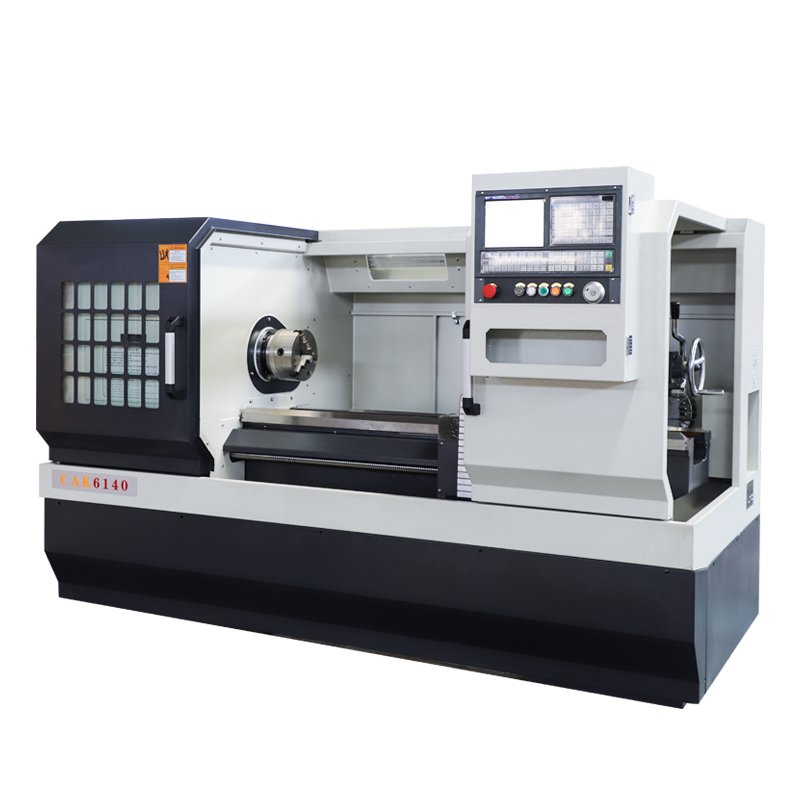
Machining is a manufacturing process that removes material from a solid workpiece using a cutting tool to produce a part with a precise, predetermined shape and size. Unlike additive processes that build a part up layer by layer, machining is fundamentally subtractive, starting with a block, rod, or casting larger than the finished part and cutting away everything that is not needed, which makes it especially well suited to producing parts with tight dimensional tolerances, fine surface finishes, or features that other processes cannot easily achieve.
Core Machining Operations
Turning, performed on a lathe, rotates the workpiece against a stationary cutting tool to produce cylindrical shapes such as shafts, pins, and threaded fasteners. Milling uses a rotating cutting tool moved against a stationary or slowly moving workpiece to cut flat surfaces, slots, pockets, and complex contoured shapes, and is arguably the most versatile of the core machining operations. Drilling creates round holes using a rotating pointed tool fed directly into the workpiece, while grinding uses an abrasive wheel rather than a single cutting edge to remove very small amounts of material and achieve extremely fine surface finishes and tight tolerances, often as a final finishing step after turning or milling.
Computer Numerical Control
Modern machining is overwhelmingly performed on computer numerical control, or CNC, machines, which follow a precisely programmed sequence of tool movements rather than relying on a human operator manually turning handwheels for every cut. A CNC program, generated from a digital 3D model through software called computer-aided manufacturing, specifies exact tool paths, speeds, and depths of cut, allowing complex parts to be reproduced with high accuracy and consistency across thousands of units without operator-to-operator variation. Multi-axis CNC machines, capable of moving and rotating a tool or workpiece simultaneously along five or more axes, can cut extremely complex geometries, such as turbine blades, in a single setup that would otherwise require repositioning the part multiple times.
Cutting Tool Materials and Wear
Cutting tools must be significantly harder than the material being cut and able to retain that hardness even as friction generates substantial heat at the cutting edge. High-speed steel tools remain common for general-purpose work, while tungsten carbide inserts, often coated with extremely hard ceramic layers like titanium nitride, dominate high-volume production machining because they retain a sharp edge at much higher cutting speeds and temperatures. Every cutting tool wears gradually with use, and machinists must balance cutting speed, feed rate, and tool life, since pushing a tool too aggressively shortens its usable life and can degrade the finished part’s surface finish and dimensional accuracy well before the tool visibly fails.
Coolants and Heat Management
Cutting generates significant heat at the tool-workpiece interface, which can soften the workpiece material, accelerate tool wear, and distort a part’s dimensions if left unmanaged. Cutting fluids, delivered as a flood of liquid coolant or increasingly as a fine mist in minimum-quantity-lubrication systems, carry heat away from the cutting zone, reduce friction, and flush away chips, the small pieces of metal removed during cutting, which can otherwise interfere with the cut or damage the tool and workpiece surface.
Tolerances and Precision
Machining can achieve dimensional tolerances far tighter than most other manufacturing processes, with precision grinding capable of holding dimensions within a few micrometers, smaller than the width of a human hair. Achieving such tolerances consistently requires rigid machine structures, controlled thermal environments, since even the machine itself expands and contracts measurably with temperature changes, and careful measurement using tools like coordinate measuring machines that verify a finished part actually matches its intended design.
Programming, Simulation, and Quality Control
Before a CNC program ever touches a real workpiece, most machine shops simulate the entire tool path in software to check for collisions between the tool, the workpiece, and the machine’s own fixtures, since a programming error that only becomes apparent when the tool physically crashes into the part can destroy an expensive tool, damage the machine, or ruin an already partially finished workpiece. This simulation step has become standard practice as parts and tool paths have grown more complex, particularly for five-axis machining where visualizing every tool movement mentally is far harder than it is for simpler three-axis work.
Fixturing, the process of securely holding a workpiece in a precise, repeatable position while it is being cut, is often as critical to a successful machining job as the cutting parameters themselves, since a workpiece that shifts even slightly under cutting forces will produce an inaccurate or scrapped part. Shops producing the same part repeatedly often invest in custom-designed fixtures tailored to that specific part’s geometry, while one-off or low-volume work frequently relies on more general-purpose vises and clamps combined with careful setup procedures.
After machining, quality control inspection verifies that a finished part actually meets its specified tolerances, using tools ranging from simple calipers and micrometers for everyday dimensions to coordinate measuring machines and optical scanners for complex or safety-critical geometries such as aerospace components. Statistical process control, tracking measured dimensions across a production run over time, helps shops catch a tool wearing out or a machine drifting out of calibration before it produces a batch of parts outside tolerance, which matters enormously in industries like automotive and aerospace manufacturing where a single bad batch can be extremely costly to trace and replace.
FAQs
What’s the difference between turning and milling?
Turning rotates the workpiece against a stationary tool to create cylindrical shapes, while milling rotates the cutting tool itself and moves it against a stationary or slowly moving workpiece to cut flat surfaces and complex contours.
Why do most modern machine shops use CNC machines instead of manual ones?
CNC machines follow a precisely programmed tool path, which reproduces complex parts with high accuracy and consistency across large quantities far more reliably than manual operation.
Quick checkWhat is the key difference between machining and additive manufacturing?Show answer
Machining is subtractive, cutting material away from a larger starting block, while additive manufacturing builds a part up layer by layer.
Editorially reviewed by Specialty Digest Editorial TeamLast reviewed November 2, 2026Researched and drafted with AI assistanceReport an issue