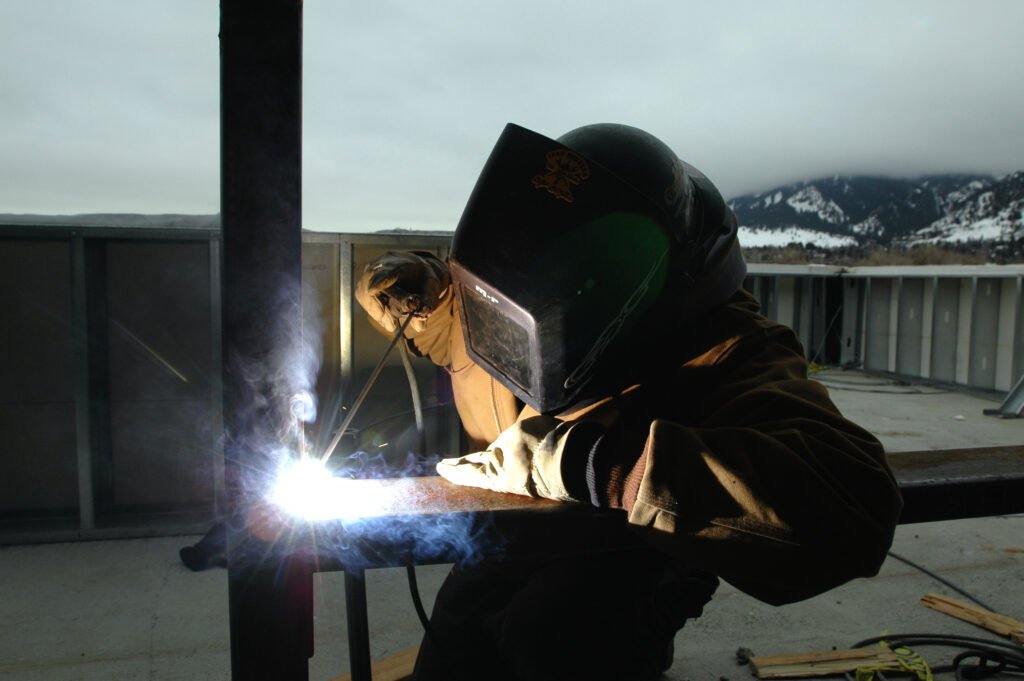
Welding is a fabrication process that joins two or more pieces of material, almost always metal, by using heat, pressure, or both to cause the materials to fuse together at a molecular level, often with an added filler material that becomes part of the permanent joint. Unlike mechanical fasteners such as bolts or rivets, which clamp parts together without altering the base materials, a properly made weld becomes continuous with the surrounding metal, which is why welded joints can match or even exceed the strength of the original unjoined material when executed correctly.
Arc Welding Processes
Arc welding, the most widely used family of welding processes, generates heat by striking an electric arc between an electrode and the workpiece, creating temperatures exceeding 3,000 degrees Celsius that melt both the base metal and a filler material at the joint. Shielded metal arc welding, often called stick welding, uses a consumable, flux-coated electrode that simultaneously supplies filler metal and generates a protective gas shield as it burns away, making it popular for outdoor and field work where wind would disrupt a separate gas shield. Gas metal arc welding, commonly known as MIG welding, feeds a continuous wire electrode through a welding gun while a separate shielding gas, usually argon or a mix including carbon dioxide, protects the weld pool, offering higher productivity and easier operation than stick welding for shop environments.
Precision and Specialty Welding
Gas tungsten arc welding, known as TIG welding, uses a non-consumable tungsten electrode and a separate filler rod fed in by hand, giving a skilled welder extremely precise control over heat input and weld appearance, which is why TIG welding is favored for thin materials, aluminum, stainless steel, and applications like aerospace components and decorative metalwork where weld quality and appearance matter most. Laser beam welding and electron beam welding concentrate an extremely narrow, high-energy beam onto the joint, producing deep, narrow welds with minimal heat affecting the surrounding material, which suits high-precision applications like automotive transmission components and medical devices where excess heat could distort or damage nearby features.
The Weld Pool and Metallurgy
During welding, the base metal and filler material melt together into a shared molten pool that then cools and solidifies into the finished joint, and the metallurgical structure of that solidified metal, called the weld’s microstructure, directly determines the joint’s final strength, hardness, and resistance to cracking. The surrounding area that does not melt but is heated enough by the process to change its metallurgical properties, called the heat-affected zone, can actually become a weak point in a welded assembly if not properly controlled, since rapid heating and cooling there can alter grain structure in ways that reduce toughness.
Weld Defects and Quality Control
Common weld defects include porosity, where trapped gas bubbles form small voids within the solidified weld; incomplete fusion, where the base metal and filler fail to bond fully; and cracking, which can occur either while the weld is still solidifying or afterward as it cools and contracts. Critical structural welds, such as those in pressure vessels, bridges, and pipelines, are routinely inspected using non-destructive testing methods like X-ray radiography and ultrasonic testing, which can reveal internal defects invisible to the naked eye without destroying the finished part.
Welder Certification and Safety
Because a defective structural weld can fail catastrophically under load, welders working on safety-critical structures are typically required to pass standardized certification tests demonstrating they can consistently produce sound welds in a specific process, material, and joint configuration. Welding also poses direct hazards including intense ultraviolet light that can damage unprotected eyes and skin, toxic fumes from vaporized metal and coatings, and fire risk from sparks and intense heat, which is why protective equipment such as welding helmets with auto-darkening lenses, fume extraction systems, and fire-resistant clothing are standard requirements on any welding job.
Welding Dissimilar and Difficult Materials
Not all metal combinations weld easily together, since successful fusion generally requires the base materials to have reasonably compatible melting points and metallurgical chemistry; trying to directly fuse metals that are too dissimilar, such as aluminum and steel, often produces brittle intermetallic compounds at the joint that crack under even modest stress. Engineers working around this limitation sometimes use specialized techniques like friction stir welding, which joins metals using frictional heat and mechanical stirring from a rotating tool rather than melting them outright, or explosive welding, which uses a controlled explosion to force two metal plates together with enough force to bond them metallurgically without conventional melting at all.
Aluminum presents its own well-known welding challenges, since it conducts heat away from the weld area roughly three times faster than steel, forms a thin oxide layer on its surface that must be removed or disrupted for a sound weld, and shows no visible color change as it approaches its melting point the way steel does, making it easier for an inexperienced welder to accidentally melt through the material. Specialized alternating-current TIG welding settings and dedicated MIG wire feed equipment have been developed specifically to manage these aluminum-specific difficulties.
Robotic welding has become standard in high-volume manufacturing such as automotive body assembly, where programmed robotic arms repeat precisely the same weld path, speed, and angle thousands of times per shift with a consistency that is difficult for even a highly skilled human welder to match over long production runs. Robots have not eliminated manual welding, however, since field repair work, custom fabrication, and welds in awkward or constantly varying positions still generally require a skilled human welder who can adapt to conditions a fixed robotic program cannot anticipate.
FAQs
Why is TIG welding preferred for thin metals and aerospace parts?
TIG welding gives a welder very precise control over heat input through a separately fed filler rod and non-consumable electrode, reducing the risk of burning through thin material or distorting precision components.
What makes the heat-affected zone a potential weak point in a weld?
The heat-affected zone doesn’t melt, but rapid heating and cooling there can alter the metal’s grain structure in ways that reduce toughness, even though the area looks unchanged from the outside.
Quick checkHow is a welded joint fundamentally different from a bolted or riveted one?Show answer
A weld fuses the base materials together at a molecular level so the joint becomes continuous with the surrounding metal, while bolts and rivets clamp parts together without altering the base materials.
Editorially reviewed by Specialty Digest Editorial TeamLast reviewed November 2, 2026Researched and drafted with AI assistanceReport an issue