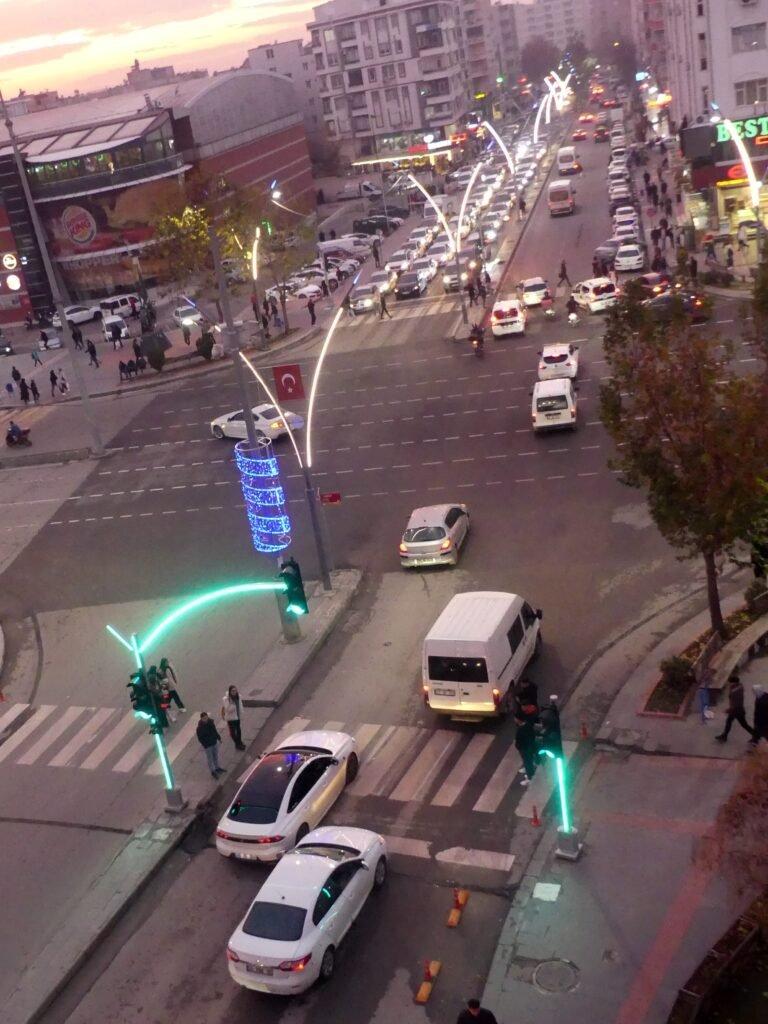
Traffic engineering is the branch of civil engineering concerned with the design, operation, and management of roads, intersections, and traffic control systems to move people and vehicles safely and efficiently. It sits at the intersection of infrastructure design and real-time systems operation, covering everything from how wide a lane should be and where a traffic signal should be timed, to how an entire road network responds to a major event, a crash, or shifting travel patterns over the course of a day.
Traffic Signal Timing
Traffic signals are timed using data collected from vehicle detectors embedded in the pavement or mounted overhead, which measure how many vehicles arrive at an intersection and how long they wait, information that traffic engineers use to calculate signal timing plans that minimize overall delay across competing approaches. Fixed-time signals run the same programmed cycle regardless of actual traffic, which works adequately on predictable, steady-volume corridors, while actuated signals adjust their timing in real time based on detected demand, extending a green light for a busy approach or skipping a phase entirely when no vehicles are waiting on a particular side street. Coordinated signal systems link multiple intersections along a corridor so that a vehicle traveling at the intended speed encounters a continuous run of green lights, commonly called a green wave, which reduces stop-and-go driving and the fuel waste and emissions that come with it.
Intersection and Roadway Design
Roundabouts, now widely adopted in many countries after decades of research, generally reduce the frequency and severity of crashes compared to traditional signalized intersections, because the circular geometry forces lower entry speeds and eliminates the high-speed right-angle and left-turn collisions that cause the most serious injuries at conventional intersections. Lane width, turning radius, sight lines, and the placement of pedestrian crossings all involve careful trade-offs between vehicle capacity, pedestrian and cyclist safety, and available right-of-way, and traffic engineers increasingly weigh these trade-offs using design guidance that explicitly accounts for all road users rather than vehicle throughput alone.
Traffic Flow Theory
Traffic flow theory models how vehicles behave in a stream of traffic, describing relationships between traffic density, the number of vehicles per unit of road length, and flow, the number of vehicles passing a point per unit of time. As density increases past a critical point, flow can drop sharply as vehicles are forced to slow down and leave larger following gaps, producing the sudden, often unexplained stop-and-go congestion familiar to anyone who has driven on a crowded highway even without any visible crash or obstruction ahead. Understanding this relationship helps engineers design features like ramp metering, which releases merging highway traffic in controlled intervals specifically to prevent the mainline flow from tipping into this unstable, congested state.
Traffic Studies and Safety Analysis
Traffic engineers rely heavily on data collected through traffic counts, speed studies, and crash records to identify locations with disproportionately high collision rates, called high-crash locations, and to evaluate whether a proposed change, such as adding a turn lane or adjusting signal timing, actually achieves its intended safety or capacity improvement after it is built. Before-and-after studies comparing crash data and travel times at a location before and after a change remain one of the most rigorous ways to verify that an engineering intervention worked as intended rather than simply assuming it did.
Intelligent Transportation Systems
Modern traffic management increasingly relies on networked sensors, cameras, and adaptive signal control software that can respond to real-time conditions across an entire city rather than optimizing one intersection in isolation, alongside traveler information systems that warn drivers of congestion or incidents ahead through variable message signs and navigation apps. These intelligent transportation systems allow traffic engineers to manage demand dynamically, for instance by adjusting signal timing network-wide in response to a major incident, rather than relying solely on the fixed physical infrastructure of the road itself.
Pedestrians, Cyclists, and Complete Streets
Traffic engineering has shifted substantially over recent decades from a near-exclusive focus on maximizing vehicle throughput toward a broader approach often called complete streets, which explicitly designs roads to serve pedestrians, cyclists, transit riders, and drivers together rather than treating non-vehicle users as an afterthought squeezed into whatever space remains. This shift has brought features such as protected bike lanes physically separated from vehicle traffic, bus-only lanes that keep transit moving even when general traffic is congested, and pedestrian refuge islands that let people crossing a wide road pause partway rather than crossing the entire width in a single signal phase.
Crossing signal timing is calculated using assumed pedestrian walking speeds, and traffic engineers increasingly use slower walking speed assumptions than were standard decades ago, reflecting research showing that many pedestrians, including older adults and people with mobility limitations, need more time to cross safely than younger, faster-walking populations the original timing standards were based on. Leading pedestrian intervals, which give people a few seconds head start crossing before parallel vehicle traffic gets a green light, have also become common at intersections with documented pedestrian safety concerns, improving the visibility of pedestrians already in the crosswalk before turning vehicles begin moving.
School zones and residential neighborhoods often receive specific traffic calming treatments, including speed humps, curb extensions that narrow the effective roadway width at crossings, and chicanes that introduce gentle curves to discourage speeding, all aimed at reducing vehicle speeds in areas where pedestrian activity, particularly by children, is high and the consequences of a high-speed collision are especially severe. Traffic engineers evaluate these treatments against measured changes in vehicle speed and, where data allows, crash rates, rather than relying solely on public perception of whether a street feels safer.
FAQs
Why do roundabouts tend to be safer than traditional signalized intersections?
Their circular geometry forces lower entry speeds and eliminates the high-speed right-angle and left-turn collisions that cause the most serious injuries at conventional intersections.
What causes stop-and-go traffic to appear on a highway with no visible crash?
As traffic density rises past a critical point, flow can drop sharply because vehicles are forced into larger following gaps and lower speeds, producing unstable, self-sustaining congestion.
In the news
Quick checkWhy do coordinated traffic signals along a corridor create a "green wave"?Show answer
Linked signals along a corridor are timed so a vehicle traveling at the intended speed encounters a continuous run of green lights, reducing stop-and-go driving.
Editorially reviewed by Specialty Digest Editorial TeamLast reviewed November 2, 2026Researched and drafted with AI assistanceReport an issue