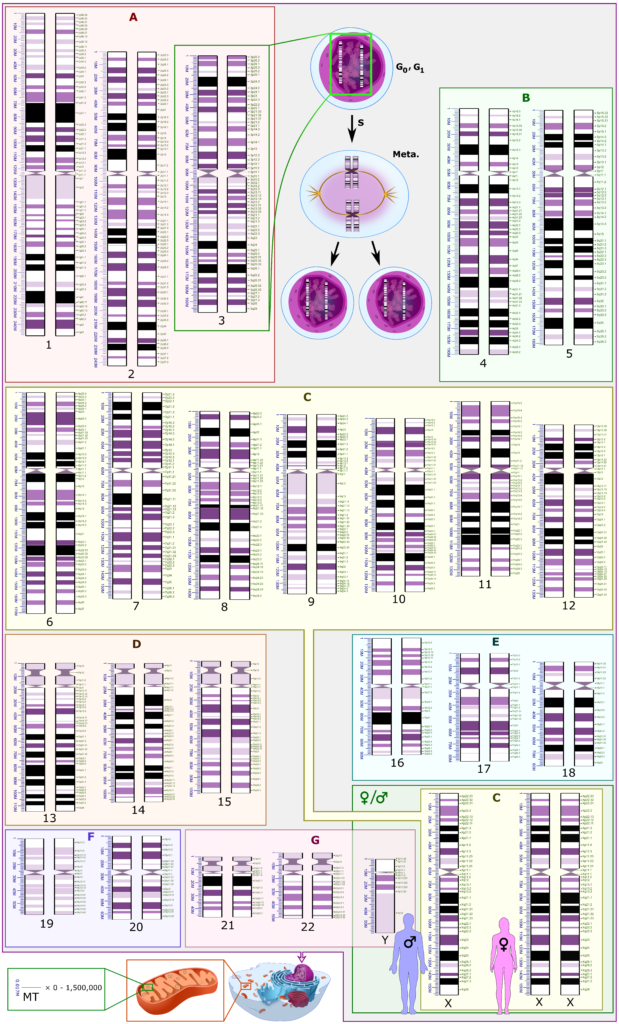
A chromosome is a tightly packaged, thread-like structure made of DNA wound around proteins called histones, which carries the genetic information of an organism and ensures that information is organized, protected, and accurately distributed whenever a cell divides. Each chromosome contains many individual genes arranged along its length, and the number of chromosomes varies considerably between species, with humans carrying 46 chromosomes arranged in 23 pairs inside the nucleus of nearly every cell in the body. The structure and behavior of chromosomes during cell division was first observed under the microscope in the late nineteenth century, decades before scientists understood that DNA, the molecule chromosomes are built from, was the actual carrier of hereditary information. The word chromosome itself derives from Greek roots meaning colored body, a reference to the way these structures readily absorb certain dyes used by early microscopists, which is precisely what first made them visible and countable under a microscope.
Structure and organization
Within a chromosome, DNA does not float freely but is wound tightly around spool-like proteins called histones, forming a compact structure called chromatin that allows an enormous length of DNA, roughly two meters if fully unwound across all of a cell chromosomes, to fit inside a cell nucleus only a few micrometers across. Each chromosome has a constricted region called the centromere, which divides it into two arms and serves as the attachment point for the fibers that pull chromosomes apart during cell division, and protective caps called telomeres at each end that prevent the chromosome from unraveling or fusing with neighboring chromosomes. Humans, like most animals, are diploid, meaning body cells carry two copies of each chromosome, one inherited from each parent, while reproductive cells such as sperm and eggs are haploid, carrying only a single copy of each. This distinction matters enormously at fertilization, since combining one haploid sperm cell with one haploid egg cell restores the normal diploid number, ensuring offspring receive a complete set of chromosomes rather than an ever-doubling amount across generations.
Sex chromosomes and autosomes
Of the 23 pairs of chromosomes in humans, 22 pairs are called autosomes and are generally similar in males and females, while the remaining pair, the sex chromosomes, determines biological sex. Humans with two X chromosomes typically develop as female, while humans with one X and one Y chromosome typically develop as male, with the Y chromosome carrying a specific gene that triggers male development early in fetal growth. Because the Y chromosome is much smaller than the X and carries far fewer genes, certain conditions caused by recessive genes on the X chromosome, including red-green color blindness and hemophilia, appear far more often in males, who have no second X chromosome to mask the effect of a faulty gene, whereas a female carrying the same faulty gene on one X chromosome usually has a normal copy on her other X chromosome to compensate.
Chromosomes during cell division
Before a cell divides, each chromosome is duplicated so that the two resulting copies, called sister chromatids, remain joined at the centromere until division is complete. During mitosis, the two sister chromatids separate and move to opposite ends of the dividing cell, ensuring each daughter cell receives a complete, identical set of chromosomes. During meiosis, which produces reproductive cells, chromosomes additionally exchange small segments with their paired partner in a process called recombination, shuffling genetic material around in a way that helps explain why full siblings, despite inheriting chromosomes from the same two parents, are never genetically identical to one another.
Chromosomal abnormalities
Errors during cell division can occasionally cause a cell to receive an incorrect number of chromosomes, a condition called aneuploidy, with Down syndrome, caused by an extra copy of chromosome 21, among the most common and best known examples in humans, alongside other, generally more severe trisomies involving chromosomes 13 and 18. The likelihood of these errors rises measurably with maternal age, which is why doctors often recommend additional prenatal screening for pregnancies in older mothers. Other abnormalities involve structural changes rather than an incorrect number, including deletions, in which part of a chromosome is missing, and translocations, in which a segment of one chromosome becomes attached to a different chromosome, both of which can disrupt the genes located in the affected region or alter how neighboring genes are regulated, even when the total amount of genetic material involved is relatively small. Many chromosomal abnormalities are detected through prenatal testing or karyotyping, a laboratory technique that arranges and photographs an individual chromosomes under a microscope, allowing clinicians to directly count and visually inspect them for structural problems. Karyotyping remains one of the oldest genetic diagnostic techniques still in routine clinical use, even as newer molecular methods capable of detecting far smaller genetic changes have become widely available alongside it.
FAQs
How many chromosomes do humans have?
Humans typically have 46 chromosomes, arranged in 23 pairs, inside the nucleus of nearly every cell in the body.
What is the difference between a gene and a chromosome?
A chromosome is a large structure made of tightly packaged DNA that contains many individual genes arranged along its length, while a gene is one specific segment of that DNA coding for a particular protein or trait.
What determines biological sex in humans?
Biological sex is determined by the sex chromosomes, with two X chromosomes typically producing female development and one X paired with one Y chromosome typically producing male development.
What causes Down syndrome?
Down syndrome is caused by the presence of an extra copy of chromosome 21, a chromosomal abnormality known as trisomy 21.
Key facts
- Made of DNA wound around histone proteins into a structure called chromatin
- Humans carry 46 chromosomes in 23 pairs, including one pair of sex chromosomes
- Centromeres and telomeres protect chromosome structure during division
- Aneuploidy (abnormal chromosome number) causes conditions such as Down syndrome
- First observed under the microscope in the late 19th century
Quick checkHow many chromosomes do humans have?Show answer
Humans typically have 46 chromosomes arranged in 23 pairs inside the nucleus of nearly every cell.
Sources
- National Human Genome Research Institute, Chromosome; Britannica, Chromosome
Editorially reviewed by Specialty Digest Editorial TeamLast reviewed November 2, 2026Researched and drafted with AI assistanceReport an issue