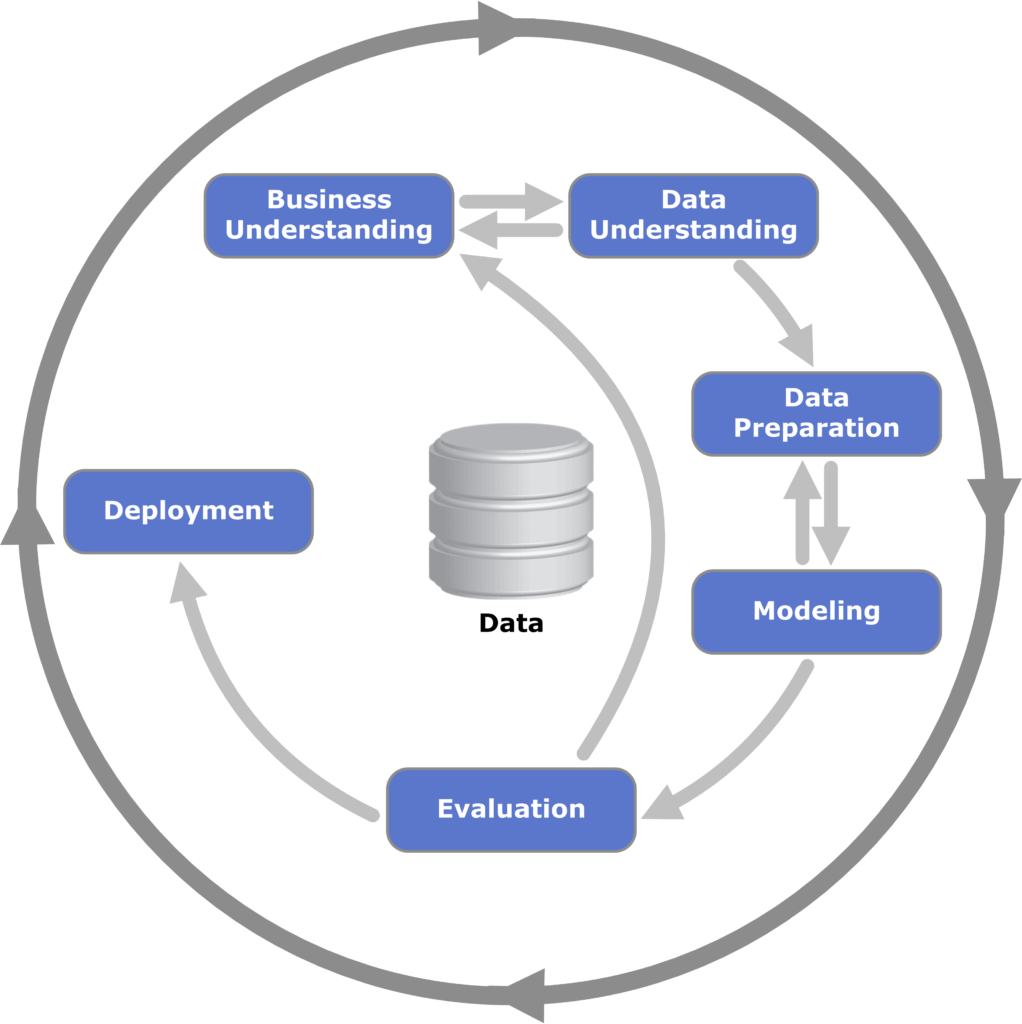
Data mining is the process of analyzing large datasets to discover previously unknown patterns, relationships, and useful information that would not be obvious from simply looking at the raw data directly. The term borrows its imagery from physical mining, since both processes involve sifting through a large quantity of raw material to extract something valuable hidden within it, in this case meaningful patterns rather than minerals. Data mining draws on techniques from statistics, machine learning, and database systems, and it underlies many familiar applications, including product recommendations, credit risk scoring, fraud detection, and customer segmentation used in marketing.
Core Tasks
Classification assigns new data into predefined categories based on patterns learned from previously labeled examples, such as determining whether a new email is spam based on patterns found in a large collection of emails already labeled as spam or not. Clustering groups data points together based on similarity without relying on any predefined categories at all, letting the natural structure of the data itself suggest meaningful groupings, which is often used to discover distinct customer segments based on purchasing behavior without deciding those segments in advance. Association rule learning looks for items or events that frequently occur together, a technique famously associated with retail analysis identifying which products customers tend to purchase together, which can inform decisions about store layout, bundled promotions, or recommendation systems.
Regression analysis, borrowed directly from statistics, predicts a continuous numeric value, such as an expected sale price or a likely future demand level, based on patterns observed in historical data. Anomaly detection identifies data points that deviate meaningfully from expected patterns, supporting applications such as flagging a credit card transaction that looks unusual compared with a customer’s typical spending behavior, or detecting a manufacturing defect that produces sensor readings outside a normal expected range. Many real-world data mining projects combine several of these techniques together rather than relying on just one, since different parts of a business question often call for different analytical approaches.
The Data Mining Process
Effective data mining generally follows a structured process rather than jumping directly into applying an algorithm. It typically begins with clearly defining the business question the analysis is meant to answer, followed by gathering and thoroughly cleaning relevant data, since raw real-world data is often incomplete, inconsistent, or contains errors that must be addressed before meaningful patterns can reliably be found. Only after this preparation does the actual pattern-discovery stage take place, applying one or more of the techniques above, followed by careful evaluation of whether the discovered patterns are genuinely useful, statistically sound, and not simply coincidental artifacts of the specific dataset examined, before any findings are deployed into an actual business decision or automated system.
A commonly cited risk in data mining is finding a pattern that appears meaningful purely by chance, especially when searching through a very large number of possible patterns across a large dataset, since testing enough combinations will eventually turn up something that looks statistically notable even in entirely random data. Responsible data mining practice guards against this by validating discovered patterns against new, separate data the pattern-finding process did not use, and by applying appropriate statistical rigor rather than accepting any interesting-looking pattern at face value simply because it was found.
Origins and Everyday Applications
Data mining grew out of several earlier fields, including database research, statistics, and the artificial intelligence subfield of machine learning, coming together into a distinct area of study and practice during the 1990s as organizations began accumulating far more electronic data than earlier manual analysis methods could reasonably handle. Academic conferences and dedicated software tools built specifically for data mining emerged during this period, formalizing many of the techniques that had previously existed in a more scattered, specialized form across different research communities.
Today, data mining techniques operate quietly behind an enormous range of everyday services. Streaming platforms mine viewing history to recommend new shows, banks mine transaction patterns to flag potentially fraudulent activity in real time, retailers mine purchase histories to personalize marketing offers, and healthcare researchers mine large patient datasets to identify risk factors for disease or early warning signs that might otherwise go unnoticed across thousands of individual medical records. This widespread, often invisible use of data mining across so many industries is a major reason the underlying techniques have become a standard, expected part of data science and business analytics training.
Frequently Asked Questions
Is data mining the same thing as machine learning? The two overlap substantially and share many of the same underlying techniques, but data mining traditionally emphasizes discovering previously unknown patterns in existing data, while machine learning more broadly emphasizes building models, often from the patterns data mining helps uncover, that can make predictions on entirely new, unseen data.
Why does raw data usually need to be cleaned before data mining? Real-world data frequently contains missing values, inconsistent formatting, duplicate records, and outright errors, and analyzing uncleaned data can produce misleading or simply incorrect patterns, so thorough data cleaning is typically one of the most time-consuming but essential steps in any serious data mining project.
Can data mining find patterns that are not actually meaningful? Yes. Searching through enough variables and combinations in a large dataset will eventually turn up patterns that look statistically interesting purely by random chance, which is why validating discovered patterns against separate, independent data is an important safeguard before acting on any data mining result.
Key facts
- Data mining draws on statistics, machine learning, and database techniques.
- Core tasks include classification, clustering, association rule learning, and anomaly detection.
- The process typically starts with defining a question, then cleaning and analyzing data.
- Patterns can appear meaningful by chance when searching very large datasets.
- Validating patterns against separate data guards against coincidental findings.
Quick checkWhy is cleaning data usually necessary before data mining can begin?Show answer
Raw real-world data commonly contains missing values, inconsistencies, and errors, and analyzing it without first cleaning it can produce misleading or incorrect patterns, making data cleaning one of the most essential early steps in the process.
Sources
- Data Mining: Concepts and Techniques (Han, Kamber, Pei); Introduction to Data Mining (Tan et al.)
Editorially reviewed by Specialty Digest Editorial TeamLast reviewed November 2, 2026Researched and drafted with AI assistanceReport an issue