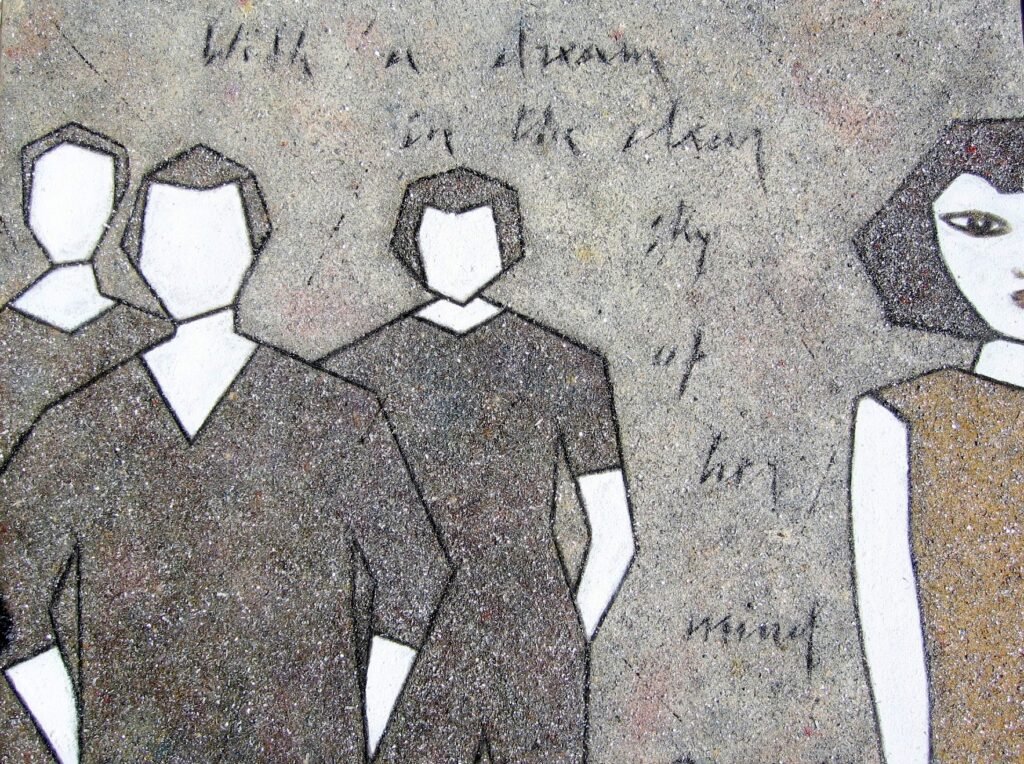
Close your eyes and picture an apple. Most people see something, from a faint outline to a vivid, almost photographic image. People with aphantasia see nothing at all. They know what an apple looks like and can describe one in detail, but no picture appears in the mind.
What is aphantasia?
Aphantasia is the inability to voluntarily form visual mental images. The term was coined in 2015 by Professor Adam Zeman of the University of Exeter, whose team has led much of the research on the topic. It combines the Greek word for imagination with the prefix a-, meaning without. Mental imagery can involve any sense, such as imagining a melody, but the term aphantasia refers specifically to the visual form.
The name can mislead. As Zeman puts it, lack of imagery does not imply lack of imagination. People with aphantasia can plan, reason, remember and create. They simply do it without a picture in the mind.
How common is aphantasia?
Estimates depend on how strictly the condition is defined. A review by Zeman, published in Trends in Cognitive Sciences and summarized by the University of Exeter, found that aphantasia is thought to affect around 1 percent of the population, while about 3 percent are hyperphantasic, meaning their imagery is exceptionally vivid. With more generous criteria, those figures rise to around 5 percent and 10 percent respectively. The review drew on around 50 recent studies.
A large 2024 survey published in Frontiers in Psychology gives a similar picture. The study recruited 3,049 adults from 85 nationalities, then combined the results with two earlier open datasets for a total of 9,063 participants. The shares in each group were:
- Aphantasia: 1.2 percent in the first sample and 0.9 percent in the combined sample
- Hypophantasia (weak imagery): 3.0 and 3.3 percent
- Typical imagery: 89.9 and 89.7 percent
- Hyperphantasia: 5.9 and 6.1 percent
In other words, roughly 4 percent of people report difficulty forming visual images, and about 6 percent report imagery as vivid as real vision. The authors found a weak positive link between age and imagery scores, but no significant link with education, continent of nationality or gender.
How do researchers measure aphantasia?
The most widely used tool is the Vividness of Visual Imagery Questionnaire, or VVIQ. The 16-item version asks people to picture scenes and rate how clear each image is on a five-point scale, giving total scores from 16 to 80. In the 2024 study, a score of 16 counted as aphantasia, 17 to 32 as hypophantasia, 33 to 74 as typical imagery and 75 to 80 as hyperphantasia. The questionnaire showed excellent internal consistency, and four attention-check items screened out careless answers.
The method has limits. Because it relies on self-report, nobody can directly compare one person’s inner experience with another’s. The authors also note that the questionnaire cannot tell whether someone was born without imagery or lost it later. Many people only discover they have aphantasia in adulthood, because it takes metacognition, or thinking about one’s own thinking, to notice that other people experience something different.
What causes aphantasia?
The causes are not settled. According to the Exeter review, aphantasia and hyperphantasia are linked to differences in the physiology and connectivity of the brain, which runs on networks of neurons, as well as to differences in behavior. Both tend to run in families, which hints at a possible genetic basis.
Aphantasia is also not a single entity. Researchers describe subtypes, and in a minority of people it appears to be linked to autism. The brain keeps rewiring itself across life through neuroplasticity, so whether a person’s imagery can change over time is a question that needs more research.
Aphantasia vs. hyperphantasia
The two sit at opposite ends of the same spectrum. Hyperphantasia describes imagery so vivid it can feel like seeing. Aphantasia describes having none. Researchers broadly agree that neither is a disorder. Both are variations in how minds work, with roughly balanced advantages and disadvantages.
- Aphantasia: no voluntary visual imagery, about 1 percent of people in most estimates
- Hypophantasia: weak or faint imagery, about 3 percent in the 2024 survey
- Typical imagery: about 90 percent in the 2024 survey
- Hyperphantasia: exceptionally vivid imagery, roughly 3 to 6 percent depending on the study
How does aphantasia affect memory and daily life?
The effects are real but subtle. Zeman’s review reports that people who cannot visualize are less likely to remember details of important past personal events and less likely to recognize faces, though not everyone with aphantasia has these difficulties. They are also less likely to experience other kinds of imagery, such as imagining music. Yet many dream in pictures even though they cannot visualize at will, and the review found they are more likely to work in scientific occupations. Further work is needed to pin these effects down in more detail.
Why aphantasia matters to researchers
Studying people who lack imagery helps scientists understand how the brain builds the inner experiences that most people take for granted. It also shows that people can reach the same goals by different mental paths. For learning and work, that is a useful reminder that advice such as picture it in your mind may not suit everyone.
Frequently asked questions
Can people with aphantasia dream in pictures?
Often yes. Zeman’s review notes that although they cannot visualize at will, many dream visually.
Is aphantasia a disorder?
Researchers broadly agree that it is not. It is treated as a variation in human experience.
Does aphantasia run in families?
It often does, which hints at a possible genetic basis, but the cause is not yet settled.
How can someone find out whether they have it?
Researchers use the VVIQ, a 16-question survey. A questionnaire is not a medical diagnosis, and the result reflects self-reported experience.