Artificial intelligence (AI) is the branch of computer science that builds systems able to perform tasks, such as recognizing patterns, making predictions, or generating text and images, that have traditionally required human intelligence. The Organisation for Economic Co-operation and Development (OECD) defines an AI system more precisely as “a machine-based system that, for explicit or implicit objectives, infers, from the input it receives, how to generate outputs such as predictions, content, recommendations, or decisions that can influence physical or virtual environments.”
AI is not one technology but an umbrella term for many techniques aimed at that goal, varying widely in how independently they operate and how much they adapt once deployed.
History of artificial intelligence
In 1950, the mathematician Alan Turing proposed a thought experiment he called the imitation game: a human interrogator exchanges written messages with a hidden person and a hidden machine, then tries to work out which is which. Turing predicted that by around the year 2000, a well-built machine might fool an average interrogator more often than not after five minutes of questioning. The exercise, later known as the Turing test, became an early influential way of asking whether a machine could be said to think, though it is debated today as a measure of convincing conversation rather than genuine understanding.
The field took its name a few years later, when American researchers organized a 1956 summer workshop at Dartmouth College to study whether machines could simulate human intelligence. Progress was uneven after that, with optimism followed by long funding droughts often called “AI winters,” until deep learning produced marked gains in image and speech recognition in the 2010s, and generative AI reached a wide public audience in the early 2020s.
Types of artificial intelligence
AI is classified two ways: by approach and by capability. By approach, early AI relied on symbolic, rule-based systems, with explicit logic written by hand for every case; most AI built today instead uses machine learning, which learns its own rules from data through one of three common training styles: supervised (from labeled examples), unsupervised (finding structure with no labels), or reinforcement learning (trial and error guided by a reward). Deep learning, a form of machine learning built on many-layered neural networks, powers most of today’s most capable systems, including the generative AI described below.
By capability, researchers distinguish narrow AI, built for one task or a limited set of tasks, from the hypothetical general AI, a system matching human-level performance across virtually any intellectual task. Every AI system in practical use today is narrow AI; general AI remains a research goal, not an existing technology.
How artificial intelligence works
To train a model, engineers show it large amounts of example data for the task it will eventually perform and repeatedly adjust its internal settings so its outputs improve. Once trained, it applies the patterns it learned to inputs it has never seen before. Deep learning does this with layered structures loosely inspired by neurons, letting a system learn more complex patterns from larger datasets.
Generative AI systems, including the large language models behind many current chatbots, are trained this way on vast amounts of text, images, or code, and learn to predict a likely next word, pixel, or token based on patterns in that training data. This is why such systems can produce fluent, convincing output without necessarily representing a true or verified fact every time.

Applications and examples of artificial intelligence
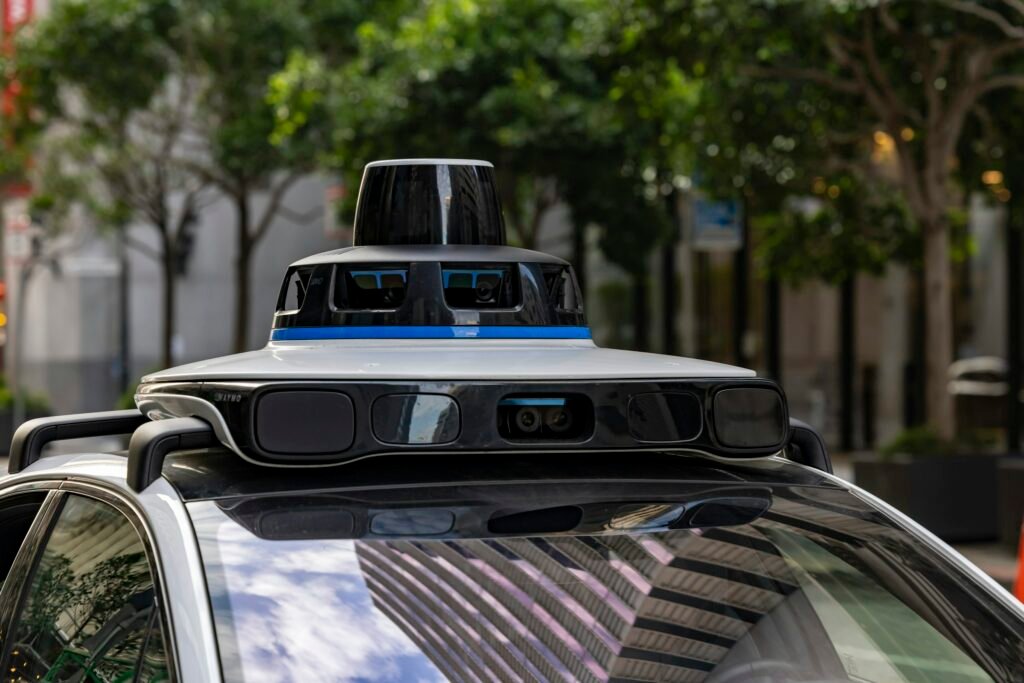
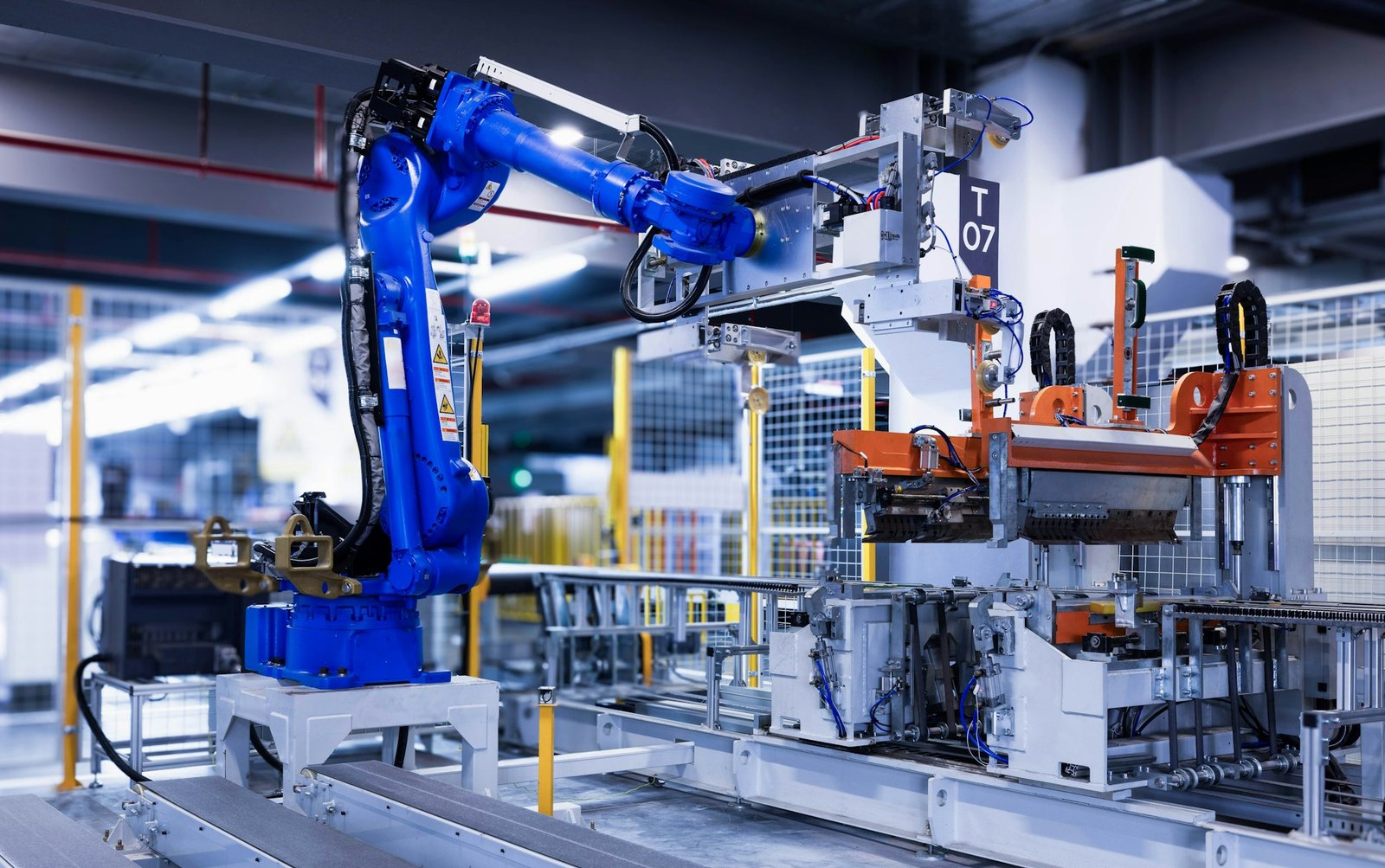
AI now sits behind many everyday tools: search and video ranking, the voice recognition in a phone’s assistant, a bank’s fraud checks on a card transaction, and automatic photo captioning or translation. In medicine, AI-based image analysis helps radiologists flag patterns in scans for closer review. In transportation, self-driving vehicles use AI to interpret camera and sensor data and decide how to respond to traffic in real time. In manufacturing, industrial robots increasingly rely on AI-based computer vision and control software to handle parts with precision and adjust to small variations, rather than following only a single fixed motion.
Advantages and disadvantages of artificial intelligence
AI’s main advantage is scale: it can process far more data, far faster and more consistently, than a person could, and can run continuously without fatigue. That is why it has proven useful for tasks like scanning millions of transactions for fraud or reviewing medical images for patterns easy for a tired human eye to miss.
The disadvantages recur often enough to state plainly. Generative systems can state incorrect information confidently, an error called a hallucination. Models trained on real-world data can reproduce biases in that data, including in hiring or lending. Training and running large models consumes substantial computing power and energy. Economists continue to debate how much and how quickly AI will change the jobs available, a question the evidence has not yet settled.
Governments have responded differently. The U.S. National Institute of Standards and Technology published a voluntary AI Risk Management Framework in January 2023 to guide trustworthy design and use. The European Union instead took a binding, risk-tiered approach: its AI Act, in force since August 2024, bans unacceptable-risk systems, sets strict obligations for “high-risk” uses like credit scoring, and requires disclosures such as labeling chatbots and deepfakes, phased in between February 2025 and August 2028.
Artificial intelligence vs. machine learning vs. robotics
These three terms are often used as if interchangeable, but they describe different things. AI is the broad field and goal: building systems that perform tasks associated with human intelligence. Machine learning is the dominant current technique for pursuing it. Robotics is a separate engineering discipline that builds physical machines able to sense and act in the world; a robot may or may not use AI, and most AI systems, a recommendation engine among them, have no physical form at all.
FAQs
Is artificial intelligence dangerous? Experts broadly agree today’s AI carries real risks, bias, errors, and misuse chief among them, rather than an imminent risk of machines acting against people on their own; serious debate continues over longer-term risk as systems grow more capable.
Can AI really think like a human? No. Generative AI produces fluent output by predicting likely patterns from its training data, not by reasoning the way a human mind does.
Key facts
- The OECD defines an AI system as a machine-based system that infers from input how to generate outputs such as predictions, content, recommendations or decisions that can influence physical or virtual environments.1
- The U.S. National Institute of Standards and Technology published a voluntary AI Risk Management Framework in January 2023 to guide trustworthy AI design and use.2
- Alan Turing's 1950 imitation game, later called the Turing test, became an early influential way of asking whether a machine could be said to think.3
- The European Union's AI Act, in force since August 2024, bans unacceptable-risk systems and sets strict obligations for high-risk uses such as credit scoring, phased in between February 2025 and August 2028.4
- Deep learning, a form of machine learning built on many-layered neural networks, powers most of today's most capable AI systems, including the generative AI behind current chatbots.5
Related concepts
In the news
Quick checkWhy can a generative AI chatbot sound confident while stating something false?Show answer
Because it is predicting likely words based on patterns in its training data, not verifying facts against the world, so fluent and correct are not the same thing for these systems.
Sources
- OECD.AI Policy Observatory. AI Principles. November 2023 (accessed 1 November 2026)
- National Institute of Standards and Technology. AI Risk Management Framework. 26 January 2023 (accessed 1 November 2026)
- Stanford Encyclopedia of Philosophy. The Turing Test. Undated (accessed 1 November 2026)
- European Commission. Regulatory Framework on AI. Undated (accessed 1 November 2026)
- IBM. The 2026 Guide to Machine Learning. Undated (accessed 1 November 2026)
Editorially reviewed by Specialty Digest Editorial TeamLast reviewed November 1, 2026Researched and drafted with AI assistanceReport an issue