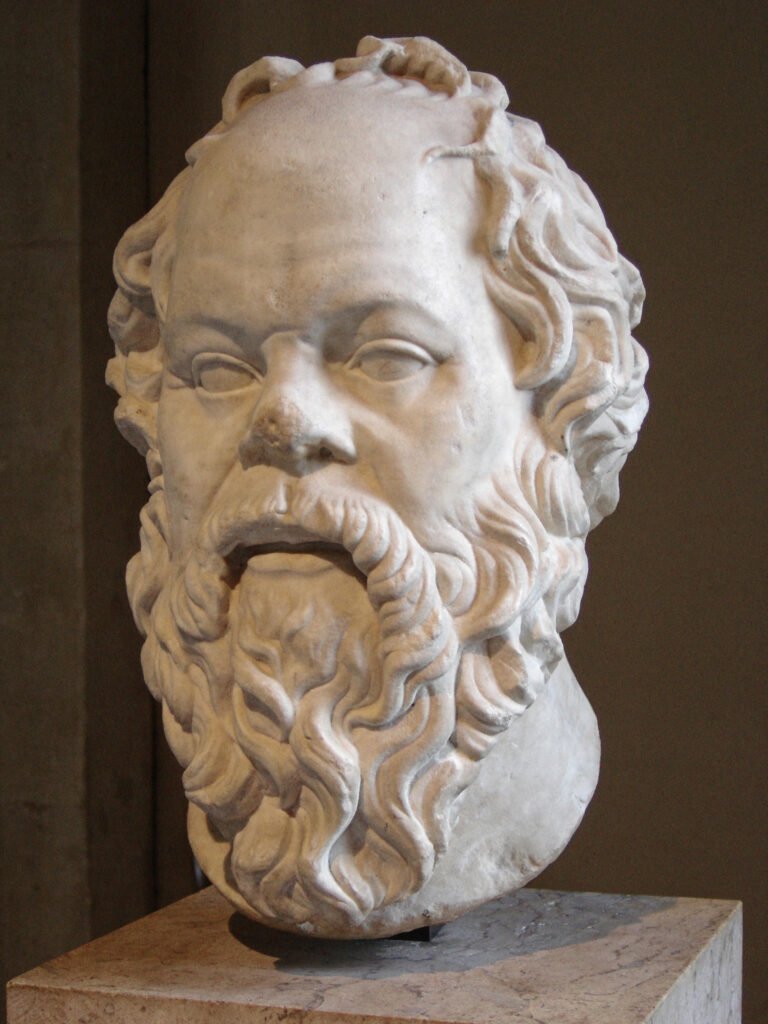
The Socratic method is a form of cooperative, dialectical dialogue in which a teacher or discussion leader poses a series of probing questions to draw out underlying assumptions, expose contradictions, and guide participants toward deeper understanding, rather than simply stating conclusions directly.
Origins in ancient Athens
The method is named for the ancient Greek philosopher Socrates, who left no writings of his own; his approach is known primarily through the dialogues written by his student Plato, in which Socrates repeatedly questions other characters about concepts such as justice, virtue, and knowledge, often revealing that their initial confident definitions do not hold up under further questioning. This technique of exposing contradictions through sustained questioning is sometimes called the elenchus.
Core structure of the method
A Socratic dialogue typically proceeds by asking a participant to state a definition or belief, then posing follow-up questions that test that definition against specific examples or counterexamples, often leading the participant to revise or abandon their original position. The goal is not necessarily for the questioner to supply a correct answer, but to help participants recognize gaps or contradictions in their own reasoning through the process of sustained, structured questioning.
Use in modern education
The Socratic method remains widely used in modern education, particularly in law schools, where professors question students about case facts and legal reasoning rather than lecturing directly, and in humanities seminars built around structured discussion of a shared text. Proponents argue the method builds critical thinking and the ability to defend a position under scrutiny more effectively than passive lecture-based instruction.
Socratic seminars
A widely used classroom adaptation, the Socratic seminar, structures a whole-class discussion around a shared text, with the teacher or a student posing open-ended questions and participants building on, challenging, or questioning one another’s responses, often with the teacher deliberately limiting direct intervention once the discussion is underway. This format is designed to shift the center of intellectual activity from the teacher to the group of participants themselves.
Difference from a simple question-and-answer format
The Socratic method is distinct from ordinary question-and-answer teaching in that its questions are specifically designed to probe the logical structure and implications of a participant’s stated position, rather than simply checking whether a participant recalls a fact. A true Socratic question typically follows up on the participant’s own previous answer rather than moving on to an unrelated new question, building a connected chain of reasoning over the course of the dialogue.
Criticisms of the method
Critics note that the Socratic method, particularly in high-pressure settings like law school cold-calling, can be intimidating for students and may favor those who are already confident speaking under scrutiny, potentially disadvantaging quieter or less confident participants regardless of their underlying understanding. Some educators have adapted the method with more supportive structures, such as advance preparation time or smaller discussion groups, to preserve its intellectual benefits while reducing this pressure.
Use beyond philosophy and law
Beyond philosophy classrooms and legal education, versions of the Socratic method appear in coaching and mentoring, where a coach asks guiding questions rather than giving direct instructions, and in some medical education settings, where instructors question students through a diagnostic reasoning process rather than simply stating a diagnosis, aiming to build the same kind of transferable reasoning skill across different professional fields.
Preparation required from participants
Because the method depends on participants having something substantive to reason about, Socratic discussions are generally most productive when participants arrive having already engaged with the relevant material, whether a legal case, a philosophical text, or a set of data, since the quality of the questioning depends heavily on having real content to probe rather than an entirely blank starting point.
Without that preparation, a Socratic discussion risks becoming a surface-level guessing exercise rather than the sustained, evidence-based reasoning the method is designed to cultivate.
Written adaptations
Some educators have adapted Socratic questioning into written formats, such as structured reflection prompts that ask students to defend a position in writing and then respond to a counter-argument, preserving the method’s core logic of testing a position against scrutiny even outside a live, spoken discussion setting.
Whether spoken or written, the underlying discipline, following a line of reasoning to its logical conclusion rather than stopping at a first plausible answer, is what gives the method its lasting educational value.
That discipline is why the method continues to be taught centuries after Socrates himself first practiced it in the streets and marketplaces of Athens.
Few teaching techniques from antiquity have proven as durable or as widely adapted across modern disciplines as this one.
Outside the classroom, the Socratic method has influenced fields beyond law and philosophy, including some approaches to medical education and executive coaching, where structured questioning is used to help a person examine their own reasoning rather than simply receiving an answer.
A common misreading treats the Socratic method as simply asking a lot of questions, but its defining feature is the systematic pursuit of a single claim through successive questions until a contradiction or gap in reasoning is exposed, which is a more demanding discipline than open-ended questioning alone.
FAQs
How do we know about Socrates’s method if he left no writings? Primarily through the dialogues written by his student Plato, which depict Socrates questioning others in this style.
What is the elenchus? The technique, central to the Socratic method, of exposing contradictions in a person’s stated beliefs through a sustained series of probing questions.
Key facts
- The Socratic method is named for Socrates, known mainly through dialogues written by his student Plato.
- The technique of exposing contradictions through questioning is called the elenchus.
- It remains widely used today, especially in law school teaching.
Quick checkThrough whose writings do we mainly know Socrates’s questioning method?Show answer
His student Plato’s dialogues.
Sources
- General philosophy and education reference
Editorially reviewed by Specialty Digest Editorial TeamLast reviewed November 2, 2026Researched and drafted with AI assistanceReport an issue