The social contract is the idea that a government’s authority is legitimate only because the people it governs have, in some meaningful sense, agreed to it — trading away part of their individual freedom in exchange for the protection and order that organized society provides. Nobody ever signed an actual document; it’s a centuries-old concept in political philosophy, and depending on which philosopher you ask, it produces very different answers about how much power a government should actually have.
The Basic Idea
Social contract theory holds that legitimate political authority rests on an actual or hypothetical agreement between the people and their government, one that spells out mutual rights and obligations. Instead of rulers claiming power by divine right, birth, or conquest, the theory argues that a government is legitimate specifically because those it governs have consented to it. That single premise — consent as the source of legitimacy, rather than force or bloodline — is what every version of the theory below builds on, even though the three philosophers most associated with it disagree sharply about what follows from it.
Hobbes: Escaping a Brutal Free-for-All
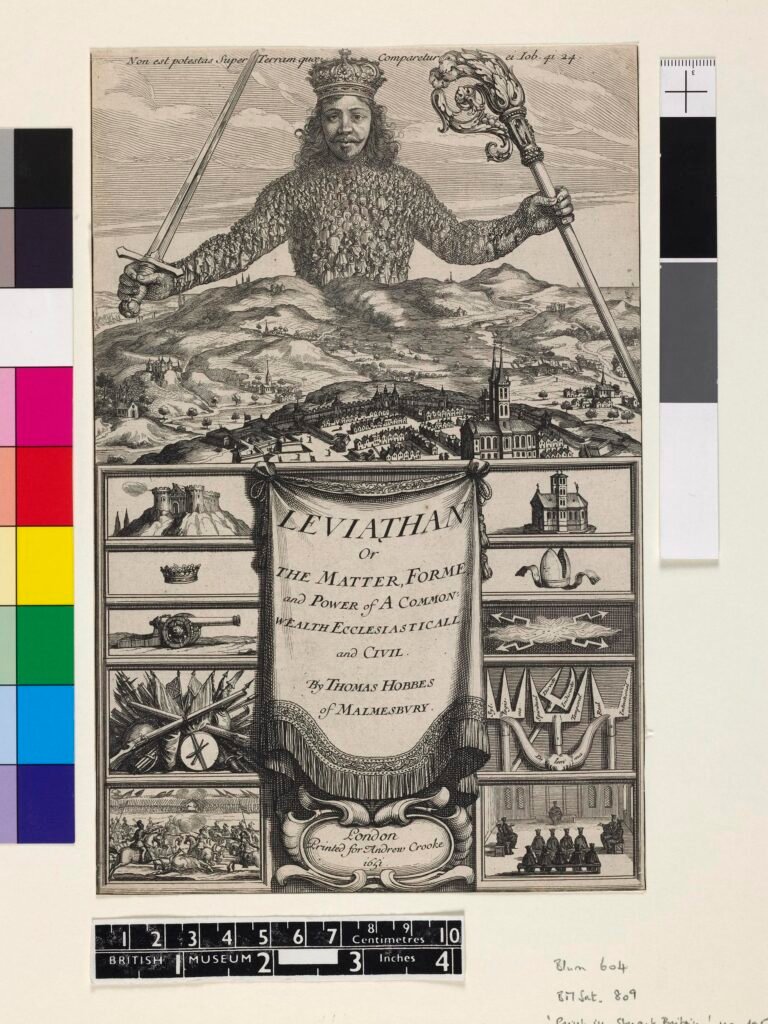
The English philosopher Thomas Hobbes gave the theory its starkest version in his 1651 book “Leviathan,” written amid the chaos of the English Civil War. Hobbes imagined a pre-political “state of nature” in which, without any government at all, life would be a war of all against all, famously “solitary, poor, nasty, brutish, and short.” To escape that condition, Hobbes argued, rational people agree to hand nearly all their power to a single, near-absolute sovereign in exchange for peace and security, even if that sovereign’s rule ends up harsh. For Hobbes, almost any stable authority beats the alternative of no authority at all.
Locke: Rights That Come Before Government
John Locke, writing several decades later, took a far gentler view of the state of nature, describing it as already governed by natural law that protected people’s life, liberty, and property, even without a formal government in place. For Locke, people form a social contract not to escape chaos but to more reliably secure rights they already possessed, and government exists specifically to protect those pre-existing rights rather than to grant new ones. Crucially, Locke argued that if a government violated that trust and became tyrannical, the people retained the right to resist and replace it — an idea that directly shaped the Declaration of Independence’s language about governments deriving their just powers from the consent of the governed.
Rousseau: The General Will
Jean-Jacques Rousseau, writing in 1762’s “The Social Contract,” opened with the famous line “Man was born free, and everywhere he is in chains,” and proposed a different fix again. Rather than surrendering power to a monarch or a limited government, Rousseau argued that legitimate authority could only come from the collective decisions of the citizens themselves, something he called the “general will,” with the people, as a body, acting as their own sovereign through direct participation rather than handing authority to a ruler at all.
Why It Still Matters
These competing versions were never just academic exercises. Locke’s consent-based framework fed directly into the American and French revolutions and remains embedded in modern constitutions and human-rights language worldwide. Even today, when politicians argue about the proper size of government, the limits of protest, or what citizens are owed by the state, they are frequently, whether they realize it or not, replaying the same three-way argument Hobbes, Locke, and Rousseau started centuries ago about what people give up, and what they get back, by living under a government at all.