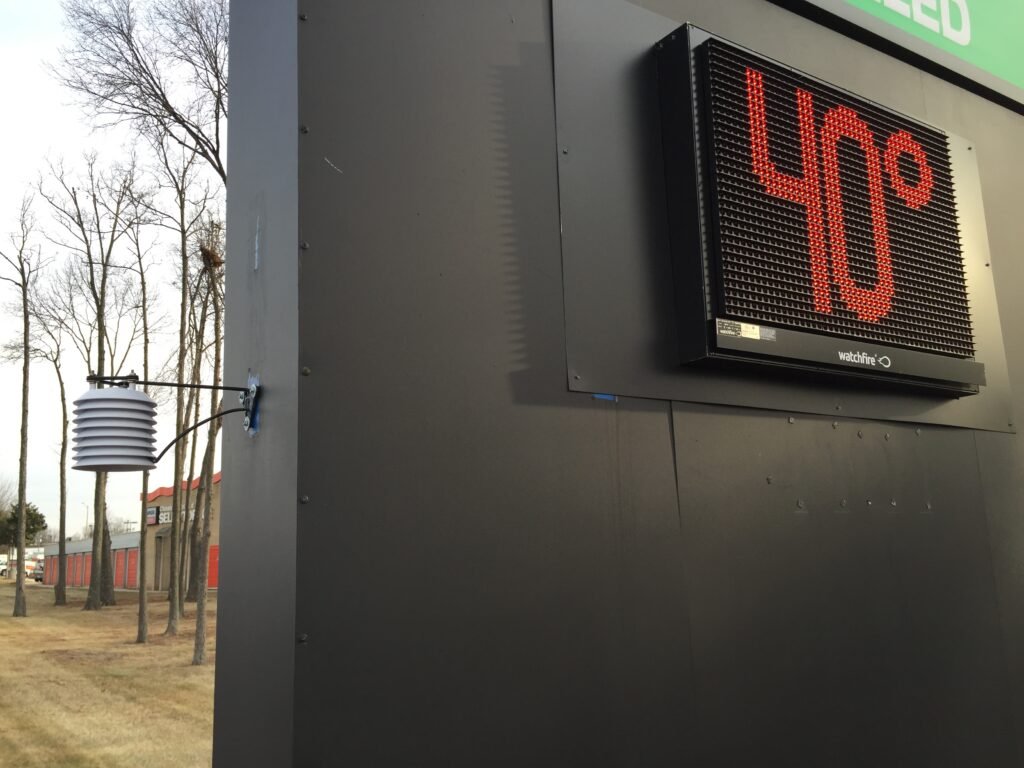
The United States still uses Fahrenheit instead of Celsius mainly because of timing and cost, not any technical advantage: Fahrenheit was already deeply embedded in American life by the time the rest of the world standardized on the metric system, and a 1975 law meant to switch the country over made the change voluntary rather than mandatory — so it never really happened.
Where the Fahrenheit scale came from
The Fahrenheit scale dates to the early 1700s and the work of Daniel Gabriel Fahrenheit, a Dutch scientist and instrument maker who built some of the first reliable mercury thermometers. At the time, dozens of competing temperature scales existed, with no agreed-upon way to pin down an absolute measurement rather than a vague comparison of “hotter” or “colder.” Fahrenheit solved this by calibrating his thermometer against two fixed reference points: the coldest temperature he could reliably reproduce using a mixture of ice, water, and salt, and human body temperature. That calibration produced a scale on which water freezes at 32 degrees and boils at 212 degrees, and it became the standard across the English-speaking world for the next two centuries, spreading through the British Empire and, with it, to Britain’s American colonies.
Why most of the world moved to Celsius instead
Celsius, developed a few decades after Fahrenheit by Swedish astronomer Anders Celsius, offered something Fahrenheit’s scale didn’t: round numbers that lined up with the metric system’s base-ten logic. Zero degrees Celsius is water’s freezing point and 100 degrees is its boiling point, a clean structure that fits naturally alongside meters, liters, and kilograms. As countries adopted the metric system for trade, science, and government through the 19th and 20th centuries, Celsius came along with it. Britain itself formally switched to Celsius for weather reporting in the 1960s, leaving the United States as one of the only countries where Fahrenheit remains the everyday standard.
Why the U.S. never finished switching
The U.S. actually tried. Congress passed the Metric Conversion Act in 1975, declaring the metric system the preferred measurement system for trade and commerce and setting up a federal board to coordinate a national transition. But the law made conversion voluntary rather than mandatory, and without a hard deadline or enforcement mechanism, most industries and consumers simply kept using the units they already knew. According to the National Institute of Standards and Technology, which now oversees U.S. metrication policy, that voluntary approach has persisted ever since: businesses that trade internationally or work in science and medicine largely use metric units, but everyday American life — weather reports, oven dials, highway signs, bathroom scales — stayed customary.
Why a full switch never happened anyway
Part of the resistance comes down to sheer scale. Converting road signs, product labeling, school curricula, manufacturing tolerances, and consumer habits all at once is enormously expensive, and the payoff is diffuse rather than immediate for any single business or household. NIST notes that working with two measurement systems concurrently creates real costs and occasional dangerous mistakes, including costly unit-conversion errors in engineering and manufacturing. But a mandatory, coordinated switch would concentrate those conversion costs upfront, which is exactly the kind of large one-time expense that tends to generate political resistance, even when it would produce long-term savings.
Fifty years after the Metric Conversion Act, Fahrenheit persists in the U.S. less because of any technical advantage and more because it’s what people grew up with. Americans have an intuitive sense of what 70 degrees Fahrenheit feels like outside, the same way most of the rest of the world has an intuitive feel for 21 degrees Celsius — and changing that intuition would mean replacing not just signage and thermostats but a lifetime of learned sensation.