Most people walk into a clinic or hospital expecting to be helped. Most are. Yet health care, for all its power, is also a place where things can go wrong: a wrong dose, a missed diagnosis, an infection picked up on the ward, an instruction that was never passed on. World Patient Safety Day, observed every year on September 17, asks the world to take those failures seriously and to prevent them. It is not a day about blaming doctors and nurses. It is a day about building systems that make safe care the easy and automatic choice.
From a resolution to a yearly day
The day has a clear legal birth. In May 2019, the Seventy-second World Health Assembly adopted resolution WHA72.6, titled “Global action on patient safety.” It endorsed World Patient Safety Day, to be observed each year on September 17, and WHO has marked the day since 2019. The idea behind it was simple: patient safety is a global health priority, and it needs a moment each year when governments, hospitals, patients and families all look at the same problem together.
Two years later the Assembly considered the Global Patient Safety Action Plan 2021 to 2030. Its stated aim is the maximum possible reduction in avoidable harm due to unsafe health care worldwide, and its vision is a world in which no one is harmed in health care and every patient receives safe and respectful care, every time, everywhere.
What “patient safety” means
Patient safety is the work of preventing avoidable harm to people who are receiving care. The key word is avoidable. Treatment always carries some risk, and a side effect that was explained and unavoidable is part of medicine. Harm becomes a safety failure when good systems, clear communication or a second check could have stopped it. Safety is therefore less about heroic individuals and more about everyday design: legible labels, hand hygiene stations, checklists before surgery, and a culture in which staff can report a near miss without fear.
The numbers behind the day
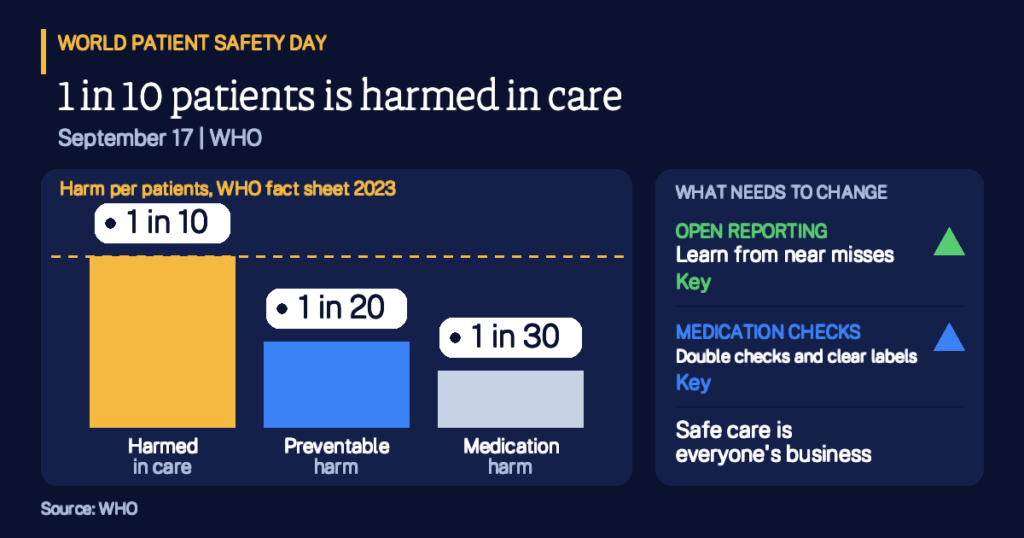
WHO’s fact sheet, updated in 2023, gives the scale. Around 1 in every 10 patients is harmed in health care, and more than 3 million deaths occur each year because of unsafe care. In low- and middle-income countries, as many as 4 in 100 people die from unsafe care. Above 50 percent of the harm, or 1 in every 20 patients, is preventable, and half of that preventable harm is attributed to medications.
Example 1: one hospital, one year. Imagine a hospital that treats 20,000 patients a year. At a rate of 1 in 10, about 2,000 of them would be harmed. At 1 in 20, about 1,000 of those cases could have been prevented. The numbers are round and illustrative, not a real hospital, but they show why even a small drop in the rate means hundreds of people spared.
Where harm hides
Three areas recur in WHO’s data. The first is medication. Medication harm affects about 1 in 30 patients, and more than a quarter of it is severe or life threatening. The second is diagnosis. Diagnostic error occurs in 5 to 20 percent of physician and patient encounters, and WHO notes that most people will experience one in their lifetime. The third is infection. WHO reports that 23.6 percent of sepsis cases managed in hospitals were health care associated, and about 24.4 percent of those patients died.
- 1 in 10patients harmed in health care
- 3 million+deaths a year linked to unsafe care
- 0.7%yearly global economic growth that harm may cost
- 16 billioninjections given worldwide each year
Example 2: a medication error caught. Suppose a clinic fills 3,000 prescriptions a month. If medication harm reached 1 in 30, about 100 patients a month would be affected. If a simple double check, clear labels and a pharmacist review prevented even a quarter of that, about 25 people a month would avoid harm. The figures are made up and rounded, but this is how small routines add up.
Who pays, and who is left behind
The cost is human first. WHO also says that harm may reduce global economic growth by 0.7 percent a year, and that its indirect cost runs to trillions of US dollars each year. The burden is not shared evenly. Where staff are stretched, supplies are short and basic infrastructure is weak, the risk rises, which is why the death figure in low- and middle-income countries is so stark. Clean water and working toilets in clinics matter too, as shown on World Toilet Day.
Primary and ambulatory care, the clinics where most people meet health services, is often overlooked. WHO says up to 4 in 10 patients may be harmed there, and up to 80 percent of that harm can be avoided. Newborns and children face particular risks, which is why the 2025 theme focused on safe care for every newborn and every child, with the slogan “Patient safety from the start!” and a spotlight on children from birth to nine years old.
Example 3: a speak-up culture. Picture a ward where nurses report 50 near misses in a year because they are encouraged to, instead of 5 because they fear blame. Each report is a free lesson. If the ward fixes the causes of 10 of them, 10 future harms never happen. The numbers are invented and round, but the logic is the one safety experts describe: learning from near misses prevents injuries.
How the day is marked, and what progress needs
Each year WHO picks a theme and invites governments, hospitals and communities to light landmarks orange, hold events and share stories. Recent themes show the widening focus, from engaging patients in 2023, to diagnosis in 2024, to newborns and children in 2025, to safe care for noncommunicable diseases in 2026. Real progress needs three habits: honest reporting, patients and families treated as partners, and steady investment in the basics.
- 2023Engaging patients for patient safety
- 2024Improving diagnosis for patient safety
- 2025Safe care for every newborn and every child
- 2026Safe care for noncommunicable diseases
Key Takeaways
- The day has a legal base. The World Health Assembly endorsed it in resolution WHA72.6 in May 2019.
- Harm is common. Around 1 in 10 patients is harmed in health care, according to WHO.
- Much of it is preventable. Above 50 percent of harm can be avoided, and half of that is linked to medications.
- Errors take many forms. Medication, diagnosis and infection are the recurring problem areas.
- Systems beat blame. Checklists, clear labels and open reporting prevent harm better than fear.
- The poorest feel it most. Up to 4 in 100 people in low- and middle-income countries die from unsafe care.
- You can help. Ask questions, check your medicines, keep a record and speak up if something seems wrong.
How solid is this? The figures come from the WHO patient safety fact sheet dated 2023, which draws on published studies, and they are estimates that vary by country and setting. The three worked examples use round, made-up numbers to show an idea. Themes follow WHO campaign pages. See also the International Days hub and the International Days Calendar.