Two people can sit at neighboring desks, carry the same responsibility and deliver the same results, and still take home different pay because of who they are. Across the world’s labor markets, that difference is not an accident of a few unfair employers. It is a measurable, global pattern, and it has a day of its own. International Equal Pay Day, observed every September 18, asks governments, employers and workers to treat equal pay as a basic right and to close the gap with evidence, laws and honest accounting. It sits alongside the International Day of Women in Diplomacy in the wider story of women’s place in public and economic life.
From a 1951 principle to a United Nations day
The idea is older than the day. In 1951 the International Labour Organization adopted Convention No. 100, the Equal Remuneration Convention, which commits countries to the principle of equal pay for work of equal value. For decades it was the main international yardstick, and the gap it targeted never closed.
The modern push gathered pace in 2017, when the ILO, UN Women and the OECD launched the Equal Pay International Coalition, known as EPIC. In 2019 the UN General Assembly established International Equal Pay Day, to be commemorated on September 18 each year; the resolution is numbered 74/142. The first observance took place on September 18, 2020. Today the UN describes the day as led by the three EPIC partners, and the ILO describes the coalition as jointly managed by them.
What equal pay really means
The phrase to remember is equal pay for work of equal value. It is wider than equal pay for the same job. Many women and men do different work, such as nursing and engineering, yet the skill, effort, responsibility and working conditions behind the jobs can be compared. If the job mostly done by women is paid less for comparable value, the principle is broken even though no two people share a title.
The gender pay gap is a different thing from a single case of unequal pay. It is the average difference between what men and women earn, and it reflects many forces at once: which occupations women are steered into, how much unpaid care they carry, interruptions to careers, and discrimination. That is why the fixes are many too, from pay laws to care services.
The numbers behind the day
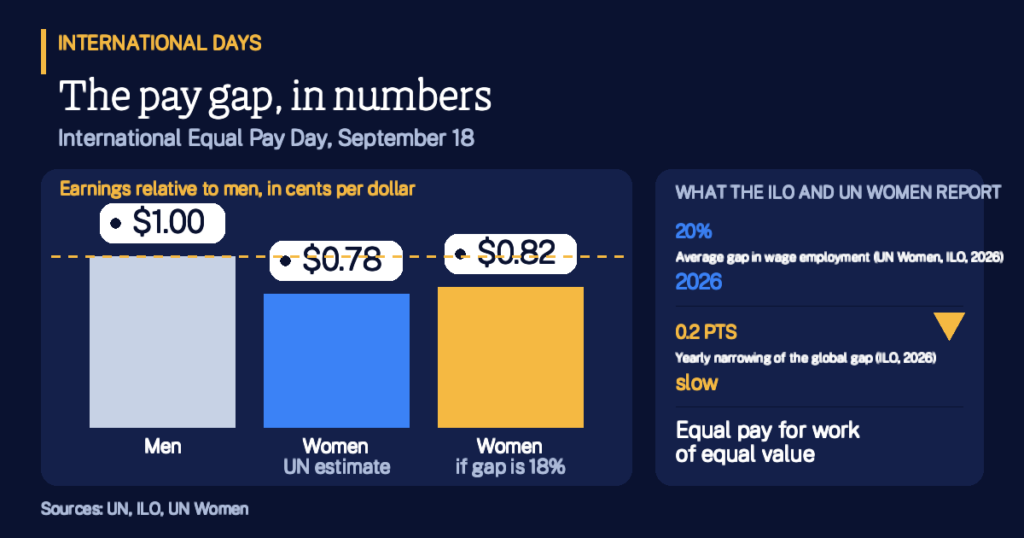
The UN states that women earn about 78 cents for every dollar men earn. UN Women says that women around the world still earn, on average, 20 percent less than men, and the ILO used the same 20 percent figure for women in wage employment in March 2026. In September 2026 the ILO published a newer estimate: women earn around 18 percent less than men globally. The difference between 20 and 18 percent is a difference of method and date, not a contradiction, and every version points the same way.
Example 1: the cost over a career. Suppose a man earns $50,000 a year and a woman in a comparable role earns 20 percent less, or $40,000. The gap is $10,000 a year. Over a 30-year career it adds up to $300,000 in lost income, before counting savings, interest and pensions that depend on pay. The numbers are round and illustrative, but they show why a gap that looks modest in a single paycheck becomes large over a lifetime.
- 20%average gap for women in wage employment (UN Women and ILO, 2026)
- 18%newest ILO global estimate (September 2026)
- 257 yearsto reach economic gender parity at the pace then seen (UN News, 2020)
- 24%less pay for women in health and care than male peers (UN)
Why the gap persists
One of the deepest causes is unpaid work. The UN notes that women spend more than 2.5 times as many hours as men on unpaid care work. Time spent caring for children and relatives is time not spent in paid work, and it shapes which jobs women can take, how many hours they can work and how far they can climb. The ILO adds that the gaps are even wider for women with children.
Example 2: the hours that vanish. Imagine a couple where he spends 10 hours a week on unpaid care and she spends 25, which is 2.5 times as many. The 15-hour difference is nearly two working days. She may turn down overtime, a distant job or a promotion that needs travel, and her pay slips behind. The hours are made up for illustration, but the 2.5 ratio is the UN’s.
Where women work matters too. The UN reports that women in health and care earn 24 percent less than their male peers, a reminder that gaps appear even in fields built largely around women’s work.
Who is left furthest behind
Averages hide the sharpest cases. The ILO says gaps are even wider for women with children, women in informal work, women with disabilities and migrant women. UN Women adds that the gap can be larger for women from racial and ethnic minorities. Equal pay policy that looks only at the average can miss the people for whom the gap is largest.
The pace of change, and what could speed it up
Progress is real, but slow. The ILO reports that the global gap narrowed by just two percentage points since its 2018 estimates, which is a pace of about 0.2 percentage points a year. Gaps narrowed by about 2.5 points in high-income countries, 2 points in lower-middle-income countries and 1 point in upper-middle-income countries over the decade.
Example 3: the arithmetic of patience. If an 18-point gap shrinks by 0.2 points a year in a straight line, it would take about 90 years to reach zero. That is a rough calculation for illustration, not an ILO forecast. It shows why the ILO calls equal pay a distant dream at the current pace unless action speeds up.
The ILO’s 2026 work on pay equity points to laws, wage-setting, care policies and social dialogue as the tools that deliver it, and the ILO has also highlighted pay transparency as a way to expose and address gaps. A new resolution on the ILO transformative agenda for gender equality in the world of work was adopted at the 2026 International Labour Conference. On September 18, 2026 the Government of Ireland hosted a gathering of EPIC in Dublin, and EPIC scheduled a webinar on pay transparency and the gender pay gap for September 28, 2026.
Key Takeaways
- Equal pay means equal value. The principle, set out in ILO Convention No. 100 in 1951, covers different jobs of comparable worth, not only identical jobs.
- The day is young. The UN General Assembly established it in 2019 and it was first observed on September 18, 2020.
- The gap is large. Women earn about 20 percent less than men by UN Women and ILO figures, and about 18 percent by the ILO’s September 2026 estimate.
- Small gaps add up. A 20 percent gap on a $50,000 salary is $10,000 a year, or $300,000 over 30 years in our illustration.
- Unpaid care is a root cause. Women spend more than 2.5 times as many hours as men on unpaid care work.
- Some women face wider gaps. Mothers, informal workers, women with disabilities and migrant women are hit hardest, the ILO says.
- Speed is the challenge. At about 0.2 points a year, change is far too slow, and laws, transparency and care services are the levers.
How solid is this? The 20 percent and 18 percent figures come from different ILO and UN Women estimates made in 2026 and are not directly comparable. The 78 cents and 2.5 times figures are quoted from the UN observance page, which does not state a year. The 257-year estimate is a 2020 UN News figure and the ILO has repeated it since. The three worked examples use round, made-up numbers. See the International Days hub and the International Days Calendar.