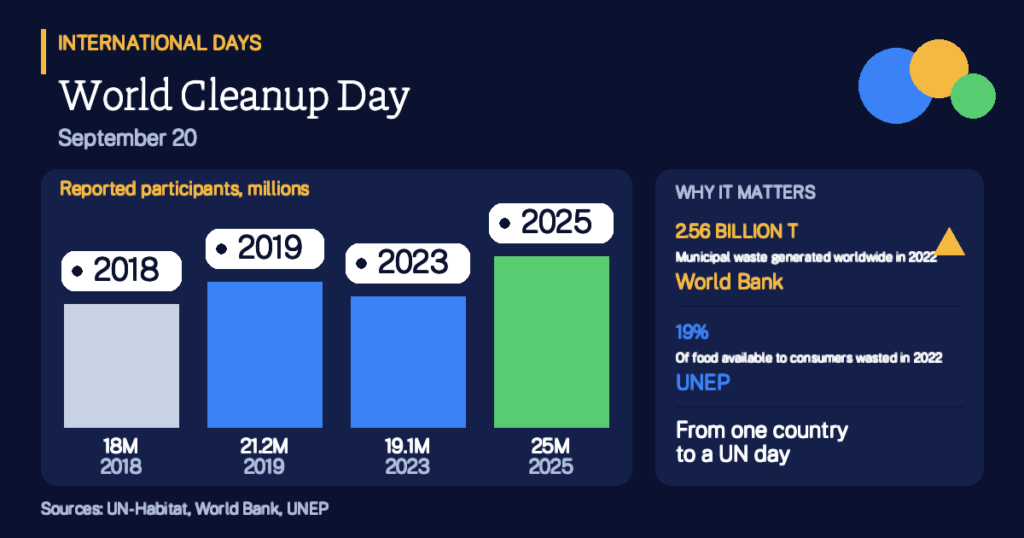
Every year on September 20, people in well over a hundred countries pull on gloves, grab bags and spend a few hours removing litter from streets, beaches, rivers and forests. It looks like a simple act, and it is. Yet World Cleanup Day grew from one small country’s bold experiment into a United Nations day, and it now carries a bigger message: waste is a system, and picking it up is only the first step in fixing it. The 2025 edition drew a record 25 million participants in 190 countries and territories, according to its organizers.
From one country to the whole world
The idea began in Estonia. In 2008, by the movement’s own account, more than 50,000 people cleaned up the entire country, gathering over 10,000 tons of trash in about five hours. The effort became Let’s Do It World, a nonprofit network based in Tallinn. In 2018 it staged the first global event, a 36-hour wave of cleanups that began in Fiji and ended in American Samoa, with more than 18 million participants.
The United Nations then gave the day formal standing. On December 8, 2023, the General Assembly unanimously adopted resolution 78/122, which proclaimed September 20 as World Cleanup Day, to be observed annually. It invites governments, UN bodies, civil society, the private sector and academia to mark the day through awareness-raising activities. UN-Habitat, the UN’s human settlements agency, facilitates the observance. Because the resolution fixes the date, it does not move from year to year.
More than a tidy morning
A cleanup day is easy to misread as cosmetic. In practice it does three jobs. It removes waste that would otherwise wash into waterways or be burned. It makes the scale of the problem visible, because a volunteer who fills a bag in an hour quickly sees how much was already lying there. And it gathers people who can then press for better collection, cleaner products and stronger rules.
Example 1: one morning, one park. Suppose 500 volunteers each collect about 10 kilograms of litter in three hours. That is 5,000 kilograms, or 5 tonnes, before lunch. The numbers are round and illustrative, but they show how ordinary effort adds up, and why Estonia’s 10,000 tons in five hours took tens of thousands of people.
The numbers behind the day
Participation has grown from millions to tens of millions. Organizers report about 18 million people in 2018, 21.2 million in 2019, 19.1 million in 2023 and a record 25 million in 2025. These are organizer counts, so treat them as a sense of scale rather than audited totals.
Behind the cleanups sits a far larger waste stream. The World Bank’s What a Waste 3.0 report estimates that the world generated 2.56 billion tonnes of municipal solid waste in 2022, a level the 2018 edition had expected only by 2030. On a business-as-usual path it could reach 3.86 billion tonnes by 2050, an increase of 50 percent. Managing it already costs more than $250 billion a year, and the report projects $426 billion by 2050.
- 25 millionparticipants in 2025, a record, in 190 countries and territories
- 2.56 billiontonnes of municipal waste generated worldwide in 2022
- 18 millionpeople work in urban waste services worldwide
- $250 billionspent each year managing municipal waste
Why litter is more than an eyesore
Waste that is not collected goes somewhere. The earlier What a Waste 2.0 report found that in low-income countries over 90 percent of waste is mismanaged, meaning openly dumped or burned, and that these countries collect only about half of the waste in cities and about one quarter in rural areas. Upper-middle and high-income countries provide nearly universal collection. Those figures come from the 2018 report, so they show the pattern more than today’s exact values.
Plastic makes the problem easy to see. The World Bank estimated that the world generated 242 million tonnes of plastic waste in 2016. UNEP reports that an estimated 11 million tons of plastic pollution enter the ocean every year, and has likened it to a garbage truck of plastic dumped into the sea every minute (2022). Plastic does not vanish. It lingers in rivers, soil and coastlines, where it can alter habitats and natural processes.
Example 2: the uncollected half. Imagine a city that generates 200 tonnes of waste a day but collects only half. Then 100 tonnes a day, or 36,500 tonnes a year, is left to pile up, clog drains or burn. Volunteers can clear some of it, but only a working collection system stops it from returning. The figures are round and illustrative.
2026: from clean plates to clean cities
The UN’s 2026 observance page chose the theme From Clean Plates to Clean Cities, which ties cleanup to food waste, and said the global observance on September 20 would take place in Shaoxing, Zhejiang Province, China. It cites UNEP’s Food Waste Index Report 2024: about 1.05 billion metric tons of food were wasted in 2022, or 19 percent of the food available to consumers. About 60 percent of consumer food waste comes from households, which waste more than one billion meals every day. Meanwhile about 673 million people experienced hunger in 2024, according to FAO.
Food loss and waste also generate roughly 8 to 10 percent of global greenhouse gas emissions, according to UNEP figures on the UN page. Sustainable Development Goal target 12.3 calls for halving per capita food waste at the retail and consumer levels by 2030.
Example 3: the leftover habit. If a household wastes just two meals a week, that is 104 meals a year. A street of 100 such homes wastes 10,400 meals a year, along with the water, energy and money used to produce them. The numbers are round and illustrative.
How the day is marked
Anyone can take part. Organizers invite people to find an event on the map, register as a volunteer or start their own cleanup. They also promote a “5 percent” idea, drawn from research on social change, which holds that when a small committed share of people act visibly, norms can shift. It is a motivating concept, not a measured target. Wear gloves, leave sharp or hazardous items alone and report them to local authorities. The deeper lesson echoes World Toilet Day: waste must be contained, collected and treated, not simply moved out of sight.
Key Takeaways
- It started with one country. Estonia’s 2008 cleanup grew into a global movement and then a UN day.
- The date is fixed. Resolution 78/122 set September 20 as the day, observed annually.
- The crowd is large. Organizers report a record 25 million participants in 2025.
- The waste stream is larger. The world generated 2.56 billion tonnes of municipal waste in 2022, with 3.86 billion projected by 2050 if nothing changes.
- Collection is the real fix. Cleanups help, but working waste systems keep litter from coming back.
- Food is part of the story. About 19 percent of food available to consumers was wasted in 2022, and households are the biggest source.
- Start small. Join a local cleanup, sort what you find and look at what you throw away at home.
How solid is this? Participation counts are reported by the organizers and are not audited. Waste figures are modeled estimates from the World Bank, with the low-income collection data taken from the 2018 report. The three worked examples use round, made-up numbers to show an idea. See also the International Days hub and the International Days Calendar.