Most of us share our lives with animals, whether it is a dog at the door, a pigeon on the sill or a bee in the garden. World Animal Day, observed every year on October 4, asks a larger question: what do we owe the creatures that share the planet with us, and what happens to us when they disappear? It began as a single rally in Berlin and grew into a worldwide day of awareness. It is not a United Nations day, which makes it unusual in this series. It is led by animal welfare groups, yet its message lines up closely with the work of UN agencies on biodiversity and health. For a day devoted to one group of species, see World Bee Day.
From a Berlin rally to a global day
The idea belongs to Heinrich Zimmermann, a journalist and editor born in Warsaw who worked in Berlin. He published a magazine called Mensch und Hund (Man and Dog) and founded a World Animal Day Committee in Germany. The first celebration took place on March 24, 1925, at the Berlin Sports Palace, and more than 5,000 people attended. The March date was a compromise forced by logistics, not the plan.
The plan was October 4, the day linked to Saint Francis of Assisi, who died on the eve of October 4, 1226 and is remembered for his care for animals. The event was first held on that date in 1929. In May 1931, at a congress in Florence, Italy, participating organizations approved the Zimmermann proposal and officially established October 4 as World Animal Day. Today the day is coordinated by the Naturewatch Foundation, a UK-based organization, whose site reports more than 90 ambassadors in more than 70 countries.
Welfare, health and one shared planet
Two ideas sit behind the day. Animal welfare is about how animals are treated and how they fare in the care of people. The World Organisation for Animal Health (WOAH) notes that animal health is a key component of animal welfare, so a sick or neglected animal is a welfare problem as well as a health one. The second idea is One Health, which the World Health Organization describes as an approach to optimize the health of humans, animals, plants and ecosystems by integrating these fields, rather than keeping them separate.
This matters because the lines between species are thinner than they look. WHO states that more than 60 percent of emerging infectious diseases reported globally come from animals, both wild and domestic. Watching the health of animals is therefore one of the ways people protect their own.
Example 1: the early report. Imagine a village veterinarian sees 20 of 200 chickens in a flock with unusual symptoms and reports it the same day. Officials can test, advise neighbors and limit movement before the problem spreads. Had the report waited two weeks, far more birds and people could have been exposed. The numbers are round and illustrative, but the logic is the one behind One Health: a fast signal from animals protects people.
The numbers behind the day
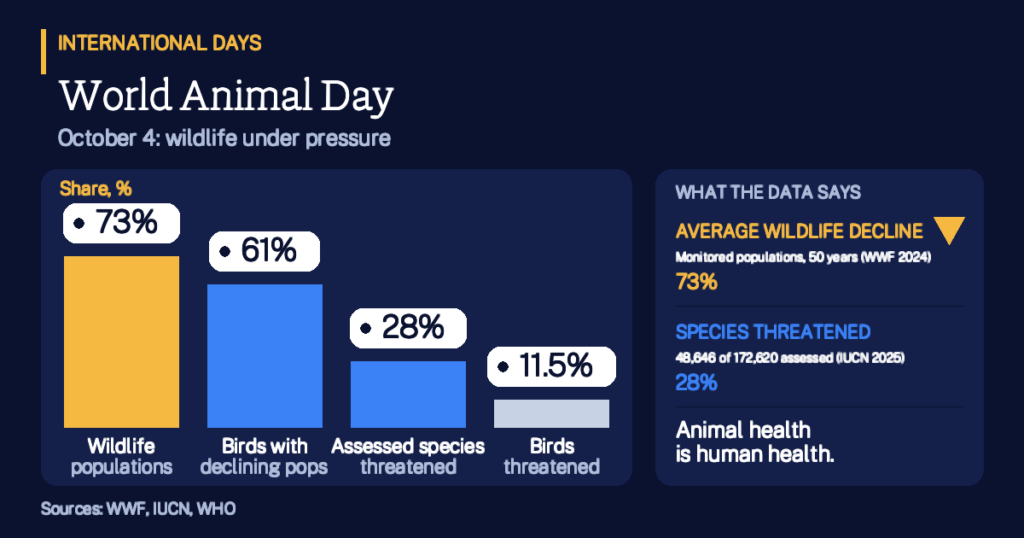
The scientific case for the day is the state of wildlife. The IUCN Red List, the most comprehensive inventory of extinction risk, reported in October 2025 that it includes 172,620 species, of which 48,646 are threatened with extinction. That is about 28 percent of the species assessed. The Red List covers only the species that scientists have been able to assess, so it is a floor of knowledge and not a census of all life.
Birds show the trend well. Of the 11,185 bird species assessed, 1,256 (11.5 percent) are globally threatened, and 61 percent of bird species have declining populations, up from 44 percent in 2016. The IUCN names habitat loss and degradation as the most prevalent cause of decline. The same 2025 update brought some good news: the green sea turtle moved from Endangered to Least Concern, a reminder that protection can work.
A second measure looks at animal numbers rather than species. WWF and the Zoological Society of London report in the 2024 Living Planet Report that monitored wildlife populations fell by an average of 73 percent in 50 years. This is an average across tracked populations, not a count of animals lost, and it is a modeled index.
Example 2: reading an average. Suppose a wetland frog population of 1,000 declines by 73 percent. About 270 frogs remain. Another population in the index might hold steady, and the average blends all of them. The numbers are round and illustrative, but they show why a decline of this size means a population is a small fraction of what it once was.
- 73%average fall in monitored wildlife populations over 50 years (WWF, 2024)
- Up to 1 millionspecies threatened with extinction, many within decades (IPBES, 2019)
- 60%+of emerging infectious diseases come from animals (WHO, 2026)
- 5,000+people at the first World Animal Day in 1925
Why it matters to people
The 2019 global assessment by IPBES, the intergovernmental science body for biodiversity, found nature declining at rates unprecedented in human history. It estimated that up to 1 million of roughly 8 million animal and plant species are threatened with extinction, many within decades. It found that three-quarters of the land environment and about 66 percent of the marine environment have been significantly altered by human actions. More than 40 percent of amphibians and almost 33 percent of reef-forming corals are threatened.
What drives the losses
IPBES ranked the direct drivers of nature loss, from largest to smallest: changes in land and sea use, direct exploitation of organisms, climate change, pollution and invasive alien species. In plain terms, animals mostly lose their homes first, then face hunting and fishing pressure, and then a warming climate. The same assessment found that more than a third of the land surface and nearly 75 percent of freshwater resources are devoted to crop or livestock production, which shows how closely farming and wildlife are tied. It also warned that negative trends continue to 2050 and beyond unless there is transformative change.
How the day is marked, and what helps
There is no single ceremony. Communities hold animal blessing services, school lessons, shelter open days and wildlife talks, and the 2025 centenary campaign carried the theme Save Animals, Save the Planet. Because the day is not tied to a UN resolution, there is no official yearly theme from the United Nations to follow, and the 2026 theme was not stated on the organizer pages we checked.
Individual action matters most where it is steady and local. Adopting from shelters, keeping pets safe and vaccinated, protecting nearby habitat, buying responsibly and supporting credible conservation groups all count.
Example 3: small hours add up. If 100 volunteers each give 10 hours to a local shelter or habitat cleanup, that is 1,000 hours of care in a year. The numbers are round and illustrative, but they show how a community can turn goodwill into measurable help.
Key Takeaways
- The day began with one rally. More than 5,000 people gathered in Berlin in 1925, and Florence made October 4 official in 1931.
- It honors Saint Francis. October 4 is tied to the eve of the day he died in 1226, long linked to care for animals.
- Roughly 28 percent of assessed species are threatened. The IUCN counted 48,646 of 172,620 in October 2025.
- Wildlife numbers have fallen sharply. Monitored populations dropped an average of 73 percent in 50 years, according to WWF.
- Animal health is human health. WHO says more than 60 percent of emerging infectious diseases come from animals.
- Habitat loss leads the causes. IPBES ranks land and sea use change first among the drivers of nature loss.
- Progress is possible. The green sea turtle moved to Least Concern in 2025, and local action adds up.
How solid is this? The Red List totals count only species assessed so far, and the Living Planet figure is a modeled average, not a headcount. The IPBES numbers are from 2019 and some are ranges or estimates. World Animal Day is an awareness day run by an NGO, not a UN-designated day. The three worked examples use round, made-up numbers to show an idea. See also the International Days hub and the International Days Calendar.