Most of us picture non-violence as the absence of fighting. The United Nations treats it as something more active: a way of living and of settling disputes that refuses to answer harm with harm. Every year on October 2, the birthday of Mahatma Gandhi, the world marks the International Day of Non-Violence. The day asks a plain but demanding question: how can people, communities and nations resolve their differences without hurting anyone? It sits beside the International Day of Peace on September 21, and it shares ground with the International Day for the Elimination of Violence against Women in November.
From a birthday to a United Nations day
Mohandas Karamchand Gandhi was born on October 2, 1869, and became the best-known champion of non-violent resistance of the twentieth century. He called his approach satyagraha, often translated as holding firmly to truth, and he used it to lead campaigns such as the 1930 Salt March against British colonial rule in India. His example later influenced movements far beyond India.
In June 2007 the UN General Assembly adopted resolution 61/271, designating October 2 as the International Day of Non-Violence. The resolution affirms the universal relevance of the principle of non-violence and the desire to secure a culture of peace, tolerance, understanding and non-violence. It asks that the day be used to spread that message, including through education and public awareness. The first observance took place on October 2, 2007, and the date has been marked every year since.
What non-violence actually means
Non-violence is often mistaken for passivity. In Gandhi’s practice it was the opposite: a disciplined refusal to harm others, joined to an equally firm refusal to go along with injustice. It can mean a strike, a boycott, a march, a sit-in, a negotiation or a mediated settlement. It can also be something quieter, such as choosing patience over retaliation. The resolution ties the idea to a broader culture of peace, where tolerance and understanding are taught and practiced, not only declared. A useful way to see it is as three levels that support one another.
The numbers behind the day
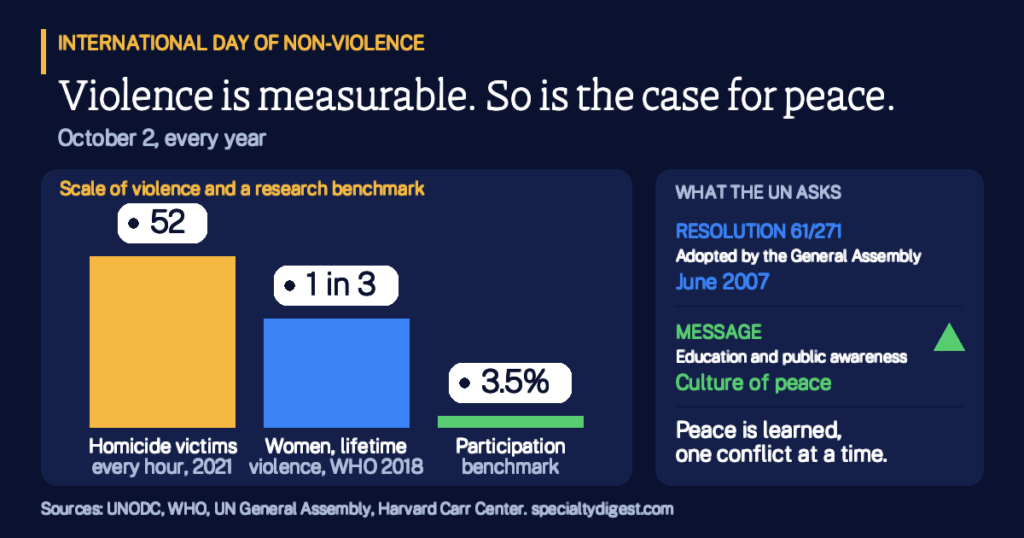
The case for the day becomes concrete when you see how much harm violence still causes. The UN Office on Drugs and Crime (UNODC) reported that 52 people lost their lives to homicide every hour in 2021, and found that homicide killed more people that year than armed conflict and terrorism combined. Much of the world’s lethal violence, in other words, happens outside formal wars, in homes, streets and neighborhoods.
Violence against women is a particular concern. The World Health Organization (WHO) estimated, in 2021 using 2018 data, that about 1 in 3 women worldwide experience physical or sexual violence in their lifetime. In November 2025 WHO reported that 840 million women had faced partner or sexual violence over a lifetime.
- 52homicide victims every hour worldwide, 2021 (UNODC)
- 1 in 3women face physical or sexual violence in a lifetime (WHO, 2018 data)
- 840 millionwomen faced partner or sexual violence, WHO report of 2025
- 3.5%participation benchmark in Chenoweth’s research on resistance
Example 1: the pace of loss. At 52 deaths an hour, the 2021 figure works out to 1,248 people a day (52 times 24). If a town of 10,000 people lost that many each day, it would be emptied in about eight days. The town is made up and the arithmetic is simple, but it shows why the UN treats prevention as urgent.
These are estimates built from national records, and counting methods differ by country, so totals shift as each new report is published.
Does non-violence work?
Skeptics say non-violence is noble but weak. Research suggests otherwise. Political scientists Erica Chenoweth and Maria Stephan compared hundreds of resistance campaigns in their 2011 book Why Civil Resistance Works and concluded that non-violent campaigns were more likely to achieve their goals than violent ones. Chenoweth later drew attention to what Harvard’s Carr Center describes as the 3.5 percent rule: in her data, no campaign that sustained active participation from about 3.5 percent of a population failed. It is a pattern in historical cases, not a guarantee, and every movement faces its own conditions.
Example 2: what 3.5 percent looks like. In a country of 10 million people, 3.5 percent is 350,000 people. That is a very large crowd, yet only a small slice of the nation. The numbers are round and illustrative, and the point is that broad, sustained, peaceful participation is demanding but within reach.
Who is affected, and who is left out
Violence does not fall evenly. Women and girls bear much of the harm from partner and sexual violence, and children can be exposed at home, at school and online. Violence also breaks the systems that protect people, from schools to clinics, and it can push families from their homes. The day’s message is that prevention is better than repair, and that it starts with how societies teach people to handle conflict. If you or someone you know is in danger, contact local emergency services or a national helpline, and see WHO’s guidance on violence against women.
Example 3: a school that teaches the skill. Suppose a school of 600 students sees about 30 serious conflicts a month, and a peer mediation program settles two thirds of them without punishment or a fight. That is about 20 conflicts a month, or 200 over a ten-month school year. The numbers are round and illustrative, but they show how a small habit, practiced early, adds up.
How the day is marked and what builds peace
Each year the Secretary-General issues a message for the day. In 2024, UN press coverage reported him saying that Gandhi believed non-violence to be more powerful than any weapon, and urging support for that noble vision. Governments, schools and civil society groups mark the day with lectures, exhibitions, peace walks and classroom lessons, and UN offices around the world share the message locally. Because the resolution highlights education and public awareness, many of the most lasting observances happen in classrooms.
There are simple ways to take part: learn about a non-violent movement, practice a calm response in a disagreement, support mediation programs in your school or workplace, and speak up when you see someone being harmed.
Key Takeaways
- Non-violence is active, not passive. It combines refusing to harm with refusing to accept injustice.
- The day belongs to everyone. It honors Gandhi’s birthday, but UN resolution 61/271 of June 2007 gave it a universal purpose.
- Violence remains vast. UNODC counted 52 homicide victims every hour in 2021.
- Women and girls carry a heavy share. WHO estimates 1 in 3 women face physical or sexual violence in a lifetime.
- The evidence is encouraging. Research found non-violent campaigns more likely to succeed, though no pattern is a guarantee.
- Peace is learned. Education and public awareness are the tools the resolution names.
- Small habits matter. Mediation, patience and speaking up begin in everyday life.
How solid is this? Homicide and violence-against-women figures are estimates from UNODC (2021 data) and WHO (2018 data, with a 2025 update) and are revised as methods improve. The 3.5 percent benchmark is a research finding from historical cases, not a rule. The three worked examples use round, made-up numbers to show an idea. See also the International Day of Peace, the International Days hub and the International Days Calendar.
More in Society
- United Nations. International Day of Non-Violence, 2 October.
- UN General Assembly. Resolution 61/271, International Day of Non-Violence (2007).
- UN News. UN declares 2 October, Gandhi’s birthday, as International Day of Non-Violence (2007).
- UN Meetings Coverage. Secretary-General’s message marking the International Day of Non-Violence (2024).
- UNODC. Fifty-two people lost their lives to homicide globally every hour in 2021 (2023).
- World Health Organization. Devastatingly pervasive: 1 in 3 women globally experience violence (2021), and Lifetime toll: 840 million women faced partner or sexual violence (2025).
- Harvard Kennedy School Carr Center. The 3.5% rule: how a small minority can change the world; Chenoweth and Stephan, Why Civil Resistance Works (2011).