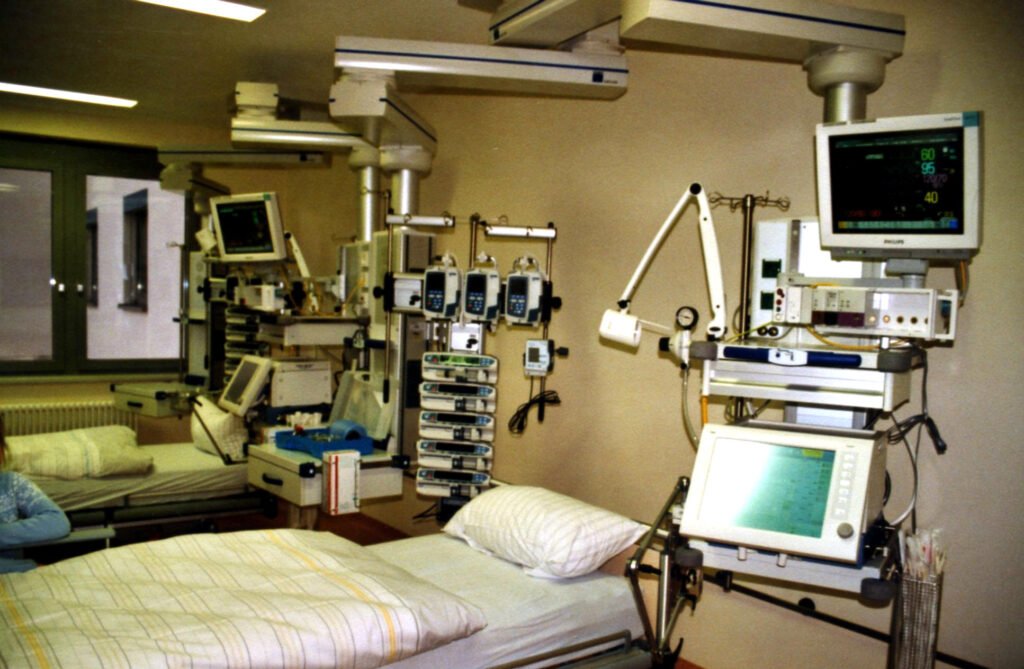
The people and hospital in this edition are composite. The professional guidance beneath the conversation is drawn from the sources listed below.
The Case
After a motorway collision on a Friday evening, two patients arrive at a district general hospital in the English East Midlands within minutes of each other.
Emily Parker is a 29-year-old teacher with severe internal bleeding. Emergency surgery could save her, but she will need intensive care afterwards. Robert Harris is a 67-year-old retired mechanic already in the emergency department with rapidly worsening pneumonia. He also needs ventilation and a critical care bed.
One bed is free. Transfer is possible, but the nearest unit with capacity is three hours away. The team must decide before either patient deteriorates further.
The Dialogue
Give me the clinical assessment. No names, no ages, no occupations.
In a unit this size, we already know who they are.
I know. Say it that way anyway. It changes what I hear.
Patient A has internal bleeding. Surgery offers a strong chance of recovery, provided a bed is free afterwards.
Patient B has severe pneumonia and is tiring. Without ventilation soon, he may arrest.
Which patient is more likely to survive intensive care?
Patient A, on the evidence in front of us. Though if we rank by who is nearest to dying, that is Patient B.
Sickest first is a real principle. It is not the same as who benefits most, and tonight they point different ways.
Patient B also arrived first. His family were told we were preparing the bed.
They heard that as a promise.
Was it a clinical commitment, or reassurance given before the second emergency arrived?
Reassurance. We had not finished assessing.
That distinction is clear to us. It will not feel clear to his family.
And if we give the bed to Patient A because she is younger, we are saying one life is worth more.
Her age cannot decide it. Nor her job. The question is whether treatment is more likely to achieve its medical purpose.
One caution. Scores that predict benefit have been criticised for quietly penalising disability and age. We should be sure ours does not.
Then we say plainly what we are weighing: tonight’s acute problem, not either patient’s baseline life.
The room went quiet.
What can still be done for whoever does not get the bed? We are talking as though the decision ends there.
We could stabilise Patient B in theatre recovery and request an emergency transfer.
The journey carries serious risk.
So does leaving him here without ventilation.
Send a critical care nurse with him, and I will ask the site manager to cover. Scarcity is not a reason to stop looking for alternatives.
And if the receiving unit refuses him?
Then we reassess. The decision stays answerable to the facts.
Patient A takes the bed because she is more likely to benefit. Not because her life is worth more.
Correct. And I will speak to Patient B’s family myself. You are not defending this alone.
Why the Decision Matters
The team gave the bed to Emily because the evidence indicated she was likelier to survive treatment. Her age, occupation and social position were excluded as measures of worth.
That is defensible, and contested. Bioethicists sort allocation principles into four families: treating people equally, favouring the worst off, maximising benefit, rewarding social usefulness. None survives every case. Prioritising expected benefit has itself been criticised for smuggling age and disability back through the scoring. Naming the standard aloud, and confining it to the acute problem rather than a baseline life, keeps it honest.
Robert received respiratory support while a transfer was arranged, a critical care nurse with him. Dr Carter took responsibility for explaining and documenting the decision.
The team could not make scarcity disappear. It could stop scarcity becoming abandonment.
A Practical Lesson
Fairness does not always mean treating everyone identically. It means applying relevant standards consistently, excluding prejudice, and taking responsibility for the person disadvantaged by a hard decision.
When the options are painfully limited, ask:
- Which facts are genuinely relevant, and which merely feel relevant?
- Am I confusing someone’s social position with the likely benefit of an action?
- What can still be done for the person who does not get the preferred option?
- Who will explain the decision, and who owns it?
A hard choice becomes defensible only when the person not chosen is still treated as someone who matters.
Sources
- Govind Persad, Alan Wertheimer and Ezekiel J. Emanuel, “Principles for allocation of scarce medical interventions,” The Lancet, vol. 373, no. 9660, 2009, pp. 423–431. Groups eight allocation principles into four families, including first come first served and sickest first, and argues that no single principle is sufficient on its own.
- Rabia Belt, Camila Strassle and Celina Malavé, “Disability and Health in the Age of Triage,” Harvard Law Review Blog, 1 July 2020. Sets out how survival-prediction tools, categorical exclusions and baseline functional status can deprioritise disabled patients, and why diagnosis alone is an unreliable predictor of survival.
- Amy C. Edmondson, “Psychological Safety and Learning Behavior in Work Teams,” Administrative Science Quarterly, vol. 44, 1999, pp. 350–383. On the conditions under which a junior member of a team will say the thing nobody has said.
The Dialogue is a work of illustrative journalism, not legal, medical or HR advice. Where a real situation involves safety, discrimination, harassment or your contract, seek advice from a qualified professional or your jurisdiction’s employment authority.
- Govind Persad, Alan Wertheimer and Ezekiel J. Emanuel, “Principles for allocation of scarce medical interventions,” The Lancet, 373(9660), 2009, 423-431.
- Rabia Belt, Camila Strassle and Celina Malave, “Disability and Health in the Age of Triage,” Harvard Law Review Blog, 1 July 2020.
- Amy C. Edmondson, “Psychological Safety and Learning Behavior in Work Teams,” Administrative Science Quarterly, 44, 1999, 350-383.