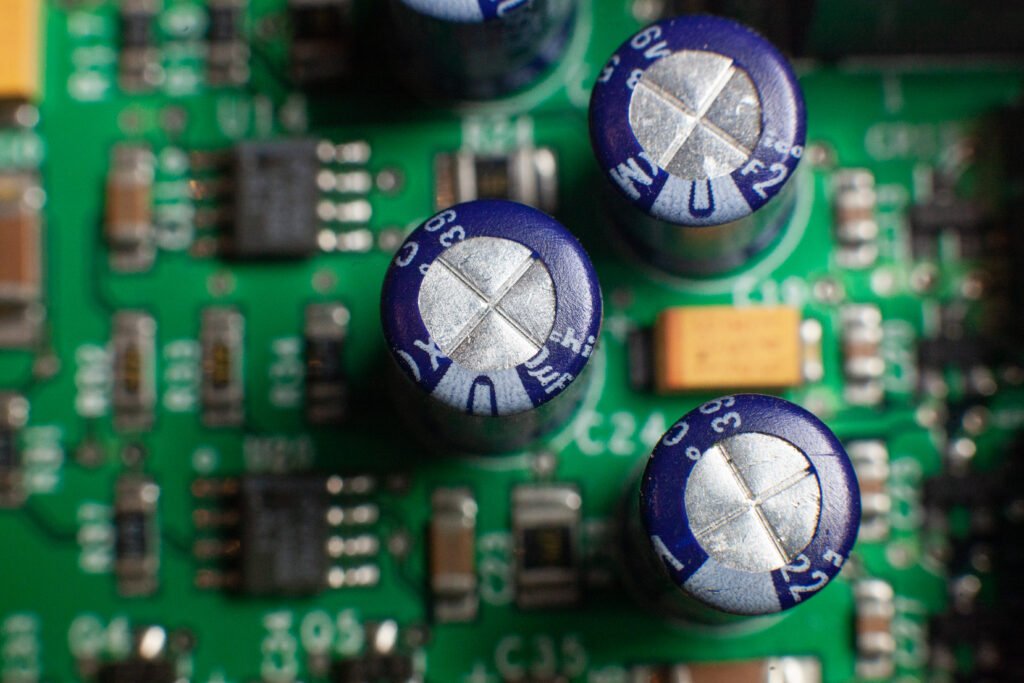
A capacitor is an electronic component that stores electrical energy in an electric field created between two conductive plates separated by an insulating material called a dielectric. Capacitors are among the most common components in electronic circuits, used to smooth out voltage fluctuations, store energy for quick release, filter unwanted signal frequencies, and time circuit behavior, appearing in everything from small phone chargers to modern car engines to massive power grid switching equipment.
How Capacitors Store Energy
When voltage is applied across a capacitor’s two plates, positive charge accumulates on one plate and negative charge on the other, creating an electric field across the dielectric material between them. This stored charge represents stored electrical energy that can be released quickly when needed, unlike a battery, which stores energy through slower chemical reactions. A capacitor’s capacitance, measured in farads, describes how much charge it can store for a given voltage, determined by the plate area, the distance between plates, and the properties of the dielectric material used.
Types of Capacitors
Ceramic, small and inexpensive, are widely used in everyday electronics for general-purpose filtering and timing applications. Electrolytic capacitors use a chemical electrolyte to achieve much higher capacitance in a relatively compact size, commonly used where larger energy storage is needed, such as in power supplies and audio amplifier circuits. Film capacitors use a thin plastic film as the dielectric and offer high stability, low loss, and long-term reliability, often chosen for precision timing and audio applications. Supercapacitors, a more recent development, store far more energy than traditional capacitors and are increasingly used in applications requiring rapid charge and discharge cycles.
Common Applications
Capacitors smooth out voltage ripples in power supplies, ensuring electronic devices receive steady, consistent voltage rather than fluctuating current straight from a rectified AC source. In combination with resistors and inductors, capacitors create timing circuits and filters that block or pass specific signal frequencies, essential in radio tuning circuits, audio equipment, power supply filters, and countless digital circuits. Capacitors also provide brief bursts of high power, such as in camera flashes, where they charge slowly from a battery but release all of their stored energy almost instantly to power a brief, bright flash of light.
Capacitors Versus Batteries
While both capacitors and batteries store electrical energy, they do so very differently and serve different roles. Batteries store far more energy for their size through chemical reactions but charge and discharge relatively slowly, while capacitors store less energy but can charge and discharge almost instantly and can be cycled far more times without degrading, since essentially no chemical wear occurs during ordinary charge and discharge operation. Many modern devices, including hybrid vehicles, use capacitors and batteries together, each handling the particular type of power delivery it is naturally best suited to provide.
Capacitors in Power Systems
Large capacitor banks are used throughout electrical power systems to improve power quality, correcting a problem called poor power factor that occurs when current and voltage fall out of alignment in circuits with heavy motor or inductive loads. By injecting capacitive reactance to counteract this effect, utilities and industrial facilities reduce wasted energy, improve voltage stability, and avoid penalties that many utilities charge large industrial and commercial customers for poor power factor performance.
History of the Capacitor
One of the earliest capacitors, the Leyden jar, was developed in the eighteenth century as scientists experimented with storing static electric charge, long before practical electrical circuits existed anywhere to make real use of the stored charge. As electronics developed through the twentieth century, capacitor design advanced dramatically in miniaturization and capacitance, becoming one of the small handful of fundamental components, alongside resistors and transistors, that underlie nearly all modern electronic circuits in use today.
Capacitors in Modern Energy Storage
Supercapacitors, also called ultracapacitors, bridge the gap between traditional capacitors and batteries, storing substantially more energy than conventional capacitors while still charging and discharging far faster than most batteries can manage. They are increasingly used in regenerative braking systems for vehicles, where they can absorb a sudden burst of energy during braking far more efficiently than a battery could accept it, and in grid applications that need to smooth out brief power fluctuations without the slower response time or cycle-life limitations that conventional batteries face under constant rapid charging and discharging cycles.
Failure Modes and Safety
Capacitors can fail through dielectric breakdown, where the insulating material between the plates degrades and allows current to leak or short-circuit between plates, often due to age, excessive voltage, or heat exposure over time. Electrolytic capacitors in particular can fail dramatically, sometimes venting gas or even rupturing if subjected to voltage reversal or severe overvoltage, which is why circuit designers include safeguards such as voltage derating, where a capacitor is used well below its maximum rated voltage, to extend reliable operating life and substantially reduce the risk of a sudden, catastrophic failure once the component is installed in a finished product.
FAQs
What is the difference between a capacitor and a battery?
Batteries store more energy through chemical reactions but charge and discharge slowly, while capacitors store less energy but can charge and discharge almost instantly and endure far more charge cycles without degrading.
What does a capacitor’s capacitance measure?
Capacitance, measured in farads, describes how much electric charge a capacitor can store for a given voltage, determined by its plate area, plate separation, and the dielectric material used between the plates.
Quick checkWhat is the difference between a capacitor and a battery?Show answer
Batteries store more energy through chemical reactions but charge and discharge slowly, while capacitors store less energy but charge and discharge almost instantly.
Editorially reviewed by Specialty Digest Editorial TeamLast reviewed November 2, 2026Researched and drafted with AI assistanceReport an issue