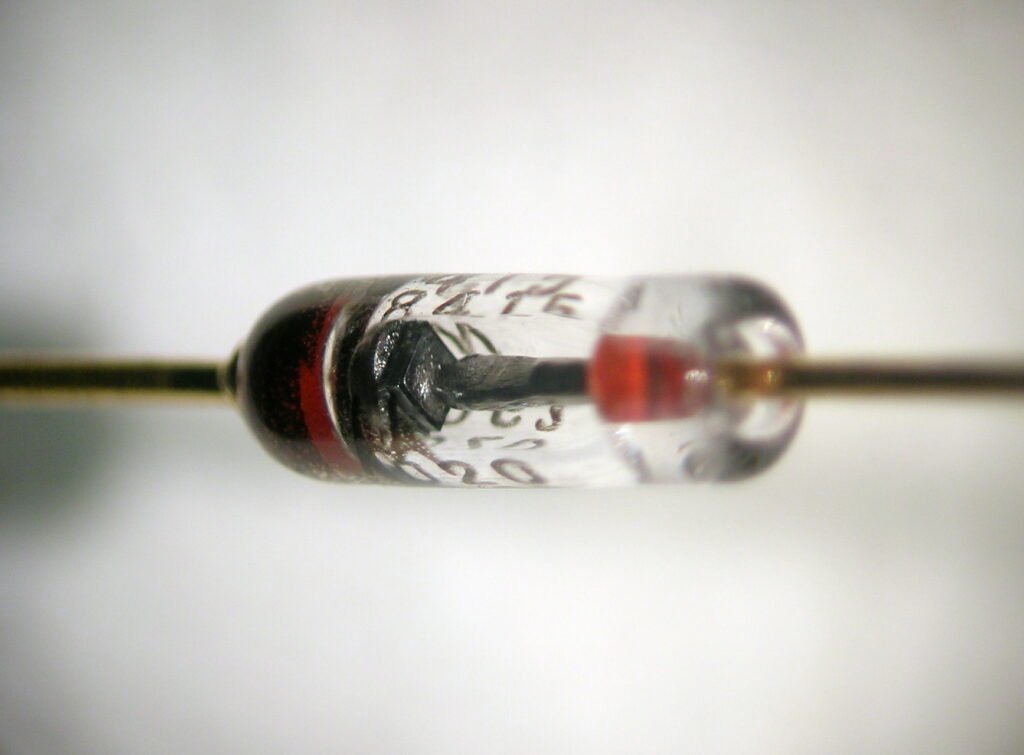
A diode is an electronic component that allows electric current to flow easily in one direction while blocking or strongly resisting flow in the opposite direction. This one-way behavior makes diodes essential for converting alternating current to direct current, protecting circuits from reversed voltage, and performing countless signal-processing tasks, making them one of the most fundamental building blocks in modern electronics alongside resistors, capacitors, and transistors.
How Diodes Control Current Flow
Most diodes are made from semiconductor material, typically silicon, engineered with two differently treated regions that meet at a junction. This junction allows current to flow readily when voltage is applied in the forward direction but creates a barrier that blocks current when voltage is applied in reverse, a property called rectification. A diode typically requires a small forward voltage, often around 0.7 volts for common silicon diodes, before it begins conducting significant current, after which current can increase rapidly with only small additional increases in voltage.
Rectification and Power Conversion
One of the most common uses for diodes is rectification, converting alternating current, which regularly reverses direction, into direct current, which flows in only one direction, a necessary step in nearly every electronic device that plugs into a wall outlet supplying AC power. Simple rectifier circuits use one or more diodes arranged to allow current through during both halves of the AC cycle, producing a pulsing direct current that capacitors then smooth into the steady voltage most electronic components require to operate reliably.
Specialized Diode Types
Light-emitting diodes, widely known as LEDs, emit light when current flows through them, now used extensively in lighting, displays, and indicator lights due to their efficiency and long operating life compared to older lighting technologies. Zener diodes are designed to allow controlled current flow in reverse once a specific voltage is reached, making them useful for voltage regulation. Photodiodes generate current when exposed to light, forming the basis of light sensors, solar cells, and optical communication receivers used throughout modern electronics and telecommunications.
Protective and Signal Applications
Diodes frequently protect circuits from damage by blocking current that flows in an unintended or reversed direction, such as preventing damage if a battery is inserted backward or absorbing voltage spikes generated when current through an inductive component, such as a motor or relay coil, is suddenly interrupted. In signal processing, diodes can detect or demodulate radio signals, clip voltage peaks to protect sensitive components, and perform basic logic functions in combination with other components.
Manufacturing and Material Choices
While silicon remains the dominant material for most diodes due to its low cost and well-understood manufacturing processes, other semiconductor materials offer specific advantages for particular applications. Gallium arsenide and related compounds allow diodes to operate efficiently at higher frequencies, useful in radio and microwave applications, while silicon carbide and gallium nitride diodes can handle higher voltages and temperatures, increasingly used in power electronics for electric vehicles and renewable energy systems where efficiency at high power matters greatly.
History of Diode Development
Early diodes took the form of vacuum tubes in the early twentieth century, bulky glass devices that controlled current flow using heated filaments inside a vacuum. The invention of the semiconductor diode in the mid-twentieth century, enabled by a deeper scientific understanding of semiconductor physics, made diodes dramatically smaller, more reliable, and cheaper to manufacture, paving the way for the broader transistor and integrated circuit revolution that followed in subsequent decades.
Diodes in Solar and Power Electronics
Solar cells are themselves a type of diode, engineered to convert light into electrical current rather than simply controlling current direction, and bypass diodes are often added within solar panels to prevent a single shaded or damaged cell from dragging down the output of an entire panel string. In power electronics, diodes serve critical roles in converters that transform electricity between different voltage levels and between AC and DC forms, applications that have grown enormously alongside the expansion of electric vehicles, renewable energy systems, and battery storage installations worldwide.
Testing and Common Failure Modes
Diodes can fail in two primary ways: an open failure, where the diode stops conducting current in either direction, effectively breaking the circuit, and a short failure, where the diode conducts current in both directions, failing to provide the one-way blocking behavior the circuit depends on. Technicians commonly test diodes using a multimeter’s diode-testing function, which applies a small voltage and measures whether current flows as expected in the forward direction while remaining blocked in reverse, a quick diagnostic step when troubleshooting a malfunctioning circuit board.
Diodes in Everyday Devices
Beyond their role inside power supplies and signal circuits, diodes appear constantly in devices people use every day without necessarily noticing them. Remote controls use infrared LEDs to transmit signals to televisions and other devices, status indicator lights on nearly every piece of modern electronics rely on simple LEDs, and surge protectors often include diodes designed specifically to absorb and redirect sudden voltage spikes before they can damage more sensitive and expensive components further along the circuit. This widespread, often invisible presence reflects just how fundamental the simple one-way current behavior of a diode has become to modern electronic design.
FAQs
What does rectification mean in the context of diodes?
Rectification is the process of converting alternating current, which regularly reverses direction, into direct current, which flows in only one direction, a task diodes perform by allowing current through in only one direction.
How does an LED differ from a standard diode?
An LED is a type of diode specifically engineered to emit visible light efficiently when current flows through it, while most standard diodes are designed purely to control current direction without producing useful light.
Quick checkWhat does rectification mean in the context of diodes?Show answer
Rectification converts alternating current, which reverses direction, into direct current, which flows one way, a task diodes perform by blocking reverse flow.
Editorially reviewed by Specialty Digest Editorial TeamLast reviewed November 2, 2026Researched and drafted with AI assistanceReport an issue