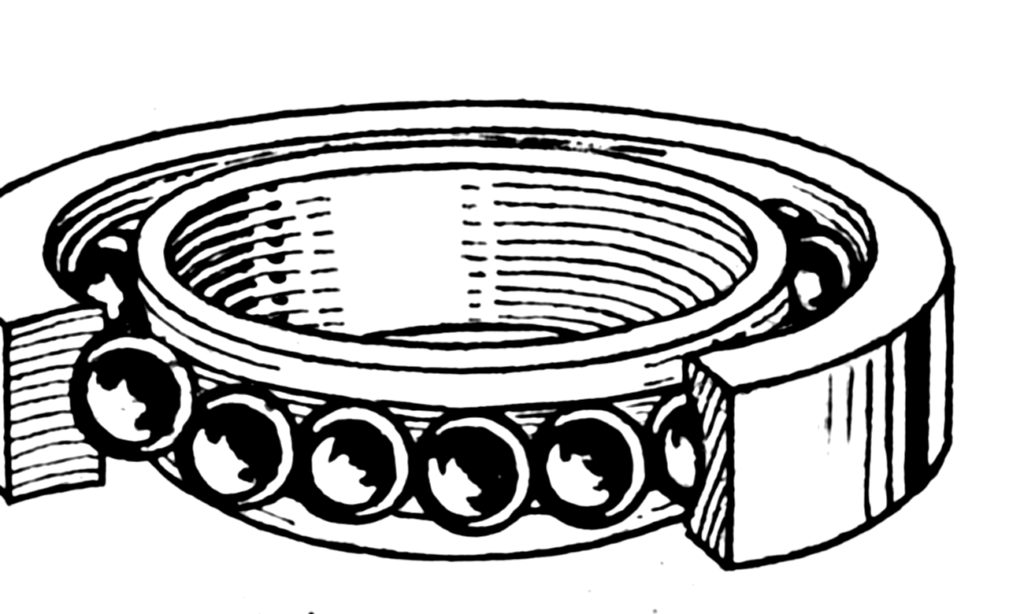
A bearing is a machine element that constrains relative motion between two parts to only the desired type of movement, typically rotation or straight-line sliding, while reducing the friction between them. Nearly every machine with moving parts relies on bearings somewhere, from the wheels of a car to the spinning platter inside a hard drive to the massive main shaft of a wind turbine, and their job is almost always the same: support a load while letting a part move smoothly and efficiently rather than grinding or seizing against whatever surrounds it.
Rolling-Element Bearings
Ball bearings and roller bearings, collectively called rolling-element bearings, place hardened steel balls or cylindrical rollers between an inner and outer ring, called races, so that the moving part rolls rather than slides against its support. Rolling friction is dramatically lower than sliding friction between the same two surfaces, which is why rolling-element bearings dominate applications like wheel hubs, electric motors, and gearboxes where minimizing energy loss and heat generation matters. Ball bearings handle combined radial and moderate thrust loads well and run at high speed with low friction, while roller bearings, which spread contact over a line rather than a point, handle heavier radial loads more effectively at the cost of being somewhat more sensitive to misalignment.
Plain and Fluid-Film Bearings
Plain bearings, also called sleeve or journal bearings, have no rolling elements at all; instead, a shaft slides directly against a bearing surface, often made from bronze, a polymer, or a steel-backed material with a low-friction liner. In many plain bearings, a thin film of lubricating oil is deliberately maintained between the two surfaces under pressure, so they never actually touch during normal operation, a design called hydrodynamic or fluid-film lubrication that can support enormous loads with very low wear, as used in large engine crankshafts and steam turbine shafts. Air bearings take this principle further, using a thin cushion of pressurized air instead of oil to support extremely precise, nearly friction-free motion in applications like semiconductor manufacturing equipment.
Thrust Versus Radial Loads
Engineers distinguish between radial loads, which push perpendicular to a shaft’s axis of rotation, and thrust loads, which push along that axis, because different bearing designs handle each far better than the other. Many machines, such as a car’s wheel hub, experience both kinds of load simultaneously, so bearings are often specifically engineered, or paired together in sets, to handle a defined combination of radial and thrust forces rather than relying on a single generic bearing to absorb everything.
Lubrication and Sealing
Because bearings concentrate load onto a small contact area, maintaining an adequate lubricant film is essential to preventing surface damage; grease is common in sealed bearings that cannot easily be relubricated, while circulating oil systems serve higher-speed or higher-load bearings in industrial machinery. Seals and shields around a bearing keep out dirt, moisture, and debris that would otherwise contaminate the lubricant and dramatically accelerate wear, which is why a failed bearing seal is a common early cause of eventual bearing failure even when the bearing itself was manufactured correctly.
Bearing Failure and Maintenance
Bearing failure rarely happens without warning signs, typically showing up first as increased vibration, noise, or a measurable rise in operating temperature well before complete failure occurs. Industries that cannot tolerate unplanned downtime, such as aviation and heavy manufacturing, routinely use vibration analysis and oil debris monitoring to catch developing bearing wear early, since replacing a bearing proactively during scheduled maintenance is far cheaper than dealing with the consequential damage of a bearing seizing or disintegrating in service.
Materials and Specialty Bearings
Most rolling-element bearing components are made from high-carbon chromium steel, hardened to resist the repeated contact stress of rolling under load without developing fatigue cracks over millions of rotation cycles. Where steel is unsuitable, such as in corrosive chemical environments, food processing equipment, or applications near strong magnetic fields, manufacturers turn to stainless steel, ceramic, or hybrid bearings that combine steel races with ceramic balls, which run cooler, resist wear longer, and tolerate less lubrication than an all-steel design, though at a significantly higher manufacturing cost.
Magnetic bearings represent a fundamentally different approach, suspending a rotating shaft in a magnetic field generated by electromagnets rather than supporting it with any physical contact at all, eliminating both friction and wear entirely during normal operation. These bearings require continuous electronic control to keep the shaft centered and stable, since a magnetic field alone is inherently unstable without active feedback adjusting the current many thousands of times per second, but the payoff is near-zero maintenance and extremely high rotational speeds, which is why magnetic bearings appear in applications like high-speed compressors and some advanced flywheel energy storage systems.
Bearing selection in practice involves balancing load capacity, speed rating, required precision, operating temperature, and cost, and engineers rely on standardized bearing catalogs and life calculations, most commonly based on a statistical measure called the L10 life, which estimates the number of rotations after which ten percent of a batch of identical bearings would be expected to show fatigue failure under a given load. This statistical approach reflects the reality that even well-made bearings have some natural variation in fatigue life, so engineers design in a safety margin rather than relying on a single fixed lifespan figure.
FAQs
Why do rolling-element bearings have lower friction than plain bearings?
Rolling friction between hardened balls or rollers and their races is inherently much lower than sliding friction between two surfaces, though fluid-film plain bearings can achieve very low friction too once a lubricant film fully separates the surfaces.
What’s the difference between a radial load and a thrust load on a bearing?
A radial load pushes perpendicular to the shaft’s rotation axis, while a thrust load pushes along that axis; many bearings are designed or paired specifically to handle one, the other, or a defined combination of both.
Quick checkWhy do rolling-element bearings generally have lower friction than plain bearings?Show answer
Rolling friction between hardened balls or rollers and their races is inherently much lower than sliding friction, though fluid-film plain bearings can also reach very low friction once a lubricant film fully separates the surfaces.
Editorially reviewed by Specialty Digest Editorial TeamLast reviewed November 2, 2026Researched and drafted with AI assistanceReport an issue