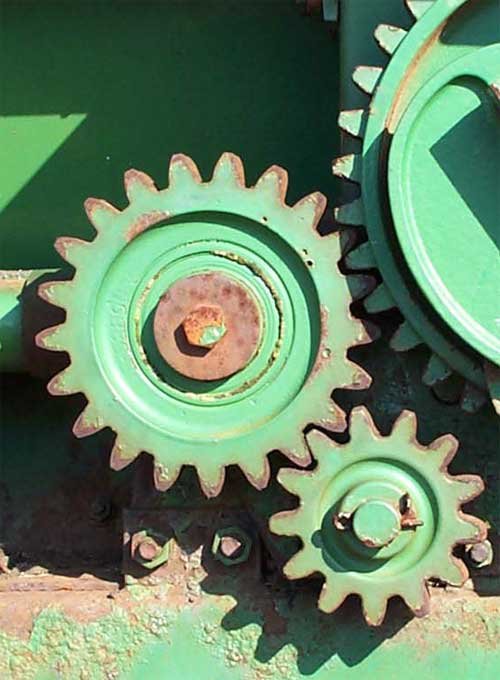
A gear is a rotating mechanical component with cut teeth that mesh with the teeth of another gear to transmit torque and rotational motion from one shaft to another, typically while changing speed, direction, or torque in a precisely predictable ratio. Gears are among the oldest mechanical devices still in continuous use, appearing in forms dating back more than two thousand years, and they remain fundamental to nearly every machine that needs to change rotational speed or torque, from wristwatches to wind turbine gearboxes to automobile transmissions.
How Gears Transmit Motion
When two gears mesh, their teeth interlock so that rotating one gear forces the other to rotate as well, with the ratio of their rotational speeds set by the ratio of their tooth counts. A small gear driving a larger gear will turn the larger gear more slowly but with proportionally more torque, since gears do not create energy but trade rotational speed for torque in almost exact inverse proportion, aside from small losses to friction. This simple relationship is why a bicycle’s smaller front gear combined with a larger rear gear makes pedaling easier but slower, while the reverse combination makes pedaling harder but covers more ground per pedal stroke.
Common Gear Types
Spur gears, the simplest and most common type, have straight teeth cut parallel to the shaft’s axis and are used to transmit motion between parallel shafts, though their straight-edged teeth engage somewhat abruptly and can be noisy at high speed. Helical gears cut their teeth at an angle, so engagement happens more gradually along a diagonal line rather than along the tooth’s full width at once, making them quieter and able to handle higher loads, at the cost of generating a sideways thrust force that the supporting shaft and bearings must be designed to absorb. Bevel gears have teeth cut on a cone-shaped surface and are used where two shafts meet at an angle, most commonly a right angle, such as in a vehicle’s differential. Worm gears pair a screw-like worm with a toothed wheel, allowing a very large speed reduction in a single stage and the useful property that the wheel generally cannot drive the worm backward, which is exploited in winches and lifting mechanisms that must hold a load without a separate brake.
Gear Trains and Gearboxes
A gear train is an assembly of multiple meshing gears used to achieve a speed or torque ratio too large for a single gear pair to provide efficiently, or to route power between shafts that are not adjacent to each other. Planetary gear systems, which arrange several small gears orbiting a central sun gear inside an outer ring gear, pack a large speed reduction and high torque capacity into a compact, coaxial space, which is why they are widely used in automatic transmissions, wind turbine gearboxes, and robotic joints where space is limited.
Manufacturing and Precision
Gear teeth are cut using specialized processes such as hobbing, where a rotating cutting tool shaped like a worm gradually carves teeth into a rotating blank, or by precision casting and forging for lower-cost applications where exact tooth geometry matters less. The precise shape of a gear tooth, almost always based on an involute curve, is chosen because it allows gears of different sizes to mesh smoothly together at a constant velocity ratio even as the exact point of contact between the teeth shifts throughout each rotation. Manufacturing tolerances matter enormously at high speed, since even small errors in tooth shape or spacing translate into noise, vibration, and accelerated wear.
Materials and Wear
Most load-bearing gears are made from hardened steel, often case-hardened so the tooth surface is extremely hard and wear-resistant while the gear’s core remains tougher and more resistant to cracking under shock loads. Plastic gears, made from materials like nylon or acetal, are common in lighter-duty applications such as small appliances and toys, where their lower cost, quieter operation, and ability to run without lubrication outweigh their lower strength and heat tolerance.
Lubrication and Gear Failure
Gear teeth experience repeated, cyclic contact stress every time they mesh, so lubrication is not simply about reducing friction but about maintaining a thin film of oil or grease between the tooth surfaces that prevents them from making direct metal-to-metal contact under load. Without adequate lubrication, gear teeth can suffer from pitting, where small fatigue cracks form just beneath the surface and eventually cause flakes of material to break away, or scuffing, where the protective oil film breaks down entirely and the surfaces weld and tear microscopically against each other. Gearboxes in demanding applications, such as wind turbine nacelles or industrial machinery, are often fitted with sensors that monitor oil condition, temperature, and vibration continuously, since early detection of a developing gear fault can prevent a far more expensive catastrophic failure later.
Gear noise is itself a diagnostic signal engineers pay close attention to, since a healthy gear train produces a relatively steady tone proportional to its rotational speed and tooth count, while developing problems such as a chipped tooth, misalignment, or bearing wear often introduce irregular noise or vibration at specific frequencies that trained technicians, and increasingly automated vibration-analysis software, can trace back to a likely cause before the gear fails outright. This predictive maintenance approach has become standard in industries like wind energy and aviation, where unplanned gearbox failure is extremely costly to access and repair.
Backlash, the small intentional gap left between meshing teeth, is another detail engineers must balance carefully: too little backlash causes teeth to bind and generate excess heat and wear, especially as temperature changes cause metal parts to expand, while too much backlash introduces unwanted play and imprecision, which matters enormously in applications like robotics and CNC machine tools where positioning accuracy is critical.
FAQs
Why does a smaller gear driving a larger one reduce speed but increase torque?
Gears conserve power aside from small friction losses, so if rotational speed drops going from a small driving gear to a larger driven gear, torque must rise by roughly the same proportion.
Why are gear teeth usually involute-shaped rather than simple triangles?
The involute profile lets gears of different sizes mesh smoothly at a constant velocity ratio throughout the rotation, even as the exact contact point between teeth shifts, which simple tooth shapes cannot guarantee.
Quick checkWhy does driving a larger gear with a smaller one reduce speed but increase torque?Show answer
Gears conserve power aside from small friction losses, so when rotational speed drops going from a small driving gear to a larger driven gear, torque rises by roughly the same proportion.
Editorially reviewed by Specialty Digest Editorial TeamLast reviewed November 2, 2026Researched and drafted with AI assistanceReport an issue