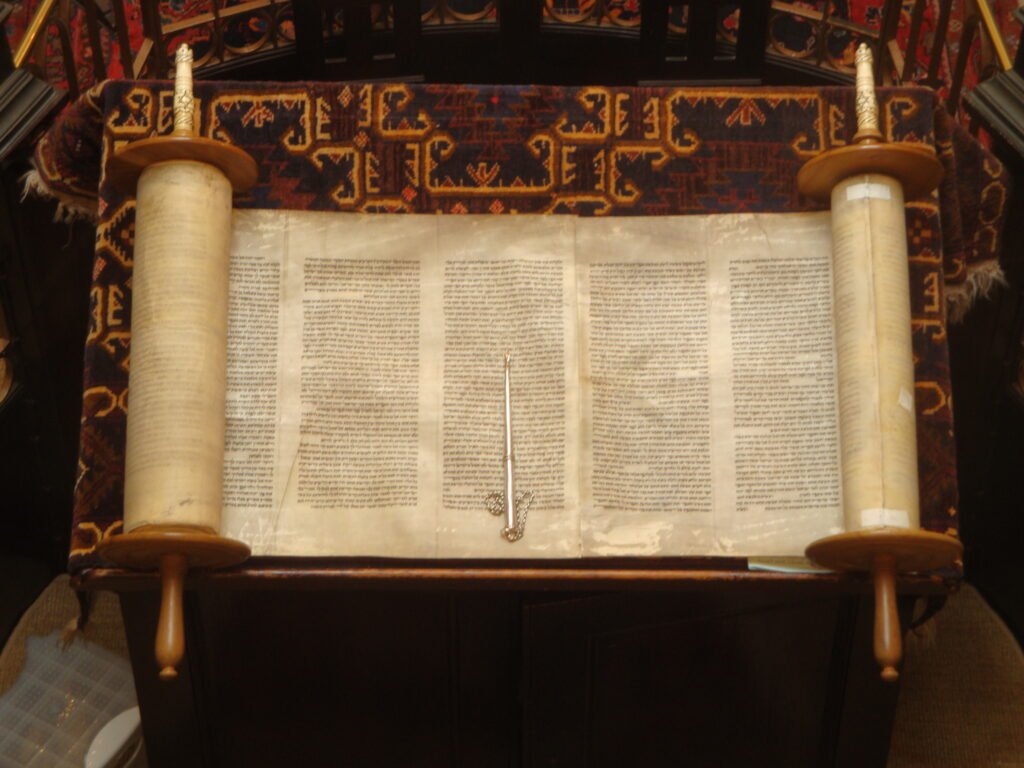
Judaism is the monotheistic religion and cultural tradition of the Jewish people, originating in the ancient Near East and generally regarded as the oldest of the three major Abrahamic faiths, which also include Christianity and Islam. Its central text, the Hebrew Bible, known in Jewish tradition as the Tanakh, describes a covenant between God and the Jewish people, traditionally traced through figures such as Abraham, Isaac, and Jacob, and through the giving of the Torah, the foundational body of law and teaching, to Moses at Mount Sinai after the Exodus from Egypt.
Judaism is distinctive among major world religions for functioning simultaneously as a religious tradition, an ethnic identity, and a cultural heritage, meaning that a person can identify as Jewish through ancestry and cultural belonging even without observing Jewish religious law or holding particular theological beliefs. Religious observance itself spans a wide spectrum, from highly traditional Orthodox practice that follows Jewish law, known as halakha, in close detail, to Reform and other liberal movements that reinterpret or selectively apply traditional practices in light of modern life.
Core Texts and Beliefs
Alongside the Tanakh, the Talmud, a vast compilation of rabbinic commentary, legal reasoning, and debate developed over centuries, occupies a central place in traditional Jewish religious life, serving as the primary basis for halakha. Central theological commitments across most forms of Judaism include strict monotheism, a belief in one God who is understood as the sole creator and sustainer of the universe, and a strong emphasis on ethical conduct, justice, and the fulfillment of mitzvot, or commandments, as a central way of living out one’s relationship with God, rather than salvation resting primarily on correct doctrinal belief alone.
Practice, Holidays, and Communal Life
Jewish religious life is organized significantly around the synagogue as a place of communal worship and study, and around a calendar of holidays that commemorate key historical and theological events, including Passover, which commemorates the Exodus from slavery in Egypt, Yom Kippur, a day of fasting and atonement, and Hanukkah, which commemorates the rededication of the Temple in Jerusalem. The Sabbath, observed from Friday evening to Saturday evening, is considered one of the most significant regular practices in traditional Jewish life, marked by rest from ordinary work and dedicated time set aside for prayer, study, and family.
History and the Jewish Diaspora
Jewish history includes periods of settlement in the ancient kingdoms of Israel and Judah, the destruction of the First and Second Temples in Jerusalem, and an extended diaspora, or dispersal, across the Mediterranean world, Europe, the Middle East, and eventually much of the globe, during which distinct regional Jewish communities and customs, such as Ashkenazi and Sephardi traditions, developed over many centuries. The twentieth century brought the Holocaust, the systematic genocide of roughly six million European Jews by Nazi Germany and its collaborators, and the establishment of the modern state of Israel in 1948, both of which remain deeply significant to contemporary Jewish identity, memory, and religious and political life around the world.
Branches and Movements Within Judaism
Modern Judaism encompasses several distinct movements that differ primarily in how closely they adhere to traditional religious law and how they approach its relationship to contemporary life. Orthodox Judaism maintains that halakha is binding and largely unchanging, and observant Orthodox Jews structure daily life, diet, and worship closely around its requirements. Conservative Judaism occupies a middle position, treating Jewish law as authoritative while allowing for gradual adaptation in response to modern circumstances, and Reform Judaism, which emerged in nineteenth-century Germany, generally treats Jewish law as a valuable ethical and spiritual guide rather than a binding legal code, emphasizing individual autonomy in religious practice. Reconstructionist Judaism and various other smaller movements add further diversity to this landscape, and a significant proportion of people who identify as Jewish do not affiliate with any particular religious movement at all, instead expressing their identity primarily through culture, community, and shared history.
Jewish Philosophy and Mysticism
Beyond law and practice, Judaism has produced a substantial tradition of philosophical and mystical reflection. Medieval Jewish philosophers such as Maimonides worked to reconcile Jewish theology with Aristotelian philosophy, producing influential, systematic accounts of Jewish belief and law that remain closely studied by scholars today. Kabbalah, a body of Jewish mystical teaching that developed especially from the medieval period onward, explores the hidden, esoteric dimensions of the relationship between God and creation through symbolic and metaphysical frameworks such as the sefirot, a structured system representing different aspects of divine emanation, and has influenced both mainstream Jewish thought and broader currents of Western esotericism over the centuries that followed.
FAQs
What is the Torah?
The foundational body of law and teaching in Judaism, traditionally understood as given to Moses at Mount Sinai, and the first five books of the Hebrew Bible.
How can Judaism be both a religion and an ethnicity?
A person can identify as Jewish through ancestry and cultural belonging even without observing Jewish religious law, since Judaism functions simultaneously as a religious tradition, an ethnic identity, and a cultural heritage.
What is the Talmud?
A vast compilation of rabbinic commentary, legal reasoning, and debate developed over centuries, serving as the primary basis for traditional Jewish religious law, or halakha.
What is the Jewish diaspora?
The historical dispersal of Jewish communities across the Mediterranean world, Europe, the Middle East, and eventually much of the globe, following events including the destruction of the Temples in Jerusalem.
Key facts
- Generally regarded as the oldest of the three major Abrahamic faiths.
- Central texts include the Tanakh (Hebrew Bible) and the Talmud.
- Functions as a religion, an ethnicity, and a cultural heritage at once.
- Major modern movements include Orthodox, Conservative, and Reform Judaism.
Quick checkIn what sense is Judaism both a religion and an ethnicity?Show answer
A person can identify as Jewish through ancestry and cultural belonging even without observing Jewish religious law, since Judaism functions simultaneously as a religious tradition, an ethnic identity, and a cultural heritage.
Sources
- Encyclopaedia Britannica, 'Judaism'
- My Jewish Learning, overview of Jewish practice and movements
- United States Holocaust Memorial Museum, historical context
Editorially reviewed by Specialty Digest Editorial TeamLast reviewed November 2, 2026Researched and drafted with AI assistanceReport an issue