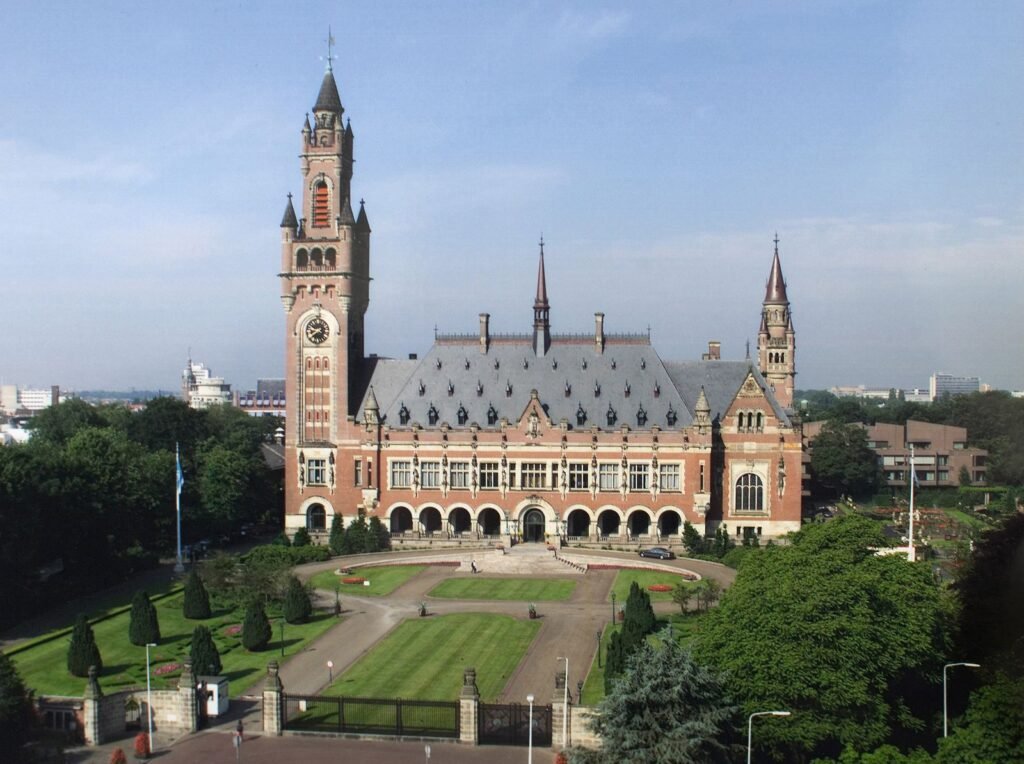
International law is the body of rules, customs, and principles that states and other international actors generally accept as binding in their relations with one another. It covers an enormous range of subjects, from the conduct of war and the treatment of diplomats to international trade, environmental protection, and human rights. The 19th-century jurist Lassa Oppenheim offered a definition still widely cited today, describing international law as a law between sovereign and equal states founded on their common consent, a framing that captures both the field’s foundation in state agreement and its lack of any single global authority standing above the states it governs.
Sources of international law
The Statute of the International Court of Justice lists the main sources judges should apply, in roughly descending order of directness. Treaties are formal written agreements between states, binding under the principle that agreements must be kept in good faith, and interpreted according to rules set out in the Vienna Convention on the Law of Treaties. Customary international law arises when states consistently follow a particular practice out of a sense of legal obligation rather than mere habit or convenience, and such custom generally binds every state except one that has persistently and openly objected to the practice from the start. General principles of law, drawn from common elements of national legal systems, help fill gaps left by treaties and custom, while judicial decisions and the writings of respected scholars serve as subsidiary tools for determining what the law actually requires in a given case.
Historical development
Early interstate agreements, including peace treaties among Mesopotamian city-states and the roughly 1279 BC pact between Egypt and the Hittite Empire, show that rules governing relations between political communities are nearly as old as those communities themselves. Ancient Rome developed the concept of jus gentium, a body of law governing relations between Romans and foreigners, while medieval Christian and Islamic scholars both developed just-war doctrines constraining when and how war could legitimately be fought. The Dutch jurist Hugo Grotius, often called the father of modern international law, published his influential 1625 work De Jure Belli ac Pacis, envisioning a society of states that could be governed by shared legal principles rather than by force alone, a vision that helped secularize the field away from its earlier grounding mainly in religious doctrine and Christian just-war theory specifically. The 1648 Peace of Westphalia is conventionally regarded as the event that cemented sovereign equality and non-interference as organizing principles of the state system, though historians continue to debate how much the treaties themselves actually established these principles.
The United Nations era
The 1945 United Nations Charter marked the most significant modern milestone in international law, replacing the failed League of Nations with an organization built around collective security and a general prohibition on the use of force between states. The Charter created the International Court of Justice to resolve legal disputes between states and the Security Council to respond to threats to international peace, while generally banning the use of force except in cases of Security Council authorization, individual or collective self-defense, or action under a recognized regional security arrangement. Subsequent decades saw a rapid expansion of international law into new areas, including international human rights law, international humanitarian law governing the conduct of armed conflict, and international environmental law addressing problems that cross national borders by their very nature.
How international law is enforced
Unlike domestic law, international law has no single overarching authority with the power to compel compliance, so enforcement depends heavily on the consent and cooperation of the states involved. Violations can draw diplomatic condemnation, economic sanctions, or in serious cases, the authorized use of force under Chapter VII of the UN Charter, though this route requires both a majority of the Security Council and the agreement, or at least the abstention, of each of its five permanent members. The International Court of Justice adjudicates disputes between consenting states and issues advisory opinions that, while not binding, carry significant legal and diplomatic weight, and regional human rights courts, such as the European Court of Human Rights, allow individuals to bring claims directly against their own governments. Universal jurisdiction allows some states to prosecute especially serious crimes, such as genocide, regardless of where the crime occurred or the nationality of those involved, while most treaty regimes, particularly environmental ones, rely mainly on monitoring, reporting, and diplomatic pressure rather than direct penalties.
FAQs
What are the main sources of international law?
Treaties, customary international law built on consistent state practice, and general principles of law, supplemented by judicial decisions and scholarly writings as subsidiary aids.
Who is considered the father of modern international law?
The Dutch jurist Hugo Grotius, whose 1625 work De Jure Belli ac Pacis envisioned a society of states governed by shared legal principles rather than force alone.
How is international law enforced without a global government?
Mainly through consent, diplomatic pressure, sanctions, Security Council action under the UN Charter, and courts such as the International Court of Justice and regional human rights tribunals.
What is universal jurisdiction?
A legal principle allowing some states to prosecute especially serious crimes, such as genocide, regardless of where the crime occurred or the nationality of those involved.
Is international law legally binding even without a world government?
Yes, in the sense that states generally treat it as creating real legal obligations, but it depends far more on voluntary compliance, reputation, and diplomatic pressure than domestic law does.
Key facts
- Lassa Oppenheim's definition describes it as law between sovereign and equal states based on common consent
- Main sources are treaties, customary international law, and general principles of law
- Hugo Grotius's 1625 De Jure Belli ac Pacis is considered foundational to the modern field
- 1945 UN Charter created the ICJ and Security Council and generally banned the use of force
Quick checkWho is considered the father of modern international law?Show answer
The Dutch jurist Hugo Grotius, whose 1625 work envisioned a society of states governed by shared legal principles.
Sources
- Wikipedia: International Law
Editorially reviewed by Specialty Digest Editorial TeamLast reviewed November 2, 2026Researched and drafted with AI assistanceReport an issue