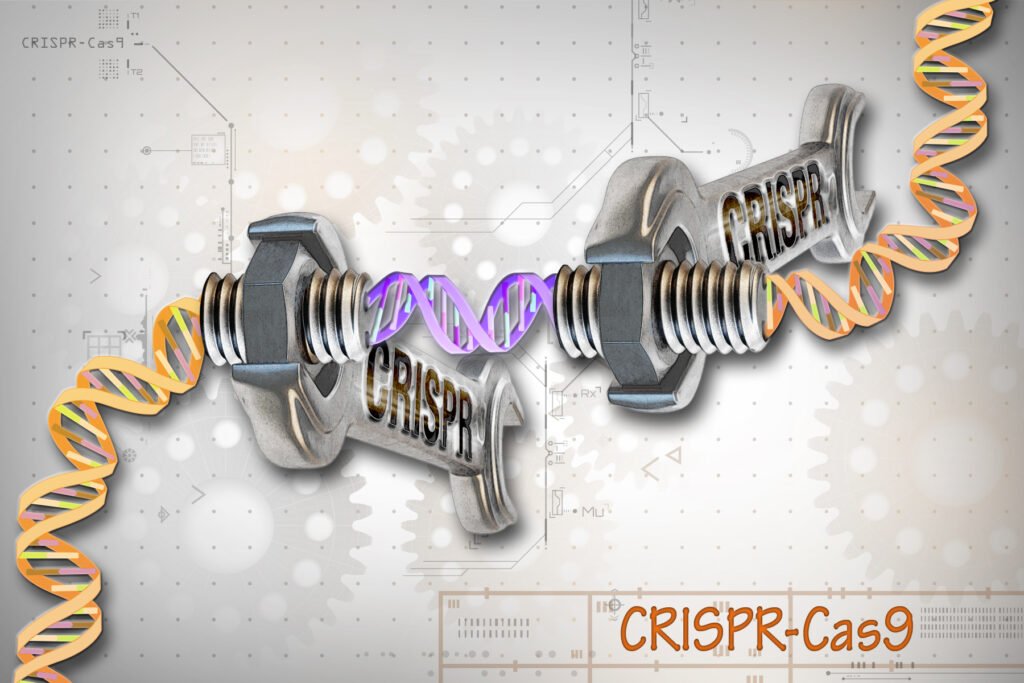
CRISPR is a gene-editing technology that allows scientists to make precise, targeted changes to DNA by exploiting a natural defense system originally found in bacteria. The full name, clustered regularly interspaced short palindromic repeats, describes a distinctive pattern of repeated DNA sequences that bacteria use to store a genetic memory of viruses that previously infected them, which they later use alongside an associated enzyme to recognize and destroy matching viral DNA on future encounters. Scientists adapted this bacterial immune system into a programmable tool, commonly called CRISPR-Cas9 after its most widely used enzyme component, that can cut DNA at a specific, chosen location in virtually any organism genome, making gene editing dramatically faster, cheaper, and more precise than the methods that preceded it. Earlier gene-editing approaches, such as zinc finger nucleases, required engineering a custom protein for every new target, a slow and expensive process that CRISPR replaced with the comparatively simple task of designing a short piece of guide RNA.
How CRISPR works
The CRISPR system used in the laboratory relies on two main components: a guide RNA molecule, designed by researchers to match a specific target sequence in an organism DNA, and the Cas9 enzyme, which acts as molecular scissors. The guide RNA leads Cas9 to the exact location in the genome specified by its sequence, where Cas9 then cuts both strands of the DNA double helix. Once the DNA is cut, the cell own natural repair machinery takes over, and scientists can exploit this repair process either to disable a gene by introducing small errors as it closes the cut, or to insert an entirely new DNA sequence at the cut site by supplying a template for the repair machinery to copy. This combination of precise targeting and the cell own repair systems is what allows CRISPR to edit genes with a level of accuracy that older gene-editing techniques could not approach, and because the guide RNA can be redesigned in days rather than months, researchers can test many different genetic targets in rapid succession.
Discovery and development
The repeated DNA sequences that give CRISPR its name were first noticed in bacteria in the late 1980s, though their function as part of an immune system remained unexplained for roughly two decades afterward. Researchers including Francisco Mojica helped establish that these sequences formed part of a bacterial defense mechanism against viruses, and in 2012, biochemists Jennifer Doudna and Emmanuelle Charpentier demonstrated that the CRISPR-Cas9 system could be reprogrammed as a general-purpose gene-editing tool usable in essentially any organism, work that earned them the Nobel Prize in Chemistry in 2020. Their discovery triggered an explosion of CRISPR-based research across biology and medicine, since the technique proved dramatically simpler, faster, and less expensive than the gene-editing tools scientists had relied on previously. Within just a few years, laboratories worldwide were using CRISPR to study gene function, model human diseases in animals, and develop entirely new therapeutic approaches that would previously have taken far longer to reach the testing stage.
Medical and agricultural applications
In 2023, regulators in the United States and United Kingdom approved Casgevy, a CRISPR-based therapy for sickle cell disease and beta thalassemia, marking the first approved treatment built on the technology, and by 2026 that therapy had been approved and made available in a growing number of countries worldwide. Researchers are actively pursuing CRISPR-based treatments for a range of other inherited diseases, certain cancers, and some viral infections, generally by editing a patient own cells outside the body before returning them, though editing cells directly inside a living patient remains technically more difficult and is still largely experimental. In agriculture, CRISPR is used to develop crop varieties with improved disease resistance, drought tolerance, or nutritional content, generally by editing a plant own existing genes rather than introducing genetic material from an unrelated species, which has led some regulators to treat CRISPR-edited crops differently from older genetically modified organisms.
Ethical questions and limitations
CRISPR raises significant ethical questions, particularly around germline editing, which changes the DNA of eggs, sperm, or early embryos in ways that would be passed on to future generations rather than affecting only the treated patient. In 2018, a Chinese scientist announced he had used CRISPR to edit the genomes of human embryos that were later born as twins, an act that was widely condemned by the international scientific community as premature and unethical, and that resulted in his prosecution and imprisonment in China. CRISPR editing is also not perfectly precise, occasionally producing unintended changes at locations in the genome other than the intended target, called off-target effects, which remains an active area of safety research as the technology moves toward wider clinical use. Researchers continue developing refined versions of the technology, including base editing and prime editing, which make smaller, more targeted changes to DNA without cutting both strands, in an effort to reduce these unintended effects further.
FAQs
What does CRISPR stand for?
CRISPR stands for clustered regularly interspaced short palindromic repeats, a pattern of repeated DNA sequences originally discovered in bacteria as part of a natural antiviral defense system.
Who discovered CRISPR gene editing?
Jennifer Doudna and Emmanuelle Charpentier demonstrated in 2012 that the bacterial CRISPR-Cas9 system could be reprogrammed as a general-purpose gene-editing tool, work that earned them the 2020 Nobel Prize in Chemistry.
Has a CRISPR treatment been approved for patients?
Yes; Casgevy, a CRISPR-based therapy for sickle cell disease and beta thalassemia, was approved by regulators in the United States and United Kingdom in 2023 and has since been approved in additional countries.
Why is CRISPR germline editing controversial?
Because changes made to eggs, sperm, or early embryos would be passed on to future generations, raising ethical concerns that go well beyond the individual patient being treated.
Key facts
- Full name: clustered regularly interspaced short palindromic repeats
- Adapted from a natural bacterial defense system against viruses
- Uses a guide RNA and the Cas9 enzyme to cut DNA at a specific location
- Jennifer Doudna and Emmanuelle Charpentier won the 2020 Nobel Prize in Chemistry for reprogramming it
- Casgevy (2023) was the first approved CRISPR-based therapy, treating sickle cell disease
Quick checkWhat does CRISPR stand for?Show answer
Clustered regularly interspaced short palindromic repeats, a pattern of DNA sequences first found in bacteria as part of an antiviral immune system.
Sources
- Doudna & Charpentier, Nobel Prize in Chemistry 2020; National Human Genome Research Institute, CRISPR
Editorially reviewed by Specialty Digest Editorial TeamLast reviewed November 2, 2026Researched and drafted with AI assistanceReport an issue