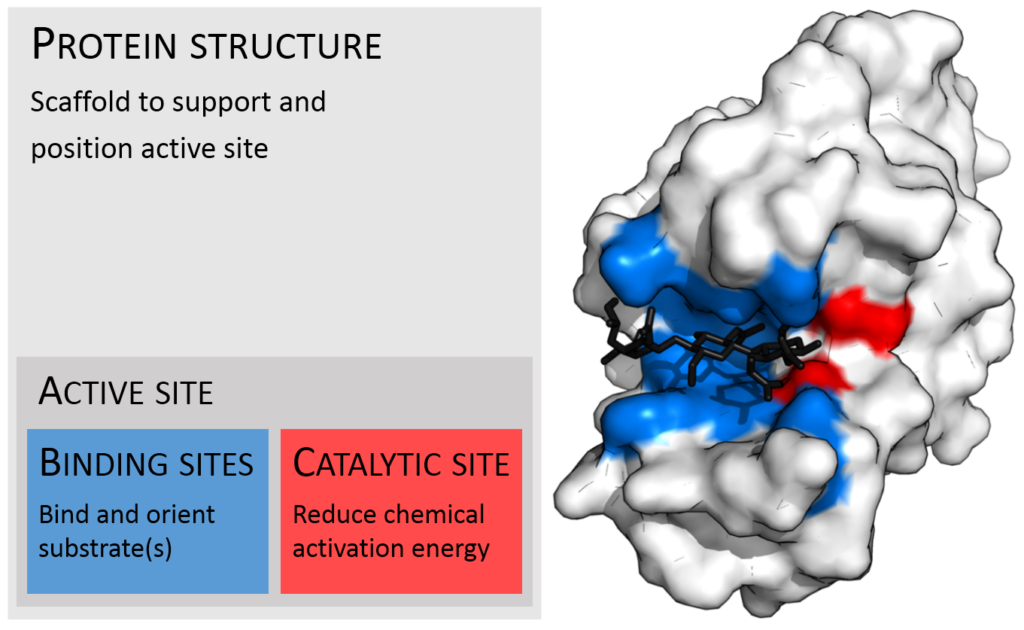
An enzyme is a biological molecule, almost always a protein, that speeds up a specific chemical reaction inside a living organism without itself being permanently changed or consumed in the process. Enzymes act as biological catalysts, often accelerating reactions that would otherwise occur far too slowly to sustain life, sometimes by factors of a million or more, and nearly every chemical process that keeps a cell alive, from digesting food to copying DNA, depends on a specific enzyme suited to that task. The study of enzymes, a field within biochemistry, has produced not only a detailed understanding of metabolism but also enormous practical applications in medicine, agriculture, and industry. Enzymes are typically named after the substrate they act on or the reaction they catalyze, usually ending in the suffix -ase, which is why names such as lactase, protease, and amylase immediately signal what each one does.
How enzymes work
Every enzyme has a specific three-dimensional shape, and a region of that shape called the active site binds to a particular target molecule, known as the substrate, with a fit often compared to a lock and key, though scientists now understand the fit is more flexible than that older analogy suggests. Binding at the active site lowers the amount of energy needed to start the reaction, called the activation energy, which is the fundamental reason enzymes speed reactions up so dramatically. After the reaction is complete, the enzyme releases its product unchanged and is immediately free to bind another substrate molecule, allowing a single enzyme to catalyze the same reaction many times over in rapid succession, with some of the fastest enzymes known capable of processing many thousands of substrate molecules every second. Because an enzyme shape determines which substrate it can bind, most enzymes are highly specific, typically acting on only one substrate or a small group of closely related ones.
Factors that affect enzyme activity
Enzyme activity depends heavily on temperature, since reactions generally speed up as temperature rises within a certain range, but excessive heat can permanently distort an enzyme shape, a process called denaturation, that destroys its ability to function. Enzyme activity is similarly sensitive to pH, with most enzymes in the human body working best within a narrow range near neutral, though some, such as the digestive enzyme pepsin, are adapted to function in the highly acidic environment of the stomach. Many enzymes also require small helper molecules called cofactors, which can be metal ions or organic molecules derived from vitamins, in order to function properly, which is one reason vitamin deficiencies can disrupt metabolism so broadly. Cells further regulate enzyme activity through inhibitors, substances that reduce or block an enzyme function, a mechanism the body uses constantly to fine-tune metabolic pathways according to its current needs. Some inhibitors occur naturally as part of normal regulation, while others are foreign substances, including many medicines and some poisons, that work precisely because they block an essential enzyme a cell or pathogen depends on.
Enzymes in digestion and metabolism
Digestive enzymes, including amylase, which breaks down starch into sugars, and lipase, which breaks down fats, are secreted into the digestive tract to break large food molecules into smaller units the body can absorb and use. Inside cells, enzymes drive the step-by-step chemical pathways of metabolism, including the series of reactions that extract usable energy from glucose during cellular respiration. Enzymes called DNA polymerases copy genetic material with remarkable accuracy whenever a cell divides, while separate repair enzymes continuously scan DNA for damage and fix errors before they can accumulate into harmful mutations. The thousands of distinct enzymes operating inside a single cell at any given moment, each dedicated to a specific chemical step, collectively allow the complex, coordinated chemistry of life to proceed in an orderly sequence rather than as chaotic, uncontrolled reactions.
Practical and medical applications
Enzyme deficiencies or malfunctions underlie numerous inherited metabolic disorders, including phenylketonuria, in which the body lacks a functional enzyme needed to break down a particular amino acid, requiring lifelong dietary management to prevent harm. Many modern drugs work by inhibiting a specific enzyme, including statins, which lower cholesterol by blocking an enzyme the liver uses to produce it, and protease inhibitors used in treating certain viral infections. Enzymes extracted from bacteria and fungi are used industrially in laundry detergents to break down protein and fat stains, in food production to curdle milk for cheesemaking, and in biofuel production to break plant material down into fermentable sugars. Diagnostic medicine also measures enzyme levels in blood tests, since elevated levels of certain enzymes released from damaged tissue, such as those seen after a heart attack or liver injury, can help doctors confirm and track a diagnosis.
FAQs
What is the main function of an enzyme?
An enzyme speeds up a specific chemical reaction by lowering the activation energy required to start it, without being permanently changed or consumed itself.
Why are most enzymes proteins?
Proteins can fold into highly specific three-dimensional shapes, including a precisely shaped active site, which allows them to bind selectively to a particular substrate molecule and catalyze its reaction.
What happens to an enzyme at high temperatures?
Excessive heat can permanently distort an enzyme shape in a process called denaturation, which destroys the active site and eliminates the enzyme ability to function.
How are enzymes used in industry?
Enzymes extracted from bacteria and fungi are used in laundry detergents, cheesemaking, and biofuel production, among many other industrial processes that benefit from a fast, specific biological catalyst.
Key facts
- Almost always a protein; speeds up reactions by lowering activation energy
- Binds a specific substrate at a region called the active site
- Activity depends on temperature and pH; excess heat causes denaturation
- Many require cofactors, often derived from vitamins, to function
- Used industrially in detergents, cheesemaking, and biofuel production
In the news
Quick checkWhat does an enzyme do?Show answer
An enzyme speeds up a specific chemical reaction by lowering its activation energy, without being permanently changed or consumed in the process.
Sources
- National Human Genome Research Institute, Enzyme; Britannica, Enzyme
Editorially reviewed by Specialty Digest Editorial TeamLast reviewed November 2, 2026Researched and drafted with AI assistanceReport an issue