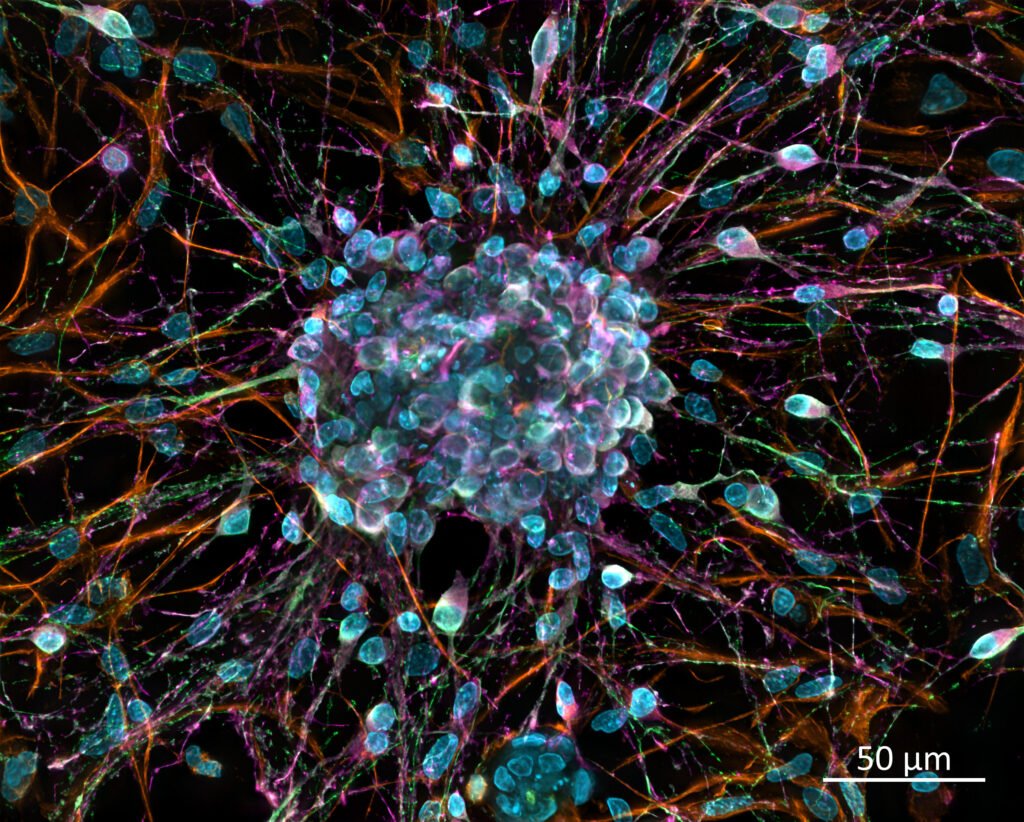
A neuron, also called a nerve cell, is a specialized cell that transmits information through the nervous system using electrical and chemical signals. Neurons are the basic functional unit of the brain, spinal cord, and peripheral nerves, and the human brain alone contains an estimated 86 billion of them, each one capable of forming thousands of connections with other neurons, producing a network of staggering complexity that underlies every thought, sensation, movement, and memory a person experiences. Unlike most other cells in the body, mature neurons generally do not divide, which is why damage to the nervous system often heals far more slowly and incompletely than damage to tissues such as skin or liver, both of which routinely replace damaged cells through ordinary cell division throughout a person life.
Structure of a neuron
A typical neuron consists of three main parts: the cell body, or soma, which contains the nucleus and most of the cell metabolic machinery; dendrites, branching extensions that receive incoming signals from other neurons; and the axon, a single long fiber that carries outgoing signals away from the cell body toward other neurons, muscles, or glands. Many axons are wrapped in a fatty insulating substance called myelin, produced by specialized support cells, which dramatically speeds up signal transmission along the axon, and damage to myelin is responsible for debilitating diseases such as multiple sclerosis, in which the immune system mistakenly attacks and strips away this insulating layer, disrupting the smooth flow of signals through the nervous system. At its far end, the axon branches into terminals that form junctions called synapses with the dendrites or cell bodies of other neurons, the specific points where information actually passes from one neuron to the next.
How neurons transmit signals
A neuron at rest maintains an electrical difference across its outer membrane, and when a neuron receives enough stimulation, this difference briefly and dramatically reverses in a rapid electrochemical event called an action potential, which then travels rapidly down the length of the axon like a wave. This process depends on specialized channels in the neuron membrane that open and close to let charged particles called ions, chiefly sodium and potassium, flow in and out in a precisely timed sequence. An action potential operates on an all-or-nothing principle, meaning a neuron either fires at full strength once a threshold of stimulation is reached or does not fire at all, with the intensity of a sensation or signal instead encoded by how rapidly a neuron fires repeated action potentials rather than by the size of any single one, much as a brighter light or a louder sound is represented by a faster rate of firing rather than a larger individual signal.
Types of neurons
Neurons are often classified by their function. Sensory neurons carry information from sensory receptors in the skin, eyes, ears, and other organs toward the brain and spinal cord, allowing the nervous system to register touch, light, sound, and other stimuli from the environment. Motor neurons carry signals from the brain and spinal cord outward to muscles and glands, triggering movement and other physical responses. Interneurons, by far the most numerous type in the human nervous system, connect other neurons to one another entirely within the brain and spinal cord, forming the complex circuits responsible for processing information, learning, and decision-making rather than directly sensing the environment or controlling movement, and they vastly outnumber sensory and motor neurons combined in the human nervous system.
Neurons, disease, and the limits of regeneration
Because mature neurons in most parts of the adult brain and spinal cord generally do not divide to replace themselves, injuries such as spinal cord damage or stroke often cause permanent loss of function in the affected area, though the nervous system can sometimes partially compensate over time by rerouting signals through alternative, undamaged pathways, a form of adaptation distinct from true cellular regrowth. Neurodegenerative diseases, including Alzheimer disease and Parkinson disease, involve the progressive loss of specific populations of neurons over time, gradually impairing memory, movement, or other functions depending on which brain regions are most affected. Research has shown that a small number of brain regions, notably one area involved in memory formation, continue generating a limited number of new neurons throughout adult life, a discovery that has encouraged research into therapies that might someday coax the nervous system into repairing itself more broadly, though translating this limited natural capacity into a reliable medical treatment remains a significant unsolved challenge.
FAQs
How many neurons are in the human brain?
The human brain contains an estimated 86 billion neurons, each capable of forming thousands of connections with other neurons.
What are the three main parts of a neuron?
The cell body, which contains the nucleus; dendrites, which receive incoming signals; and the axon, a long fiber that carries outgoing signals to other neurons, muscles, or glands.
What is an action potential?
A rapid, all-or-nothing electrochemical signal that travels down a neuron axon once the neuron receives enough stimulation to cross a firing threshold.
Can damaged neurons regenerate?
Generally not; mature neurons in most of the adult brain and spinal cord do not divide to replace themselves, though a small number of brain regions continue generating limited new neurons throughout life.
What is myelin and why does it matter?
Myelin is a fatty insulating substance wrapped around many axons that dramatically speeds up signal transmission, and its loss is responsible for diseases such as multiple sclerosis.
Key facts
- The basic functional unit of the brain, spinal cord, and peripheral nerves
- The human brain contains an estimated 86 billion neurons
- Structure: cell body (soma), dendrites, and a single long axon
- Signals travel as electrochemical action potentials following an all-or-nothing principle
- Mature neurons generally do not divide, limiting regeneration after injury
In the news
Quick checkWhat is the function of a neuron?Show answer
A neuron transmits information through the nervous system using electrical and chemical signals, forming the basic functional unit of the brain and nerves.
Sources
- National Institute of Neurological Disorders and Stroke, Neuron; Britannica, Neuron
Editorially reviewed by Specialty Digest Editorial TeamLast reviewed November 2, 2026Researched and drafted with AI assistanceReport an issue