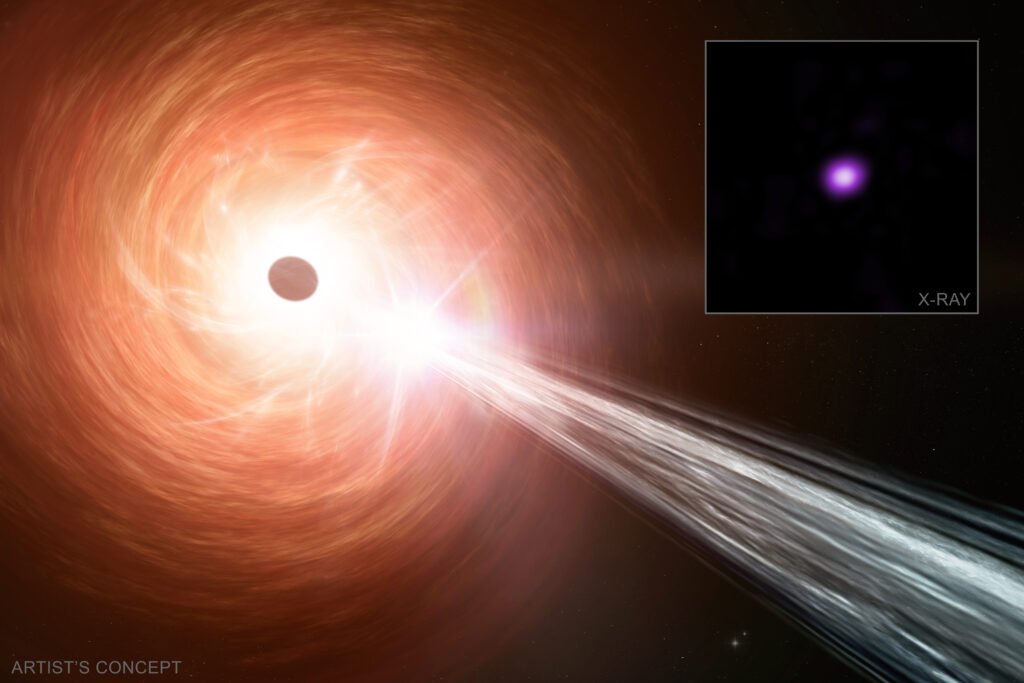
A black hole is a region of space where gravity is so intense that nothing, not even light, can escape once it crosses a boundary called the event horizon. Black holes form when a sufficiently massive amount of matter is compressed into a small enough volume, most commonly when a massive star exhausts its nuclear fuel and collapses under its own gravity at the end of its life. Although black holes cannot be observed directly since they emit no light of their own, astronomers detect them through their powerful gravitational effects on nearby stars and gas, and in 2019 the Event Horizon Telescope collaboration released the first-ever direct image of a black hole, capturing the glowing ring of material surrounding the supermassive black hole at the center of the galaxy M87, a landmark result that provided striking visual confirmation of predictions scientists had made for decades using mathematics alone.
How black holes form
Stellar black holes form when a star considerably more massive than the Sun exhausts the nuclear fuel that had been generating enough outward pressure to counteract its own gravity, causing the star core to collapse catastrophically, often in a supernova explosion that blows away the star outer layers. If the collapsing core is massive enough, no known force can halt the collapse, and the matter continues compressing into an infinitesimally small point of enormous density called a singularity, surrounded by the event horizon that marks the boundary beyond which escape becomes impossible. Supermassive black holes, millions or even billions of times the mass of the Sun, are believed to reside at the center of most large galaxies, including the Milky Way, though exactly how they grow to such enormous sizes, and whether they formed early or grew gradually over cosmic history, remains an active area of research.
The event horizon and general relativity
The event horizon is not a physical surface but rather a boundary in space defined by the point where a black hole gravitational pull becomes strong enough that the escape velocity needed to break free exceeds the speed of light, the fastest speed anything in the universe can travel. Black holes are predicted directly by Albert Einstein general theory of relativity, published in 1915, which describes gravity as the curvature of spacetime caused by mass, and an object as compact and massive as a black hole curves spacetime so severely that it effectively cuts off a region of space from the rest of the universe. Near a black hole, time itself behaves unusually according to relativity, appearing to run progressively slower for an observer approaching the event horizon as seen by someone watching from a safe distance far away.
Detecting the undetectable
Since black holes emit no light, astronomers rely on indirect evidence to detect and study them, chiefly by observing how their gravity affects nearby matter. When a black hole has a companion star, it can pull gas from that star into a swirling, superheated disk that emits intense X-rays detectable by orbiting telescopes, providing some of the earliest strong evidence for stellar black holes. In 2015, scientists first directly detected gravitational waves, ripples in spacetime predicted by general relativity, produced by two black holes spiraling together and merging in a distant galaxy, opening an entirely new way of observing the universe. The 2019 image of the black hole at the center of M87, followed by a 2022 image of Sagittarius A*, the supermassive black hole at the center of the Milky Way, were produced by the Event Horizon Telescope, a global network of radio telescopes working together as a single enormous virtual instrument.
Common misconceptions
A persistent misconception holds that black holes act like cosmic vacuum cleaners, actively sucking in everything around them, when in fact a black hole gravitational pull at a given distance is no stronger than that of any other object of the same mass, meaning the Sun would not pull the Earth in any differently if it were somehow replaced by a black hole of equal mass. Another misconception imagines falling into a black hole as instantaneous, when relativity predicts that, from a distant observer perspective, an object approaching the event horizon would appear to slow down and fade rather than appear to vanish suddenly. Science fiction frequently depicts black holes as gateways to other times or places, an idea inspired by legitimate theoretical solutions to the equations of general relativity, though no evidence suggests any real black hole could be safely traversed in this way.
FAQs
What happens if you fall into a black hole?
From a distant observer perspective, an object approaching the event horizon would appear to slow down and fade from view rather than vanish suddenly, due to the extreme effects of gravity on time near the black hole.
When was the first image of a black hole taken?
In 2019, the Event Horizon Telescope collaboration released the first direct image of a black hole, showing the glowing ring of material around the supermassive black hole at the center of the galaxy M87.
Do black holes suck in everything around them?
No; a black hole gravitational pull at a given distance is no stronger than that of any other object of equal mass, so nearby objects are affected only as much as ordinary gravity would affect them.
What is a supermassive black hole?
A black hole millions or billions of times the mass of the Sun, believed to reside at the center of most large galaxies, including the Milky Way.
Key facts
- A region where gravity prevents even light from escaping past the event horizon
- Forms when a massive star collapses at the end of its life
- Predicted by Einstein's 1915 general theory of relativity
- First direct image (of M87's black hole) released in 2019 by the Event Horizon Telescope
- Supermassive black holes reside at the center of most large galaxies, including the Milky Way
In the news
Quick checkWhat is the event horizon of a black hole?Show answer
The boundary around a black hole beyond which the escape velocity exceeds the speed of light, making escape impossible.
Sources
- Event Horizon Telescope Collaboration, 2019; NASA, Black Holes
Editorially reviewed by Specialty Digest Editorial TeamLast reviewed November 2, 2026Researched and drafted with AI assistanceReport an issue