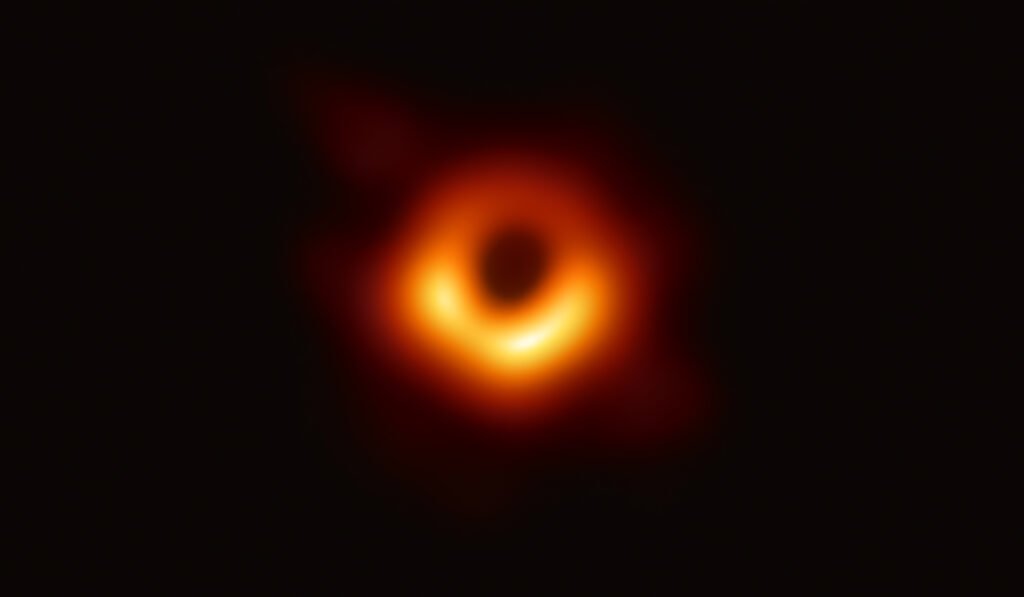
A black hole is a region of space where gravity has become so extreme that nothing — not even light — can escape once it crosses a boundary called the event horizon. In 2019, astronomers released the first-ever image of one: not a photograph of the black hole itself, which can’t be photographed by definition, but a glowing ring of superheated gas circling a dark, perfectly round shadow.
What a Black Hole Actually Is, Physically
A black hole isn’t a hole in the ordinary sense, and it isn’t empty. It’s an incredibly dense concentration of mass packed into a small enough space that its gravitational pull overwhelms everything nearby, including light itself. The event horizon is the boundary around that mass past which escape becomes physically impossible — cross it, and there’s no trajectory, however fast, that leads back out. At the very center lies the singularity, a point where, according to general relativity, matter is compressed to infinite density, though physicists still debate whether that’s a literal description or a sign that the math breaks down at extremely small scales.
How a Black Hole Actually Forms
Most black holes form from the death of massive stars. A star with more than roughly 20 times the mass of our Sun eventually burns through its nuclear fuel, and once the outward pressure from fusion stops, gravity takes over completely. The star’s core collapses in on itself, and if what remains weighs more than about three solar masses, no known force can stop the collapse from continuing all the way down into a black hole. Smaller collapsing cores instead become neutron stars — extremely dense, but not quite dense enough to trap light.
Not All Black Holes Are the Same Size
Astronomers group black holes into rough size categories. Stellar-mass black holes, the most common type, weigh anywhere from about three to several dozen times the mass of the Sun and are scattered throughout galaxies. Supermassive black holes are in an entirely different league, ranging from around 100,000 to billions of solar masses, and sit at the centers of nearly every large galaxy, including our own Milky Way. The famous 2019 image showed the supermassive black hole at the center of the galaxy M87, weighing in at about 6.5 billion times the mass of the Sun. A third, less understood category, intermediate-mass black holes, falls somewhere in between and was only confirmed by strong observational evidence starting in 2019.
How Scientists Detect Something Invisible
Because a black hole itself emits no light, astronomers can’t see it directly, so they look instead for its effects on the surroundings. Gas and dust spiraling toward a black hole heats up into a glowing accretion disk, sometimes the brightest object in its region of the sky. Some black holes also blast out jets of particles traveling near the speed of light, and their gravity visibly warps and bends the light of stars behind them, an effect called gravitational lensing. In 2015, scientists detected an entirely different kind of signal: gravitational waves, ripples in spacetime itself produced when two black holes spiraled together and merged, confirming a prediction Einstein had made a century earlier.
Why Black Holes Matter Beyond Their Mystery
Black holes aren’t just cosmic curiosities. Supermassive black holes appear to play a role in how galaxies form and evolve, since their gravity and energetic outbursts can shape star formation across an entire galaxy. Studying black holes also pushes physics to its limits, testing Einstein’s general relativity in the most extreme gravitational environments known to exist, and offering clues about how gravity, space and time behave in conditions no laboratory on Earth could ever recreate.