Diplomacy is the quiet machinery of world affairs. Ambassadors, negotiators and mediators draft treaties, defuse crises and speak for whole nations. For most of modern history, almost all of them were men. The International Day of Women in Diplomacy, observed every year on June 24, asks a plain question: if diplomacy decides questions of war, trade, climate and human rights, why do so few women sit at the table? It pairs naturally with United Nations Public Service Day, which honors the people who run public institutions, because a foreign ministry is one of the oldest of those institutions.
How the day came to exist
The General Assembly created the day during its 76th session, in resolution A/RES/76/269. According to the United Nations, the Assembly declared by consensus that June 24 of each year would be the International Day of Women in Diplomacy. That means no member state stood in the way, which is notable for a topic that touches national politics and hiring.
The resolution invites all member states, UN organizations, nongovernmental groups, academic institutions and associations of women diplomats, where they exist, to observe the day in the way each considers most appropriate, including through education and public awareness. It does not set targets or quotas. Its job is to keep attention on the subject every year, the way a calendar reminder keeps a promise alive. The UN describes the 2024 commemoration, themed “Women’s Leadership in Multilateral Diplomacy,” as the second annual commemorative event.
What the word “diplomacy” really covers
Diplomacy is more than cocktail parties and formal dress. It includes the ambassador who represents a country abroad, the permanent representative who votes and negotiates at the United Nations, the negotiator who haggles over a ceasefire line, and the mediator who persuades two enemies to keep talking. It also includes thousands of junior officers who report, draft and translate, and who are the pipeline from which future ambassadors come. When people say women are “missing” from diplomacy, they usually mean two different things: too few at the very top, and too many who enter at the bottom but never rise.
The numbers behind the day
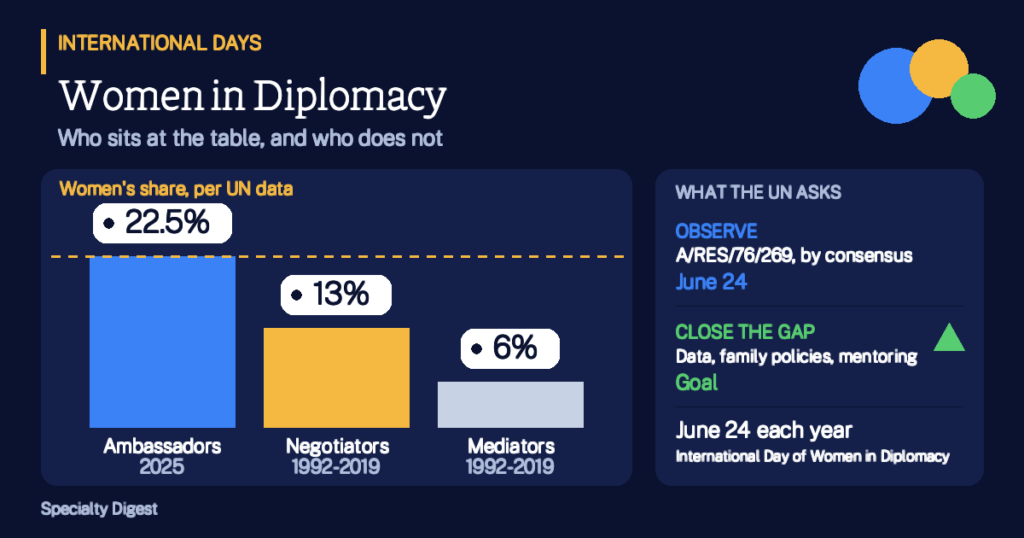
The most recent global count comes from a UN Women policy paper on the diplomatic corps, which draws on the Women in Diplomacy Index. In 2025, women held 22.5 percent of all ambassador and permanent representative positions worldwide. Only three countries had reached 50 percent women among their ambassadors.
- 22.5%of ambassador posts held by women, 2025
- 3countries with 50% women ambassadors, 2025
- 34women led 31 countries as head of state or government, January 2023
- 12%of defense ministers worldwide are women, per the UN
The pattern repeats elsewhere in senior public life. The UN notes that just four women have been elected President of the General Assembly in its 77 years. These are not isolated gaps. They are the same gap seen from different angles.
Example 1: the narrowing pyramid. Imagine a foreign ministry that hires 100 junior officers, 60 of them women. If each promotion step keeps only 70 percent of the women but 85 percent of the men, then after four steps about 14 women remain against about 21 men. The figures are round and illustrative, but they show how a majority at the entrance can become a minority at the top without any single dramatic decision.
Why the peace table matters
The day is not only about fairness to individual careers. It is also about results. The UN reports that between 1992 and 2019, women represented 13 percent of negotiators, 6 percent of mediators and 6 percent of signatories in peace processes worldwide. Of the five UN-led or co-led peace processes in 2021, two were led by women mediators, a sign that change is possible.
Example 2: the empty chairs. Picture a negotiation with 50 delegates, 40 men and 10 women, with one woman among five mediators. Topics such as displaced families, schools and the safety of aid workers can fade if no one in the room has lived them. The numbers are made up for illustration, but they show why advocates argue that who is present shapes what gets discussed.
Why the gap persists
The UN Women paper names several structural barriers rather than blaming individuals. One is pipeline leakage: women are a larger share of entry levels but drop off in middle and senior ranks. Another is mobility. Diplomats rotate between countries every few years and keep irregular hours, which clashes with caregiving, and the paper notes that women do about 2.5 times as many hours of unpaid care per day as men. Family policies often exist in principle but are poorly calibrated to overseas life.
There is also portfolio segregation. Women tend to be concentrated in development, health, human rights and humanitarian work and are less represented in defense, sanctions and economic strategy. Women ambassadors are less likely to be sent to strategic countries, and senior posts sometimes go to women during crises or budget cuts. Scarce mentorship and thin professional networks add to the problem, and many countries do not publish the data needed to see where the bottlenecks are.
Example 3: the childcare bill. Suppose a diplomat is posted to a capital where childcare costs $2,000 a month but the ministry allowance covers $800. The family absorbs $1,200 every month, or $14,400 a year. The figures are round and illustrative. A key informant quoted in the paper describes this same pattern, with childcare costs that far exceeded ministry allowances, which is exactly the kind of quiet barrier that pushes talented people out.
Progress and how the day is marked
Change can be fast when governments decide to act. The paper reports that in Honduras the share of women ambassadors rose from 25 percent in 2024 to 37 percent in 2025, and that 43 percent of Australian ambassadors were women in 2025. It also shows how far some systems still have to go: Mexico’s foreign service stood at 66 percent men and 34 percent women under a 2024 policy.
On the day itself, the General Assembly leadership and UN Women hold commemorative events, and many embassies and associations of women diplomats host panels and mentoring sessions. The UN Women paper recommends concrete steps: gender audits of foreign ministries, public data on hiring, promotion and postings, parity guidelines at every stage of a career, paid parental leave and childcare allowances matched to local costs, gender-aware diplomatic training and mentorship networks.
Key Takeaways
- The day is young but official. The General Assembly created it by consensus in resolution A/RES/76/269.
- The top is still mostly male. Women held 22.5% of ambassador and permanent representative posts in 2025.
- Parity is rare. Only three countries had 50% women among their ambassadors in 2025.
- Peace tables show the gap. From 1992 to 2019, women were 13% of negotiators and 6% of mediators.
- Barriers are structural. Pipeline leakage, rotation, unpaid care and uneven postings explain more than individual choices.
- Change can be quick. Honduras moved from 25% to 37% women ambassadors in one year.
- Data comes first. Countries that publish hiring and promotion figures can find and fix their bottlenecks.
How solid is this? The ambassador and country figures come from the Women in Diplomacy Index as reported in a 2026 UN Women paper, and they change as appointments change. Peace process figures cover 1992 to 2019 and defense minister and head of government counts are as reported by the UN, with the years shown. The three worked examples use round, made-up numbers to show an idea. See also the International Days hub and the International Days Calendar.
More in Society
- United Nations, International Day for Women in Diplomacy (24 June)
- UN Press, “Declaring 24 June International Day, General Assembly Stresses Women’s Participation in Diplomacy Crucial to Achieving Peace, Democracy” (2022)
- Office of the President of the General Assembly (76th session), Celebrating the Adoption of the International Day of Women in Diplomacy
- UN Women, Women in the Diplomatic Corps: Normative Frameworks, Structural Barriers and Policy Recommendations (2026)
- President of the General Assembly (78th session), Remarks at the commemorative event, June 24, 2024
- UN Digital Library, International Day of Women in Diplomacy (A/RES/76/269)