Every idea that crosses a border passes through someone’s hands first. A treaty, a vaccine label, a novel, a news bulletin: each reaches readers in another language only because a translator, an interpreter or a terminologist did careful and mostly invisible work. International Translation Day, observed every year on September 30, exists to make that work visible. It honors the professionals who carry meaning between languages, and it invites a larger question: what would global cooperation look like without them?
From a saint’s feast to a United Nations day
September 30 is the feast day of Saint Jerome, the scholar who rendered the Bible into Latin and who is traditionally honored as the patron saint of translators. Translators’ associations have long used the date to celebrate their profession. The International Federation of Translators (FIT), the worldwide body of translators’ associations, chooses a theme each year and encourages its members to use it, a habit it has kept for over 35 years. The UN’s own language services also hold an annual St. Jerome Translation Contest.
The step from tradition to official status came in 2017. The General Assembly adopted resolution A/RES/71/288, titled “The role of professional translation in connecting nations and fostering peace, understanding and development,” and declared September 30 an official UN International Day. The day honors professional translators, interpreters and terminologists. The title of the resolution states the case plainly: professional translation is treated as a tool for peace, understanding and development, not as a courtesy.
Three jobs that are often confused
Translation converts written text from one language into another. Interpreting does the same for speech, either at the same moment as the speaker or in turns. Terminology is the quieter third craft: building and maintaining the agreed vocabulary that lets a hundred documents use the same word for the same concept. The resolution honors all three professions, which is why the day is not only about translators in the narrow sense.
A good translator does not swap words one for one. Idioms, tone, legal force and cultural references have to survive the trip. A phrase that is polite in one language can sound cold in another, and a term with a precise legal meaning in one country may have no exact twin in the next.
Example 1: one phrase, two meanings. Suppose a clinic’s notice tells a patient to “follow up.” A literal rendering in some languages could read as “chase” or “track,” which may alarm the patient. A skilled translator chooses the wording that means “come back for a check.” The scenario is illustrative, but it shows why meaning, not vocabulary, is the real unit of work.
A record of the world in translation
One of the most revealing documents about translation is itself a list. The Index Translationum is an international bibliography of translations that began in 1932, created by the International Institute of Intellectual Co-operation, a body of the League of Nations. UNESCO describes it as its oldest and longest running database. The first run was published quarterly from 1932 to 1940, and UNESCO revived it in 1948.
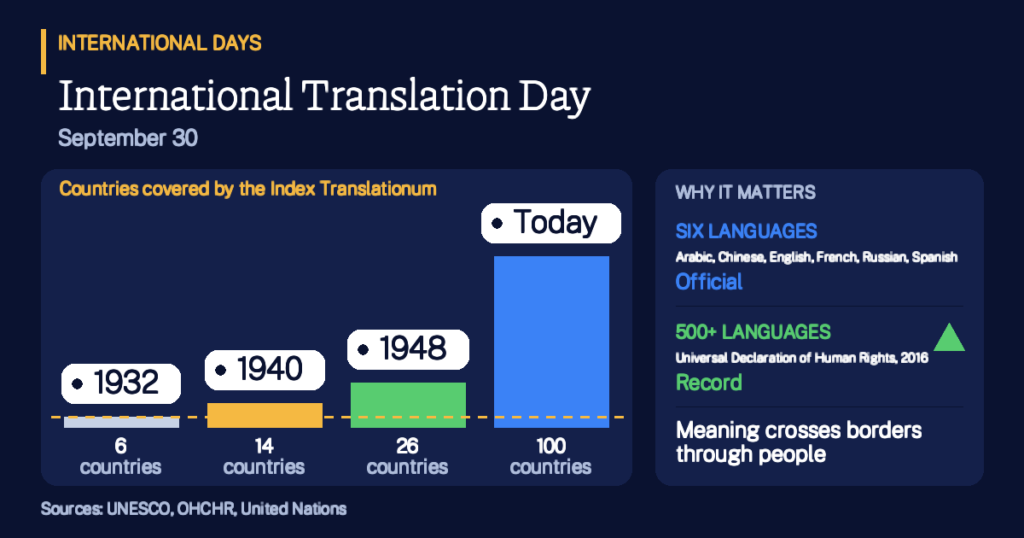
The growth of its coverage shows how widely translation spread. The first Index covered six countries, the 1940 Index fourteen and the 1948 Index 26. Today the database holds over 700,000 bibliographical entries from 100 countries. Each entry records the year and country of publication, the languages, and the names of the author, the translator and the publisher.
The Index also corrects a common habit of mind. Readers remember authors, yet every entry lists a translator as well. In 2025 UNESCO published the 1978 to 2008 portion as an open dataset on its Datahub, so anyone can analyze what was translated, into which languages, and by whom.
Six languages, one conversation
Nowhere is the need more visible than at the United Nations itself. The Organization works in six official languages: Arabic, Chinese, English, French, Russian and Spanish. Every speech in a meeting room and every report that Member States must read depends on language professionals who move meaning among them, often under tight deadlines.
Language also carries rights. The Universal Declaration of Human Rights, adopted in 1948, is recorded by the UN human rights office (OHCHR) as available in more than 500 languages and dialects as of 2016, a figure recognized by Guinness World Records as the most translated document. A right that exists only in a language you cannot read is hard to claim.
Example 2: reaching a whole town. Imagine a town of 10,000 people in which 8,000 read the national language and 2,000 read a regional one. A flood warning issued only in the national language reaches 80 percent of residents. Add a translated version and the reach rises toward 100 percent. The numbers are round and illustrative, but this is the logic behind translated public notices.
Why it matters in an age of machines
The 2025 theme chosen by FIT, “Translation, shaping a future you can trust,” was inspired by the UN International Year of Peace and Trust, which FIT cites as General Assembly resolution A/RES/78/266, and by the theme of FIT’s 2025 congress, “Mastering the machine: shaping an intelligent future.” The FIT Council said the theme highlights the role of human trust, including translators, interpreters and terminologists providing oversight of AI-generated text and machine translation.
The point is not that machines are useless. Automated tools can draft quickly, and for a casual message that may be enough. The question is who is accountable when the stakes are high, such as a contract, a medical consent form, a court transcript or a peace agreement. Someone must be able to answer for the meaning of the words. Professionals who work to shared standards are one way societies answer that question.
Example 3: a review step. Suppose software drafts 1,000 patient leaflets in a second language and a human reviewer checks them. If the reviewer finds that 50 of them, five percent, contain a misleading instruction, those errors are caught before they reach anyone. Without the review, 50 families would receive wrong guidance. The figures are round and illustrative, but they show why speed is useful and accuracy is essential.
Whose language gets translated?
Translation is not evenly spread. Languages used by large institutions tend to have large pools of trained professionals, while many other languages have few. A language with few translators is a language whose speakers read less of the world, and whose own writing travels less far. The Index Translationum’s growth to 100 countries shows how much the practice has spread, but a record of what is translated also shows what is not. For related reading, see International Day of Sign Languages, which reminds us that translation includes languages of the hands as well as of the voice.
How the day is marked, and what progress needs
Around the date, FIT member associations mark the day and use the annual theme, and FIT hosts an online webinar; the 2025 edition took place on September 26, 2025. The UN’s language services run the St. Jerome Translation Contest. FIT announces each new theme on its own website, so check there for the current year rather than relying on a guess.
For readers, the simplest mark of respect is to credit translators by name and to ask who produced the version of a text in front of you. Societies that value the work tend to build the training, standards and fair pay that keep it trustworthy. The Index Translationum shows what is possible when someone decides the translator’s name is worth writing down.
- 100countries in the Index Translationum today
- 700,000+bibliographical entries in the Index
- 500+languages and dialects for the UDHR, 2016
- 6official languages of the United Nations
Key Takeaways
- The day is official since 2017. Resolution A/RES/71/288 made September 30 a UN International Day honoring translators, interpreters and terminologists.
- Three crafts, one purpose. Written translation, spoken interpreting and terminology all move meaning across languages.
- Translation leaves a record. The Index Translationum grew from six countries in 1932 to 100 in its database today.
- The UN runs on language work. Six official languages mean every meeting and document relies on skilled professionals.
- Rights need a readable language. The Universal Declaration of Human Rights exists in more than 500 languages and dialects.
- Trust is the 2025 message. FIT’s theme stressed human oversight of machine translation, especially when stakes are high.
How solid is this? The Index Translationum figures come from UNESCO and the 2025 theme from FIT. The UDHR count is OHCHR’s 2016 figure and has likely grown since. This article does not guess the 2026 theme. The three worked examples use round, made-up numbers to show an idea. See also the International Days hub and the International Days Calendar.