The heart does its work without being asked, which is why most of us forget it until something goes wrong. World Heart Day, observed every year on September 29, exists to change that habit. It is not a United Nations day. It is a campaign led by the World Heart Federation (WHF) and backed by the World Health Organization, and it carries a plain message: cardiovascular disease is the leading cause of death in the world, and most of it can be prevented. Here is where the day came from, what the numbers say, and what actually moves them.
How the day began
The idea came from a cardiologist, not a government. According to the World Heart Federation’s own history, Dr. Antoni Bayés de Luna first proposed the concept during his term as WHF president from 1997 to 1999, and it was launched with support from the World Health Organization and UNESCO. The first World Heart Day took place on September 24, 2000, the last Sunday of that month, under the theme “Let it Beat.” For its first decade the day moved with the calendar. From 2011 onward it has been held on the fixed date of September 29.
What “cardiovascular disease” means
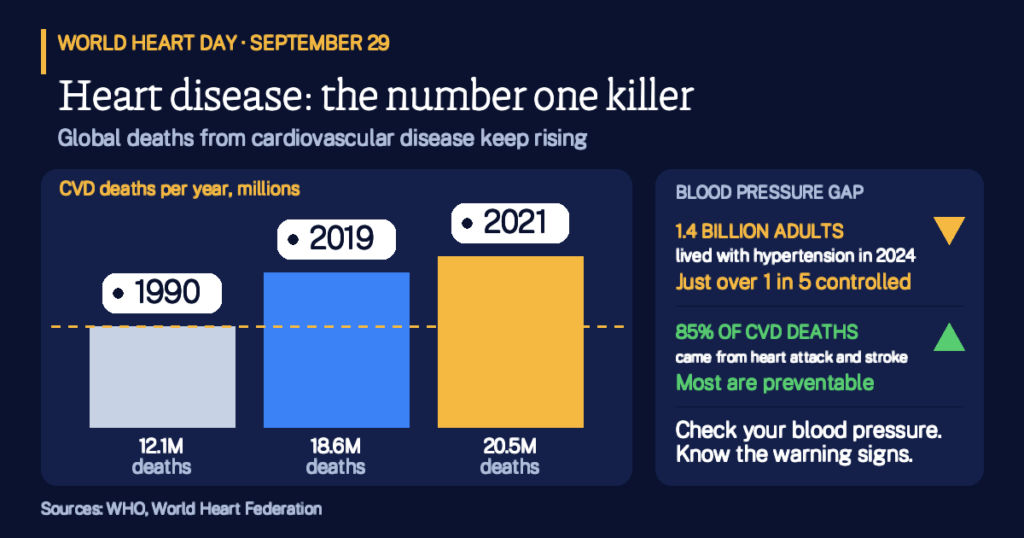
Cardiovascular disease, or CVD, is a group of disorders of the heart and blood vessels. It includes coronary heart disease, which can cause heart attacks, and cerebrovascular disease, which causes strokes. It also covers conditions such as rheumatic heart disease, which WHO says accounts for about 2 percent of CVD deaths. In practice the two big killers dominate: WHO reports that 85 percent of CVD deaths in its latest count were due to heart attack and stroke.
The numbers behind the day
WHO estimates that 19.8 million people died from CVD in 2022, about 32 percent of all deaths worldwide. The World Heart Federation’s 2023 World Heart Report, which uses a slightly different estimate, puts the toll at 20.5 million deaths in 2021, close to a third of all deaths, and notes that more than half a billion people live with cardiovascular disease. Its figures show how far the problem has grown: 12.1 million CVD deaths were recorded in 1990.
Part of that rise is simple arithmetic: more people, living longer. The same report shows the age-standardized death rate falling from 354.5 per 100,000 people in 1990 to 239.9 in 2019. In other words, the risk for any one person has dropped even as the total has climbed. But the gains are uneven. The WHF report says declines have been much faster in high-income countries than in low- and middle-income ones, where more than 80 percent of CVD deaths occur.
Example 1: why totals rise while risk falls. Picture a town where the death rate from heart disease falls by a quarter over thirty years, but the number of older residents doubles. The rate is lower, yet the number of deaths is higher. The figures are round and illustrative, but this is the pattern the age-standardized numbers describe.
The silent driver: high blood pressure
Many cardiovascular events trace back to a condition people cannot feel. WHO’s 2025 global report found that 1.4 billion people lived with hypertension in 2024, and that just over one in five had it under control. Of the 195 countries and territories analyzed, 99 have national control rates below 20 percent. WHO also reports that every hour, over 1,000 lives are lost to strokes and heart attacks caused by high blood pressure, and that most of these deaths are preventable. Our piece on World Hypertension Day looks at this condition in more depth.
Example 2: a screening day. A community health team screens 500 adults on one afternoon. Suppose 100 have high blood pressure and 60 of them did not know it. Those 60 people can now be started on treatment and lifestyle advice before a first heart attack or stroke. The numbers are made up for illustration, but this is exactly how undetected risk becomes manageable risk.
What causes it and what prevents it
WHO lists the main risk factors as tobacco use, an unhealthy diet that includes excess salt, sugar and fats, obesity, physical inactivity, harmful use of alcohol and air pollution. The encouraging side of the same list is that most cardiovascular disease can be prevented by addressing behavioral and environmental risk factors. The World Heart Federation states that up to 80 percent of premature heart attacks and strokes can be prevented. WHO adds that drug treatment of hypertension, diabetes and high blood lipids is necessary to reduce cardiovascular risk, and that evidence from 18 countries shows hypertension programs can be run efficiently and cost-effectively in primary care.
Example 3: what better control could mean. Imagine a country of 10 million adults where 20 percent have hypertension, or 2 million people. If only 20 percent of them are controlled, 400,000 are protected. Raising control to 40 percent would protect another 400,000. The figures are round and illustrative, but they show why control, not just diagnosis, is the goal.
Who is left behind
The burden is heaviest where care is thinnest. WHO says over three quarters of CVD deaths take place in low- and middle-income countries. Access to medicines is part of the gap: only 7 of 25 low-income countries report general availability of all WHO-recommended hypertension medicines, compared with 93 percent of high-income countries. The costs reach beyond health. WHO notes that CVD and other noncommunicable diseases push households into poverty through catastrophic health spending, and that cardiovascular diseases, including hypertension, were projected to cost low- and middle-income countries about $3.7 trillion between 2011 and 2025, around 2 percent of their combined GDP.
How the day is marked
Each year the World Heart Federation chooses a campaign. Past themes have followed the changing view of the problem: “Women and Heart Disease” in 2003, “Know Your Risk” in 2008, “Use Heart to Beat CVD” in 2020, “Use Heart for Action” in 2024, which urged countries to develop national cardiovascular health action plans, and “Don’t Miss a Beat” in 2025, the day’s 25th anniversary. The WHF’s 2026 messaging focused on recognizing the signs and symptoms of heart disease. Observances range from health checks and walks to school lessons. Anyone can take part by checking blood pressure, learning the warning signs, and asking a doctor about personal risk. If you think you or someone near you may be having a heart attack or stroke, call your local emergency number right away.
- 2000Let it Beat
- 2003Women and Heart Disease
- 2008Know Your Risk
- 2020Use Heart to Beat CVD
- 2024Use Heart for Action
- 2025Don’t Miss a Beat
Key Takeaways
- It is a campaign, not a UN day. The World Heart Federation leads it with WHO support, and it has been held on September 29 since 2011.
- CVD is the world’s biggest killer. WHO estimates 19.8 million deaths in 2022, about 32 percent of all deaths.
- Heart attack and stroke dominate. They account for 85 percent of CVD deaths.
- Risk per person has fallen, but totals keep rising. Age-standardized death rates dropped between 1990 and 2019 while deaths grew with population and age.
- Blood pressure is the weak link. Of 1.4 billion adults with hypertension in 2024, just over one in five had it under control.
- Prevention works. Up to 80 percent of premature heart attacks and strokes can be prevented, according to the World Heart Federation.
- The gap is global. Over three quarters of CVD deaths occur in low- and middle-income countries, where medicines and care are harder to reach.
How solid is this? Death counts are modeled estimates, and WHO (2022) and the World Heart Federation (2021 and 2019) use different years and methods, so the totals differ slightly. Some WHO statements about low- and middle-income countries carry no stated year. The three worked examples use round, made-up numbers to show an idea. This article is general information, not medical advice. See also the International Days hub and the International Days Calendar.
More in Health
- World Health Organization. Cardiovascular diseases (CVDs) fact sheet (July 2025).
- World Health Organization. Uncontrolled high blood pressure puts over a billion people at risk (September 23, 2025).
- World Health Organization. Global report on hypertension 2025.
- World Heart Federation. World Heart Report 2023: Confronting the world’s number one killer.
- World Heart Federation. World Heart Day: a global movement of action and awareness.
- World Heart Federation. About World Heart Day.