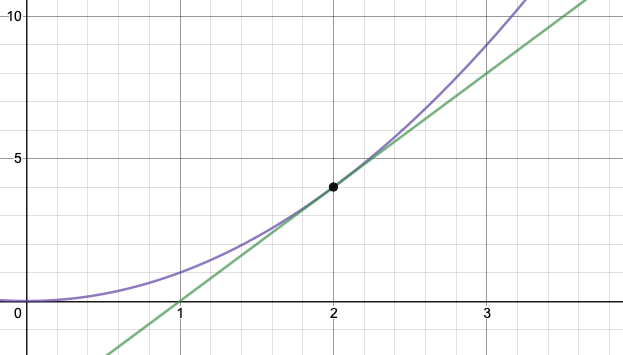
Calculus is the branch of mathematics that studies continuous change, built around two complementary operations called differentiation and integration. Differentiation measures how quickly a quantity changes at a given instant, producing what is called a derivative, while integration accumulates quantities over an interval to find totals such as area, volume, or distance traveled. Developed independently in the late seventeenth century by Isaac Newton and Gottfried Wilhelm Leibniz, calculus became the essential mathematical language for describing motion, growth, and any process that unfolds continuously rather than in discrete steps, and it remains foundational to physics, engineering, economics, and statistics.
Differentiation and the derivative
The derivative of a function at a particular point describes the instantaneous rate of change of that function, which can be visualized as the slope of the line tangent to the function graph at that point. For a position function describing an object moving over time, the derivative gives the object instantaneous velocity, and the derivative of velocity in turn gives acceleration. Differentiation rules, such as the power rule, product rule, and chain rule, allow mathematicians to compute derivatives of complicated functions systematically rather than returning to first principles every time, and these rules form the practical toolkit that students spend most of an introductory course learning to apply.
Integration and the integral
Integration can be understood as the reverse of differentiation, and the fundamental theorem of calculus formally establishes that connection, showing that accumulating a rate of change over an interval recovers the total change in the original quantity. A definite integral calculates a specific numerical total, such as the exact area under a curve between two points, while an indefinite integral produces a general family of functions called antiderivatives. Integration techniques, including substitution and integration by parts, extend the basic antiderivative rules to a much wider range of functions, and numerical integration methods allow computers to approximate integrals for functions too complex to solve by hand.
Limits and rigor
Both Newton and Leibniz relied on an intuitive notion of infinitesimally small quantities that mathematicians at the time could not define with full logical rigor, leaving calculus vulnerable to philosophical objections for well over a century. The modern concept of a limit, which describes the value a function approaches as its input gets arbitrarily close to some point without necessarily ever reaching it, was formalized during the nineteenth century chiefly through the work of Augustin-Louis Cauchy and Karl Weierstrass. Limits allowed mathematicians to define both the derivative and the integral with complete logical precision, removing the need to treat infinitesimals as mysterious quantities and placing calculus on the same rigorous footing as the rest of mathematics. This more rigorous branch of the subject, often called real analysis, is typically introduced after an introductory calculus sequence rather than within it.
Historical development and the priority dispute
Isaac Newton developed his version of calculus, which he called the method of fluxions, in England during the mid-1660s while working out the mathematics needed to describe planetary motion and gravity, though he delayed publishing his results for decades, circulating them only privately among a small circle of colleagues while he focused on other projects, including his work on optics and his eventual role as Master of the Royal Mint. Gottfried Wilhelm Leibniz independently developed an equivalent system in Germany during the 1670s and published his notation first, including the integral sign and the d-notation for derivatives that mathematicians still use today. The resulting priority dispute between supporters of Newton and Leibniz became one of the most bitter controversies in the history of mathematics, dividing British and Continental European mathematicians for much of the eighteenth century, even though historians now generally agree the two men developed their ideas independently.
Applications across science and everyday life
Physicists use calculus to derive the equations governing motion, electromagnetism, and quantum mechanics, since nearly every fundamental physical law is most naturally expressed as a relationship between a quantity and its rate of change. Economists apply calculus to find the production level that maximizes profit or minimizes cost, since these optimization problems reduce to finding where a derivative equals zero. Medical researchers use differential equations, which describe relationships involving derivatives, to model how drug concentrations change in the bloodstream over time and to project the spread of infectious disease through a population, work that became widely visible to the public during disease outbreaks when models built on these equations were used to forecast case counts and evaluate the likely effect of different public health interventions. Engineers rely on calculus constantly, from calculating the structural loads a bridge can bear to designing the control systems that keep an aircraft stable in flight.
FAQs
Who invented calculus, Newton or Leibniz?
Historians now generally agree that Isaac Newton and Gottfried Wilhelm Leibniz developed calculus independently of one another in the late seventeenth century, though a bitter priority dispute over credit divided mathematicians for decades afterward.
What is the difference between a derivative and an integral?
A derivative measures the instantaneous rate of change of a function, while an integral accumulates a quantity over an interval to find a total, such as area or distance; the fundamental theorem of calculus shows these two operations are inverses of each other.
What is the fundamental theorem of calculus?
It is the result establishing that differentiation and integration are inverse operations, meaning the total accumulated change of a quantity over an interval can be found by evaluating its antiderivative at the endpoints.
Why is calculus required for so many college majors?
Because nearly every quantitative field, including physics, engineering, economics, and biology, relies on describing how quantities change continuously over time or space, which is precisely what calculus was built to handle.
Key facts
- Built around two operations: differentiation (rates of change) and integration (accumulation)
- Developed independently by Isaac Newton and Gottfried Wilhelm Leibniz in the late 17th century
- The fundamental theorem of calculus connects differentiation and integration as inverse operations
- Leibniz's integral sign and derivative notation are still standard today
- Foundational to physics, engineering, economics, and statistics
Quick checkWho invented calculus?Show answer
Isaac Newton and Gottfried Wilhelm Leibniz independently developed calculus in the late 17th century, sparking a famous priority dispute.
Sources
- Britannica, Calculus; Stanford Encyclopedia of Philosophy, Newton and Leibniz
Editorially reviewed by Specialty Digest Editorial TeamLast reviewed November 2, 2026Researched and drafted with AI assistanceReport an issue