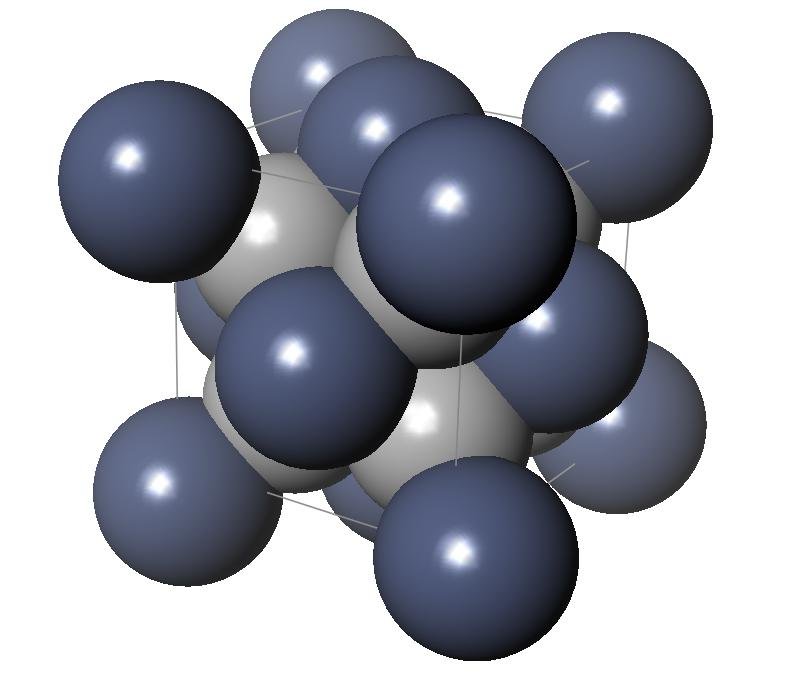
Crystal structure refers to the specific, repeating three-dimensional arrangement of atoms, ions, or molecules within a crystalline solid, which repeats at regular intervals in every direction to form what materials scientists call a lattice. This underlying atomic geometry, rather than a material’s chemical composition alone, is often the single biggest factor determining properties such as strength, ductility, electrical conductivity, and how a material behaves when it is bent, heated, or struck. Two materials made of exactly the same element, like carbon in diamond versus graphite, can have drastically different properties purely because their atoms are arranged in different crystal structures.
Unit Cells and Lattice Systems
Crystallographers describe a crystal structure using its unit cell, the smallest repeating block of atoms whose geometry, stacked endlessly in three dimensions, recreates the entire crystal. Crystals are classified into seven basic lattice systems based on the unit cell’s shape and symmetry, including cubic, hexagonal, and tetragonal systems, with cubic structures being especially common among engineering metals because of how efficiently they pack atoms together. Within the cubic system, metals typically adopt one of two common arrangements: face-centered cubic, where atoms sit at the corners and face centers of the cube, or body-centered cubic, where atoms sit at the corners plus one atom in the very center.
How Structure Determines Properties
Face-centered cubic metals such as aluminum, copper, and austenitic stainless steel tend to be ductile and easy to form into new shapes, because their atomic packing provides many well-aligned planes along which atoms can slip past one another under stress without breaking bonds entirely. Body-centered cubic metals such as iron at room temperature and tungsten are generally stronger but less ductile, since their atomic planes are less favorably arranged for this slip process. Iron is a particularly striking example of how much structure matters: it is body-centered cubic at room temperature but transforms into a face-centered cubic structure above about 912 degrees Celsius, and controlling exactly when and how fast that transformation happens during heat treatment is central to how steel is hardened.
Crystal Defects
Real engineering materials are never perfect crystals; they contain defects such as vacancies, where an atom is simply missing from its expected lattice position, and dislocations, where a line of atoms is misaligned relative to the surrounding lattice. Counterintuitively, these defects are often essential to how metals behave usefully rather than purely harmful, since the movement of dislocations through a crystal is the actual physical mechanism behind plastic deformation, meaning a totally defect-free metal crystal would in theory be far stronger but also far more brittle than real metals. Engineers deliberately introduce controlled numbers of defects, for instance by cold-working a metal to tangle up dislocations and make further deformation harder, which is how techniques like work hardening increase a material’s strength.
Grain Structure
Most engineering metals are polycrystalline, made up of many small individual crystals called grains, each with its own lattice orientation, separated by boundaries where the atomic arrangement abruptly shifts from one grain to the next. Grain boundaries interfere with dislocation movement, so metals with smaller, more numerous grains are generally stronger than the same metal with large grains, a relationship formalized in materials science as the Hall-Petch relationship. Controlling grain size through processes like controlled cooling rates, alloying, and mechanical working is one of the primary tools metallurgists use to tune a metal’s strength without changing its chemical composition at all.
Studying Crystal Structure
X-ray diffraction remains the principal technique for determining an unknown material’s crystal structure, exploiting the fact that X-rays scatter off the regularly spaced atomic planes in a crystal and produce a distinctive interference pattern that can be mathematically decoded to reveal exact atomic positions. Electron microscopy techniques can image individual grains, defects, and even in some cases individual atomic columns directly, complementing the statistical picture X-ray diffraction provides across a larger sample.
Crystal Structure in Non-Metals and Alloys
Crystal structure governs far more than metals alone. Semiconductors such as silicon adopt a diamond-cubic structure, and the precision with which manufacturers grow silicon as a single, essentially defect-free crystal is one of the reasons modern microchips can be manufactured with such reliability, since even a handful of misplaced atoms can disrupt the electronic behavior a chip design depends on. Ceramic often have more complex crystal structures than metals, combining multiple types of atoms in fixed ratios, which is part of why ceramics tend to be hard and heat-resistant but also brittle, since their more rigid, less symmetric lattices offer far fewer favorable planes along which atoms can slip without simply fracturing.
Alloying, the practice of mixing two or more elements to form a new material, frequently works by altering crystal structure directly. Adding carbon to iron does not simply blend two substances together; the carbon atoms lodge within the iron lattice and distort it, which is the principal reason steel is so much harder than pure iron despite carbon making up only a small fraction of its mass. Some alloying elements instead substitute directly for atoms in the host lattice without changing the overall structure type, a process called solid solution strengthening, which still slows dislocation movement and raises strength even though the crystal’s basic geometry is unchanged.
Phase transformations, where a material’s crystal structure changes entirely in response to temperature or pressure, underlie many of the heat treatments used in manufacturing. Rapidly cooling, or quenching, steel from a high temperature can trap carbon atoms inside a distorted structure before they have time to diffuse out, producing the extremely hard but brittle phase known as martensite, which is why quenched steel is almost always tempered afterward with a controlled reheating step to relieve some of that trapped internal stress.
FAQs
Why do diamond and graphite have such different properties if they’re both pure carbon?
Their carbon atoms are arranged in entirely different crystal structures: diamond’s rigid tetrahedral lattice makes it extremely hard, while graphite’s stacked, weakly bonded sheets let layers slide past each other easily.
Are crystal defects always bad for a material?
No. Controlled defects like dislocations are the actual mechanism behind useful behaviors such as ductility and work hardening; a theoretically perfect crystal would be far more brittle.
Quick checkWhy can two materials made of the same element have very different properties?Show answer
Because their atoms can be arranged into different crystal structures, like diamond versus graphite, and crystal structure often matters more to a material's properties than its chemical composition.
Editorially reviewed by Specialty Digest Editorial TeamLast reviewed November 2, 2026Researched and drafted with AI assistanceReport an issue