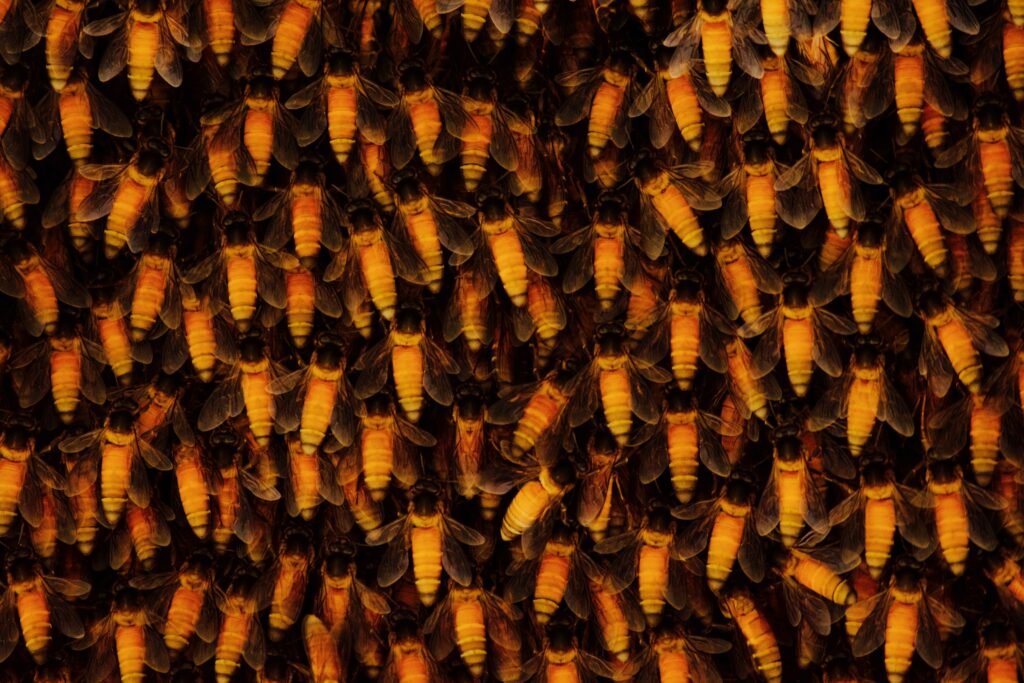
Bees make honey by repeatedly swallowing and regurgitating flower nectar among themselves, adding an enzyme that breaks its sugar down each time, then evaporating most of its water until what’s left is thick, sugar-dense, and stable enough to store for years. It’s a group effort that runs through the whole colony, not the work of any single bee.
A Second Stomach Just for Nectar
It starts when a forager bee visits flowers and sucks up nectar, a thin, sugary liquid that’s roughly 70 percent water. Rather than swallowing it into her digestive stomach, she holds it in a separate internal pouch called the honey stomach, or crop, according to entomologists at NC State University. Nothing is digested there — the nectar just rides along, unchanged, as she flies back to the hive.
Passed From Bee to Bee
The forager doesn’t drop her cargo straight into a cell. She regurgitates the nectar into the mouth of a younger worker, called a processor or house bee, waiting near the entrance. That bee carries it deeper into the hive and regurgitates and re-swallows it again, passing it down a short chain of workers before it finally lands in a wax cell. Each handoff is part of what turns raw nectar into something the colony can actually keep.
An Enzyme Splits the Sugar
Every handoff also adds a bit of saliva containing an enzyme called invertase. As NC State entomologist David Tarpy has explained, invertase breaks the complex sugar sucrose into two simpler sugars, glucose and fructose. That chemical split is what starts turning nectar into something closer to honey — and it’s also why the finished product resists spoiling: the altered sugar mix is much harder for bacteria and fungi to use as food.
Drying It Out
Sweet sugar water on its own would still ferment, so the colony’s next job is pulling the water out. Research on foraging bees, published in Scientific Reports, found that bees start concentrating nectar even before they reach the hive, repeatedly exposing droplets on their mouthparts to the air inside their crop. Once the nectar is in the comb, worker bees line up and fan their wings across the open cells, driving airflow that evaporates the rest of the moisture. Raw nectar’s water content, around 70 percent, has to drop below roughly 18.6 percent before it counts as honey rather than concentrated nectar.
Capped and Stored for Later
Once the moisture is low enough, worker bees seal the cell with a thin cap of fresh beeswax, locking the honey away from humid air and contamination. A strong colony can turn gallons of nectar into ripened, capped honey over a single nectar flow — a stable, sugar-dense reserve that can feed tens of thousands of bees through winter, long after the flowers that supplied it are gone.
- NC State University News, “How Do Bees Make Honey? (It’s Not Just Bee Barf).” news.ncsu.edu.
- Scientific Reports (Nature), “Honey bees save energy in honey processing by dehydrating nectar before returning to the nest.” nature.com.
- Photo: Nireekshit, CC BY-SA 4.0, via Wikimedia Commons.