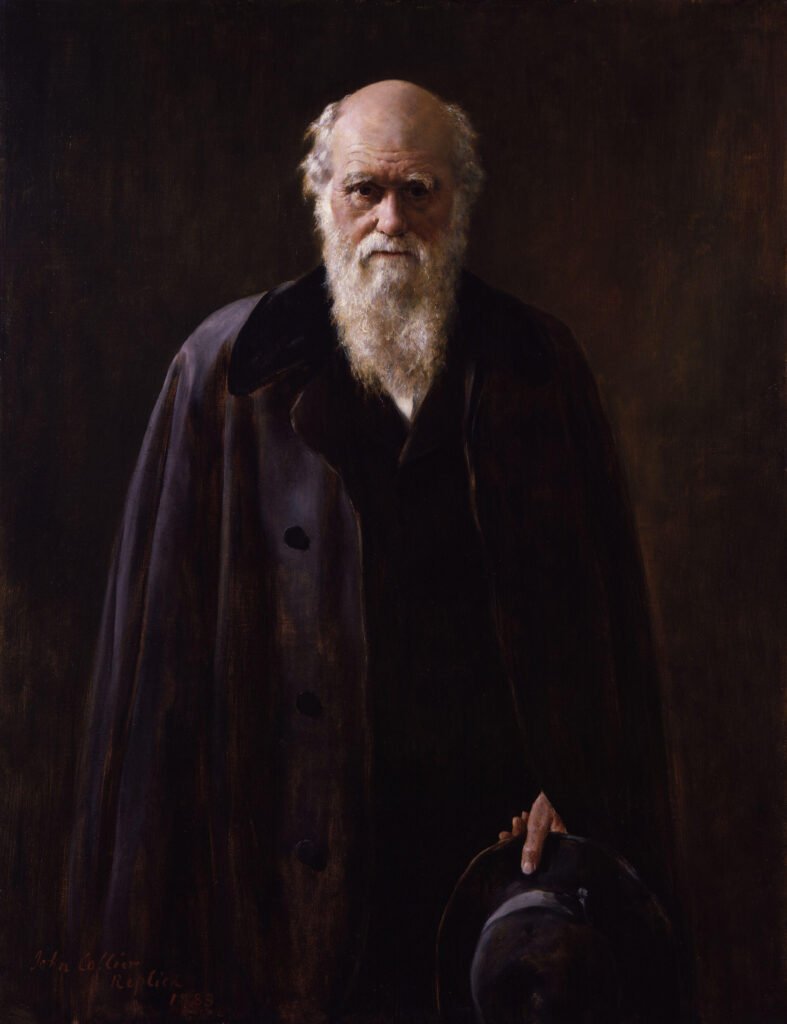
Evolution is the process by which populations of living organisms change in their genetic characteristics across successive generations, ultimately producing the enormous diversity of life found on Earth today from shared common ancestors. The modern understanding of evolution rests chiefly on the theory of natural selection, proposed jointly by Charles Darwin and Alfred Russel Wallace in 1858 and developed at length in Darwin 1859 book On the Origin of Species, which explains how organisms better suited to their environment tend to survive and reproduce more successfully than others, gradually shifting a population traits over time. Evolution is considered the central organizing principle of modern biology, since it explains the relationships between all living species and the mechanisms that produced their distinctive features. The term evolution itself predates Darwin by decades, and earlier thinkers including Jean-Baptiste Lamarck had already proposed that species change over time, but Darwin and Wallace were the first to identify a credible natural mechanism, rather than divine design or an inherent drive toward improvement, capable of producing that change.
Natural selection
Natural selection operates on three basic observations: individuals within a population vary in their traits, at least some of that variation is heritable and can be passed to offspring, and individuals whose traits make them better suited to their environment tend to leave more surviving offspring than individuals with less favorable traits. Over many generations, this unequal reproductive success causes favorable traits to become more common in a population while unfavorable traits become rarer, a process Darwin termed selection by analogy with the deliberate breeding practiced by farmers and animal breeders. Natural selection does not act with any purpose or foresight, since it simply rewards whatever traits happen to improve survival and reproduction in a given environment at a given time, which is why a trait that proves advantageous in one environment can become a disadvantage if conditions change. Peppered moths in industrial England provide a frequently cited example, since darker-colored moths became far more common during the heavily polluted nineteenth century, when soot-darkened trees made them harder for predators to spot, before lighter moths became common again once pollution controls cleaned the air.
Evidence for evolution
The fossil record provides direct physical evidence of extinct organisms and documents gradual changes in body form across geological time, including well-studied transitional sequences such as the evolution of whales from land-dwelling ancestors. Comparative anatomy reveals homologous structures, such as the forelimb bones shared by humans, bats, and whales despite their very different functions, indicating descent from a common ancestor that was later modified for different purposes. Molecular biology offers some of the strongest modern evidence, since comparing DNA sequences across species reveals patterns of genetic similarity that closely match the relationships predicted by the fossil record and comparative anatomy. Direct observation of evolution occurring in real time is also possible in organisms that reproduce quickly, such as bacteria developing antibiotic resistance within a human patient lifetime or finches on the Galapagos Islands shifting beak size measurably within a few decades in response to changing food supplies, with beak size tracking rainfall and the resulting seed hardness so closely that researchers could predict the change from one drought to the next.
Mechanisms beyond natural selection
Natural selection is the best-known mechanism of evolution but not the only one recognized by modern evolutionary biology. Genetic drift describes random fluctuations in how common a particular trait is within a population, which can have an outsized effect in small populations regardless of whether the trait provides any survival advantage. Gene flow occurs when individuals migrate between populations and interbreed, introducing new genetic variation and sometimes equalizing differences that would otherwise have accumulated between separated groups. Mutation, a random change in an organism genetic material, is the ultimate source of all new genetic variation that natural selection and the other mechanisms then act upon, since without mutation there would be no new traits for selection to favor or eliminate. Most mutations have little or no effect on an organism, some are harmful, and only a small fraction turn out to be beneficial, but across the enormous number of organisms and generations involved, even a small supply of beneficial mutations is enough to fuel substantial long-term change.
Common misunderstandings
A persistent misunderstanding holds that evolution means an organism chooses to adapt or that traits appear because an organism needs them, when in fact natural selection acts only on variation that already exists by chance within a population. Another common error treats evolution as a ladder of progress leading inevitably toward greater complexity or toward humans specifically, whereas biologists instead describe evolution as an unguided branching process that has produced simple organisms such as bacteria in enormous abundance alongside more complex ones. Describing something as only a theory is sometimes used to cast doubt on evolution, but within science the word theory refers to a well-substantiated explanation supported by extensive evidence, not a mere guess, placing evolutionary theory in the same category of scientific confidence as the theory of gravity or germ theory.
FAQs
Who proposed the theory of evolution by natural selection?
Charles Darwin and Alfred Russel Wallace jointly proposed natural selection in 1858, with Darwin developing the idea at length in his 1859 book On the Origin of Species.
What is the difference between evolution and natural selection?
Evolution describes the overall change in a population genetic characteristics over generations, while natural selection is one specific mechanism, alongside genetic drift, gene flow, and mutation, that can drive that change.
What evidence supports evolution?
The fossil record, comparative anatomy showing shared structures across species, DNA sequence comparisons, and direct observation of rapid evolution in organisms such as bacteria all provide strong, mutually consistent evidence.
Is evolution just a theory?
In science, a theory is a well-substantiated explanation supported by extensive evidence, not a guess, so evolutionary theory holds the same scientific status as the theory of gravity.
Key facts
- Proposed jointly by Charles Darwin and Alfred Russel Wallace in 1858
- Natural selection favors heritable traits that improve survival and reproduction
- Other mechanisms include genetic drift, gene flow, and mutation
- Supported by the fossil record, comparative anatomy, and DNA sequence comparison
- Considered the central organizing principle of modern biology
In the news
Quick checkWhat is natural selection?Show answer
The process by which individuals with traits better suited to their environment tend to survive and reproduce more successfully, gradually shifting a population traits over generations.
Sources
- Charles Darwin, On the Origin of Species; Britannica, Evolution
Editorially reviewed by Specialty Digest Editorial TeamLast reviewed November 2, 2026Researched and drafted with AI assistanceReport an issue