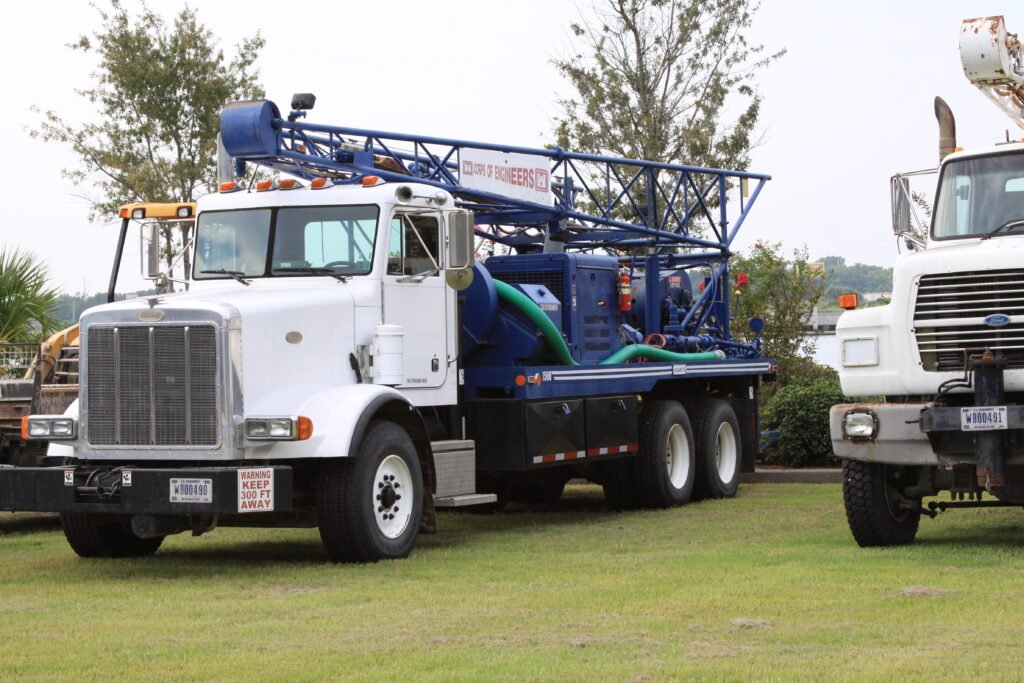
Geotechnical engineering is the branch of civil engineering that studies the behavior of soil, rock, and groundwater and uses that understanding to design the parts of a structure that sit below ground or in contact with the earth. Every building, bridge, dam, tunnel, and road ultimately rests on the ground, so before engineers can finalize a design above the surface, they must understand what lies beneath it: how strong the soil is, how much it will compress under load, how water moves through it, and how it behaves during an earthquake or heavy rain.
Site Investigation and Soil Testing
A geotechnical project begins with a site investigation. Engineers drill boreholes, collect soil and rock samples, and run laboratory tests to measure properties such as shear strength, compressibility, density, and permeability. Field tests, including the standard penetration test and the cone penetration test, measure how soil resists being pushed into the ground, giving engineers a direct read on bearing capacity without waiting for lab results. This data feeds into a soil profile that shows how conditions change with depth, often the single most important input for the rest of the design.
Foundations and Earth Retention
Once soil conditions are known, geotechnical engineers help select and size foundations. Shallow foundations, such as spread footings, work where near-surface soil is strong enough to carry the structure’s weight directly. Where surface soil is weak or loads are heavy, deep foundations such as driven piles or drilled shafts transfer load down to stronger soil or bedrock. Retaining walls, sheet piles, and soil nails hold back soil on slopes or at excavation edges, preventing collapse during construction and over the life of the structure.
Slope Stability and Ground Improvement
Natural and constructed slopes can fail when the forces pulling soil downhill exceed the soil’s internal strength, a risk geotechnical engineers quantify using slope stability analysis. Where native soil is too weak, compressible, or prone to liquefaction, ground improvement techniques such as compaction, soil grouting, or installing stone columns strengthen it before construction begins. These methods are often cheaper than switching to a more expensive foundation type and can make an otherwise unusable site viable.
Seismic and Groundwater Considerations
In earthquake-prone regions, geotechnical engineers evaluate how loose, saturated soils respond to shaking, since some soils can temporarily behave like a liquid in a process called liquefaction, causing buildings to settle or tilt. Groundwater is a constant concern as well: a high water table reduces effective soil strength, increases pressure on underground structures, and must be managed during excavation through dewatering systems so construction can proceed safely and foundations are not later undermined by rising water.
History of the Field
Although builders have grappled with foundation problems for millennia, visible in the tilt of structures like the Leaning Tower of Pisa, geotechnical engineering became a distinct discipline in the twentieth century. Karl von Terzaghi, often called the father of modern soil mechanics, published foundational work in the 1920s and 1930s that gave engineers mathematical tools to predict soil behavior rather than relying solely on experience and trial and error. The field has since grown to include specialized practices for offshore structures, nuclear facilities, and deep underground infrastructure.
Specializations Within the Field
As infrastructure has grown more ambitious, geotechnical engineering has split into specialized sub-fields. Offshore geotechnical engineers design foundations for oil platforms and wind turbines that must resist wave loading and sit on seabed soils investigated using remote sensing and underwater drilling. Environmental geotechnical engineers manage contaminated soil at old industrial sites and design landfill liners that prevent waste from polluting groundwater. Earthquake geotechnical engineers focus specifically on how ground shaking is transmitted and amplified through different soil layers, work that directly shapes building codes in seismic zones.
Modern practice increasingly relies on computer modeling, including finite element analysis, to simulate how soil will respond to a structure’s loads over time rather than relying only on simplified hand calculations. These models help engineers predict long-term settlement, evaluate how a new structure might affect nearby buildings, and test design alternatives before construction begins, reducing the risk of costly surprises once excavation starts. Climate change has added a further layer of complexity, since shifting rainfall patterns and rising groundwater tables in some regions are changing the assumptions that older designs were built on, pushing engineers to revisit how they model long-term soil behavior.
Risk, Monitoring, and Instrumentation
Because soil conditions can never be known with complete certainty from a limited number of boreholes, geotechnical engineering is fundamentally a discipline of managing uncertainty. Engineers build in safety factors, use conservative assumptions where data is sparse, and often install instrumentation such as piezometers to track groundwater pressure and inclinometers to detect slope movement during and after construction. On large projects, this monitoring continues for years, allowing engineers to catch early warning signs of settlement or slope creep before they become structural problems, and to verify that a design is performing as predicted.
FAQs
What is the difference between geotechnical and structural engineering?
Structural engineering designs the load-bearing parts of a building or bridge above the ground, while geotechnical engineering determines how the ground beneath and around that structure will behave and designs the foundation connecting the two.
Why does soil liquefaction happen during earthquakes?
Liquefaction occurs when shaking causes loose, water-saturated soil to lose contact strength between its particles, temporarily behaving like a liquid and causing buildings or underground pipes above it to sink, tilt, or float upward.
Quick checkWhy does soil liquefaction happen during earthquakes?Show answer
Shaking causes loose, water-saturated soil to lose contact strength between particles and temporarily behave like a liquid, which can make buildings or buried pipes sink, tilt, or float upward.
Editorially reviewed by Specialty Digest Editorial TeamLast reviewed November 2, 2026Researched and drafted with AI assistanceReport an issue