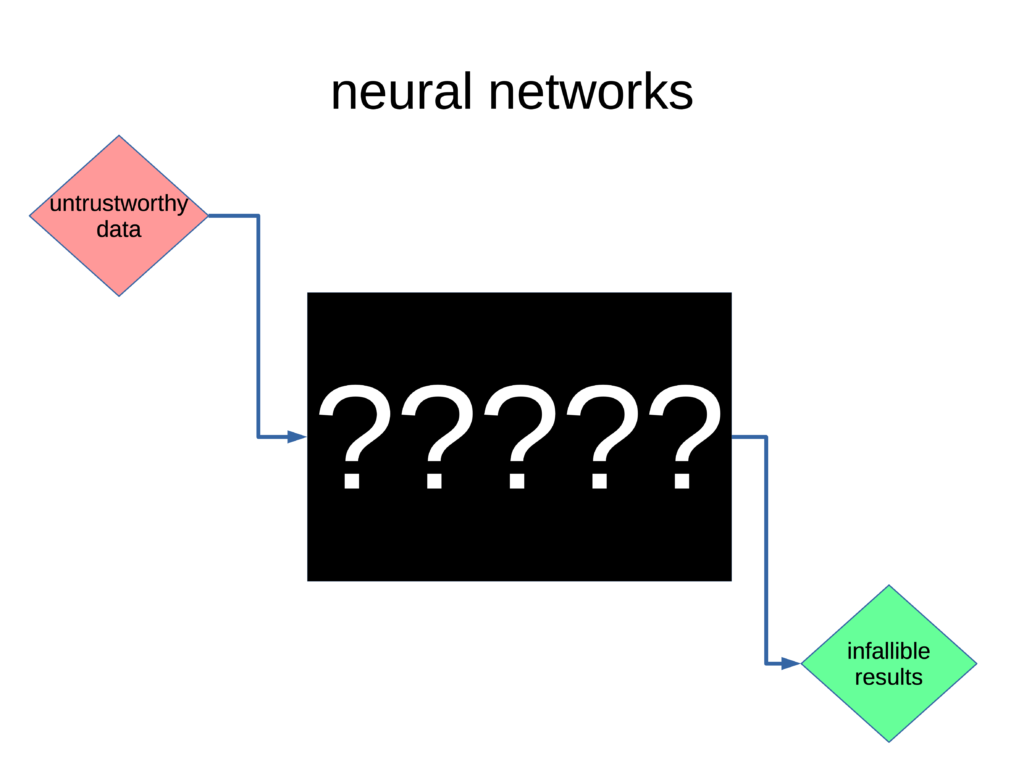
A neural network is a type of computing system loosely inspired by the structure of the brain, built from layers of simple connected units called neurons that each take in numbers, apply a mathematical transformation, and pass the result along to the next layer. Although the biological comparison is loose, the basic idea carries over well: a single neuron is not very powerful on its own, but connecting enormous numbers of them together, with each connection carrying an adjustable strength called a weight, lets the overall network learn to recognize extremely complex patterns in data, from the handwriting in a scanned document to the objects in a photograph to the structure of human language itself.
How a Neural Network Learns
A typical neural network is organized into an input layer, which receives raw data such as the pixel values of an image, one or more hidden layers that transform that data step by step, and an output layer that produces a final answer, such as a label identifying what the image shows. Before training, the weights connecting neurons are set to essentially random values, and the network’s guesses are little better than chance. Training adjusts those weights using a large set of examples where the correct answer is already known. For each example, the network makes a prediction, a loss function measures how far that prediction was from the correct answer, and an algorithm called backpropagation calculates exactly how much each individual weight in the network contributed to that error, nudging every weight slightly in the direction that would have produced a better answer. Repeating this process across millions of examples gradually shapes the weights until the network produces reliably accurate predictions, even on new examples it has never seen before.
The depth of a network, meaning how many hidden layers it stacks between input and output, determines how complex a pattern it can learn to represent. Networks with many hidden layers, called deep neural networks, are capable of building up increasingly abstract representations of data layer by layer; in an image-recognition network, early layers might learn to detect simple edges and colors, middle layers might combine those into shapes like eyes or wheels, and later layers might combine those shapes into recognition of a full face or a car. This layered abstraction is the foundation of the field known as deep learning, which has driven most of the dramatic progress in artificial intelligence over the past decade.
Specialized Architectures
Different tasks call for different arrangements of neurons, called architectures. Convolutional neural networks, built around small filters that scan across an image looking for local patterns regardless of where they appear, dominate image recognition and computer vision tasks. Recurrent neural networks, and the transformer architecture that has largely superseded them, are built to handle sequences of data, such as sentences or audio, where the order of information matters and earlier parts of a sequence influence how later parts should be understood; transformers in particular underlie the large language models behind modern chatbots and writing assistants. Choosing an architecture suited to the structure of the data at hand is often just as important to a project’s success as the sheer size of the network itself.
From Early Theory to Modern Breakthroughs
The core idea behind neural networks dates back to 1943, when researchers Warren McCulloch and Walter Pitts proposed a simplified mathematical model of how a biological neuron might work, and the field saw an early wave of enthusiasm in the late 1950s with the perceptron, a basic single-layer network. Progress stalled for years afterward once researchers proved that simple perceptrons could not solve certain basic problems, and funding and interest in neural networks dropped sharply during a period often called the first AI winter. Interest revived in the 1980s with the popularization of backpropagation as a practical training method for networks with multiple layers, though neural networks remained limited by the available computing power and the relatively small datasets of the time.
The modern deep learning boom began around 2012, when a convolutional neural network dramatically outperformed competing approaches on a large-scale image recognition competition, demonstrating that combining deep architectures with far larger datasets and much more powerful graphics processing hardware could unlock performance far beyond what earlier researchers had achieved. That breakthrough set off a wave of rapid progress that has since produced systems capable of translating languages, generating realistic images, and powering the large language models behind todays most capable AI assistants.
Frequently Asked Questions
Is a neural network the same thing as a human brain? No. Neural networks borrow a loose organizing metaphor, simple connected units passing signals to one another, but artificial neurons are vastly simpler than biological ones, and the learning process, based on mathematical optimization over labeled examples, works very differently from how biological brains actually learn.
Why do neural networks need so much training data? A neural network starts with no built-in knowledge and must infer every pattern it uses purely from the examples it is shown. Complex tasks like recognizing speech or translating language involve enormous variation, so the network typically needs to see a very large and varied set of examples before its learned weights generalize reliably to new, unseen situations instead of simply memorizing the training examples themselves.
What is the difference between a neural network and deep learning? A neural network is the general computing structure; deep learning refers specifically to neural networks with many hidden layers, along with the broader set of techniques used to train such deep networks effectively. All deep learning uses neural networks, but not every neural network is deep enough to be considered part of deep learning.
Key facts
- Neurons are organized into input, hidden, and output layers.
- Training adjusts connection weights using backpropagation and a loss function.
- Deep neural networks have many hidden layers and build increasingly abstract representations.
- Convolutional networks suit images; transformers suit sequences like language.
- Neural networks require large amounts of training data to generalize well.
In the news
Quick checkHow does a neural network improve its predictions during training?Show answer
It compares its predictions against known correct answers using a loss function, then uses backpropagation to calculate how much each connection weight contributed to the error and adjusts every weight slightly to reduce that error, repeating across many examples.
Sources
- Deep Learning (Goodfellow, Bengio, Courville); Stanford CS231n course notes
Editorially reviewed by Specialty Digest Editorial TeamLast reviewed November 2, 2026Researched and drafted with AI assistanceReport an issue