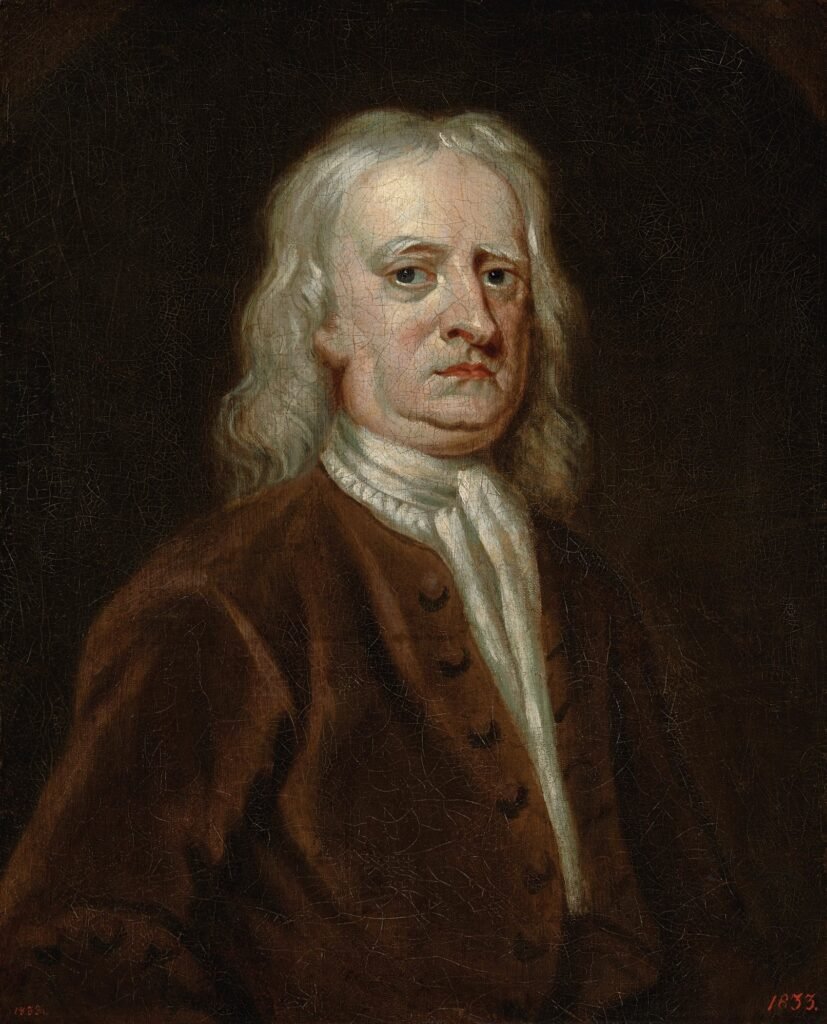
Newton laws of motion are three physical principles, first stated together by Isaac Newton in his 1687 work Philosophiae Naturalis Principia Mathematica, that describe the relationship between a physical object and the forces acting upon it, and how that object moves in response. Together they formed the foundation of classical mechanics for more than two centuries, explaining everything from the fall of an apple to the orbits of planets, and although later refined by Einstein relativity and quantum mechanics at extreme scales, they remain entirely accurate and are still the standard tool used to analyze motion in engineering, everyday physics, and spaceflight.
The first law: inertia
Newton first law states that an object at rest stays at rest, and an object in motion stays in motion at a constant velocity in a straight line, unless acted upon by a net external force. This property of resisting a change in motion is called inertia, and it explains why passengers in a braking car feel pushed forward, since their bodies tend to continue moving at the car former speed even as the car itself slows down. The first law overturned the older Aristotelian assumption that objects naturally come to rest unless a force continuously pushes them, an assumption that seemed intuitive on Earth only because friction and air resistance are usually present and were not properly accounted for before Galileo and Newton isolated their effects. Galileo own earlier experiments rolling balls down inclined planes had already hinted at this principle decades before Newton formalized it, by showing that a ball continued moving for longer distances as the surface it rolled across was made progressively smoother.
The second law: force, mass, and acceleration
Newton second law is usually written as the equation F equals m times a, stating that the net force acting on an object equals its mass multiplied by its acceleration. This means that for a given force, a more massive object accelerates less than a lighter one, and for a given mass, a larger force produces greater acceleration. The second law provides the quantitative core of classical mechanics, allowing the motion of virtually any object, from a falling apple to a rocket leaving the launch pad, to be predicted precisely once the forces acting on it are known. Mass in this equation refers to an object resistance to acceleration, called inertial mass, which experiments have shown to be equivalent to the gravitational mass that determines how strongly gravity pulls on an object, a correspondence that puzzled physicists for centuries until Einstein built it into the foundation of general relativity as the equivalence principle.
The third law: action and reaction
Newton third law states that for every action there is an equal and opposite reaction, meaning that whenever one object exerts a force on a second object, the second object exerts a force of equal magnitude in the opposite direction back on the first. This explains how rockets generate thrust in the vacuum of space, since the rocket engine pushes exhaust gas backward and the gas pushes the rocket forward with equal force, without needing any air or surface to push against. It also explains why walking is possible at all, since a foot pushes backward against the ground and the ground pushes the foot forward with equal force, and why recoil occurs when a gun is fired, as the forward force propelling the bullet is matched by an equal backward force on the weapon. Swimmers and birds in flight rely on the same principle, pushing water or air backward in order to be pushed forward in turn, which is why swimming technique focuses heavily on maximizing the backward force a stroke generates.
Limits and later refinements
Newton laws describe motion with extraordinary accuracy at the speeds and scales encountered in ordinary life and most of engineering, but they break down as an object approaches the speed of light, where Einstein special theory of relativity takes over, and at the scale of atoms and subatomic particles, where quantum mechanics governs behavior instead. Newton own law of universal gravitation, which he published alongside the three laws of motion, was itself eventually superseded by Einstein general theory of relativity as the more accurate description of gravity, though Newton version remains an excellent approximation for nearly every practical calculation, including the trajectories used to send spacecraft to other planets. Physicists therefore still teach and use Newtonian mechanics as the default framework for analyzing motion, reserving relativity and quantum mechanics for the specific extreme conditions where Newton approximations no longer hold. NASA engineers, for example, still use ordinary Newtonian calculations to plot spacecraft trajectories to the Moon and Mars, since the tiny relativistic corrections involved are far smaller than the margins of error already present in launch and navigation systems.
FAQs
What are Newton three laws of motion in simple terms?
The first law says an object resists changes to its motion, the second law says force equals mass times acceleration, and the third law says every force has an equal and opposite reaction force.
Why do rockets work in the vacuum of space if there is no air to push against?
Rockets work through Newton third law, since the engine pushes exhaust gas backward and the gas pushes the rocket forward with equal force, a reaction that requires no air or surface at all.
Are Newton laws of motion still considered correct today?
Yes, within their intended range; they remain extremely accurate at ordinary speeds and sizes, and are only superseded by relativity and quantum mechanics at speeds near light speed or at atomic scales.
What is the difference between mass and weight under Newton laws?
Mass is a measure of an object resistance to acceleration and does not change with location, while weight is the force gravity exerts on that mass, which varies depending on the strength of the local gravitational field.
Key facts
- Stated by Isaac Newton in his 1687 Principia Mathematica
- First law: an object in motion stays in motion unless acted on by a net force (inertia)
- Second law: force equals mass times acceleration (F=ma)
- Third law: every action has an equal and opposite reaction
- Remain accurate except near the speed of light or at atomic scales, where relativity and quantum mechanics take over
Quick checkWhat is Newton's second law of motion?Show answer
It states that the net force acting on an object equals its mass multiplied by its acceleration, written as the equation F=ma.
Sources
- Isaac Newton, Philosophiae Naturalis Principia Mathematica; Britannica, Laws of motion
Editorially reviewed by Specialty Digest Editorial TeamLast reviewed November 2, 2026Researched and drafted with AI assistanceReport an issue