Object-oriented programming, often shortened to OOP, is a programming paradigm that organizes software around objects, self-contained units that bundle together data, called properties or attributes, and the functions that operate on that data, called methods. Rather than writing a program as one long sequence of instructions acting on separate, loosely connected data, object-oriented programming models a problem the way people often think about the real world, as a collection of interacting things, each responsible for its own behavior. A banking application, for instance, might represent each customer account as an object that stores its own balance and owner information while providing its own methods for depositing, withdrawing, and checking that balance.
Core Principles
Object-oriented programming rests on a small set of core ideas. Encapsulation bundles an object’s data together with the methods that operate on it and restricts outside code from reaching in and changing that data directly, instead forcing other code to go through the object’s own methods, which helps prevent accidental corruption and keeps the internal details of how an object works hidden from the rest of the program. Abstraction builds on encapsulation by letting a programmer interact with an object through a simple, well-defined interface without needing to understand everything happening inside it, much like a driver can operate a car’s pedals and wheel without understanding the engine’s internal combustion process.
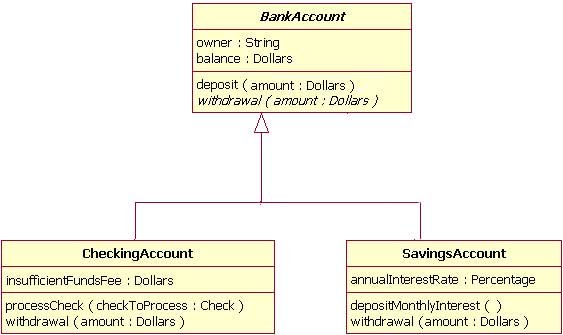
Inheritance lets a new class of object, called a subclass, reuse and extend the properties and methods of an existing class, called a superclass, avoiding the need to rewrite shared behavior from scratch. A general Vehicle class might define properties like speed and methods like accelerate, while more specific Car and Motorcycle subclasses inherit all of that shared behavior automatically and add only what makes them distinct. Polymorphism, the fourth core principle, allows different classes of objects to respond to the same method call in their own specific way; calling a generic makeSound method on a collection of different Animal objects can produce a bark, a meow, or a roar depending on which specific subclass each object actually belongs to, without the calling code needing to know which one it is dealing with in advance.
Classes, Objects, and Real-World Use
In object-oriented programming, a class acts as a blueprint describing what properties and methods a certain kind of object will have, while an object is a specific instance created from that blueprint. A single Car class might be used to create thousands of individual car objects in a game or simulation, each with its own particular color, speed, and fuel level, even though they all share the same underlying structure and behavior defined once in the class. This separation between the general blueprint and its many specific instances is what allows object-oriented code to scale cleanly as a program grows more complex.
Object-oriented programming became the dominant paradigm for large-scale software through languages including C++, Java, and C#, and it remains deeply embedded in how many modern applications, game engines, and graphical user interface frameworks are structured, since visual elements such as buttons, windows, and menus map naturally onto objects with their own properties and behavior. The paradigm is not universally preferred for every kind of problem; functional programming and other paradigms are sometimes favored for tasks involving heavy mathematical computation or highly concurrent processing, and most modern languages, including Python and JavaScript, support object-oriented features alongside other paradigms rather than forcing a single style.
Origins of the Paradigm
Many of the foundational ideas behind object-oriented programming trace back to Simula, a language developed in Norway in the 1960s for writing simulations, which introduced the concept of grouping data and behavior together into reusable units. Smalltalk, developed at Xerox PARC in the 1970s, pushed the idea much further, building an entire programming environment and user interface around objects communicating by sending each other messages, and many of the terms still used today, including class and method, trace directly back to Smalltalk’s design. Object-oriented programming reached mainstream popularity in the 1980s and 1990s through C++, which added object-oriented features to the widely used C language, and Java, which was designed from the ground up around object-oriented principles and became a dominant language for enterprise software, Android applications, and large web systems throughout the following decades.
Frequently Asked Questions
What are the four main principles of object-oriented programming? The four principles most commonly taught are encapsulation, which bundles data with the methods that use it and restricts outside access; abstraction, which hides internal complexity behind a simple interface; inheritance, which lets one class reuse and extend another’s behavior; and polymorphism, which lets different classes respond to the same method call in their own way.
What is the difference between a class and an object? A class is a blueprint defining what properties and methods a kind of object will have, while an object is an actual instance created from that blueprint, holding its own specific values for those properties. Many separate objects can be created from the same single class.
Is object-oriented programming the best approach for every program? No single paradigm fits every problem equally well. Object-oriented programming tends to shine when a program models many interacting, stateful entities, such as a simulation or a graphical application, while other paradigms, including functional programming, are sometimes better suited to problems centered on mathematical transformations or highly parallel computation.
Do all programming languages support object-oriented programming? Most widely used modern languages support it to some degree, though the depth of support varies. Java and C# were designed from the start to be strongly object-oriented, Python and JavaScript support object-oriented features alongside other styles, and some older or specialized languages, including plain C, offer no built-in object-oriented features at all, requiring programmers to simulate similar organization manually when needed.
Key facts
- OOP organizes code around objects combining data and methods.
- Encapsulation restricts direct outside access to an object's internal data.
- Inheritance lets a subclass reuse and extend a superclass's behavior.
- Polymorphism lets different classes respond differently to the same method call.
- A class is a blueprint; an object is a specific instance created from it.
Quick checkWhat are the four core principles of object-oriented programming?Show answer
The four core principles are encapsulation, abstraction, inheritance, and polymorphism, which together let software be organized around objects that bundle data with behavior and reuse code cleanly across related classes.
Sources
- Design Patterns (Gamma et al.); Object-Oriented Software Construction (Meyer)
Editorially reviewed by Specialty Digest Editorial TeamLast reviewed November 2, 2026Researched and drafted with AI assistanceReport an issue