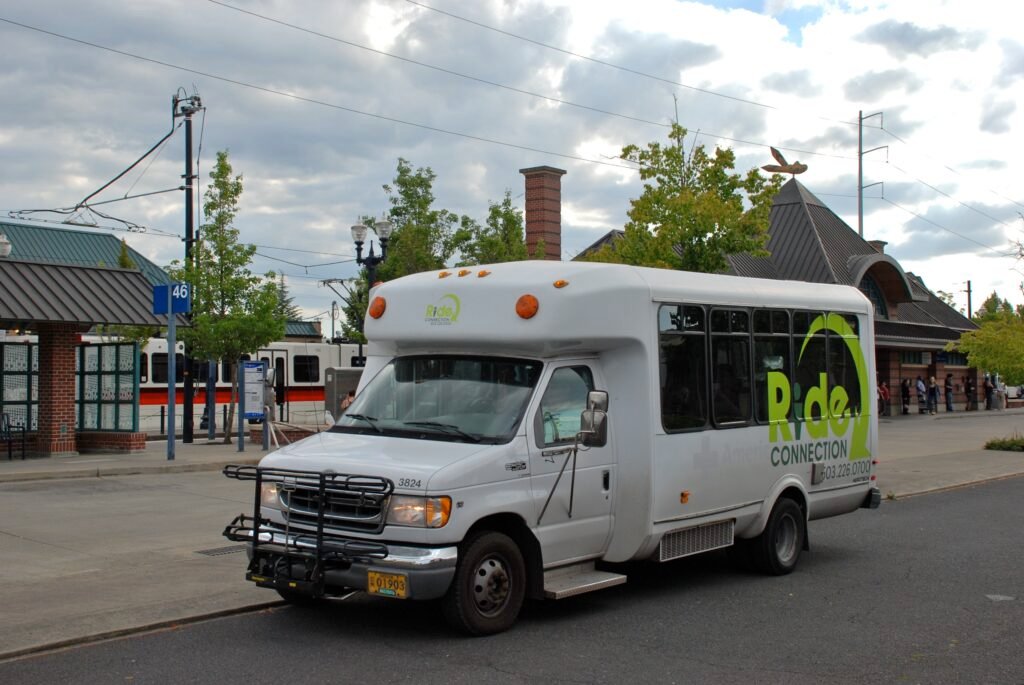
Legal Mandate and Origins
Paratransit service exists in its modern form largely because of disability rights legislation, most notably the Americans with Disabilities Act in the United States, which requires transit agencies operating fixed-route bus or rail service to also provide comparable paratransit service for riders whose disabilities prevent them from using the fixed-route system. Similar legal requirements exist in many other countries, typically mandating that paratransit service be available within a defined distance of existing fixed routes and during similar hours, effectively making paratransit a legally required complement to, rather than a substitute for, conventional transit.
Operating Model and Cost Structure
Paratransit trips are typically booked a day or more in advance, scheduled by dispatch software that groups nearby pickups and drop-offs to share vehicle capacity, and delivered using smaller vans or sedans rather than full-size buses, reflecting the individualized, often door-to-door nature of the service. This model makes paratransit substantially more expensive per passenger trip than fixed-route transit, since a van might serve only a handful of riders across an hour of scheduled stops compared with dozens or hundreds on a single bus route, a cost disparity that has pushed transit agencies to explore more efficient alternatives.
Integration with On-Demand Technology
Many transit agencies have begun integrating ride-hailing-style smartphone apps and even partnerships with commercial rideshare companies into their paratransit operations, allowing some eligible riders to book trips with shorter notice and more flexible scheduling than traditional phone-based dispatch allowed. These technology-enabled approaches have shown promise in reducing cost per trip and improving rider satisfaction in some programs, though eligibility screening, vehicle accessibility requirements, and driver training needs mean that fully replacing traditional paratransit with commercial rideshare remains limited to supplementary roles in most systems so far.
Eligibility Determination Process
Transit agencies typically require riders to complete an eligibility certification process before qualifying for paratransit service, often involving a functional assessment, sometimes including an in-person evaluation, to confirm that a disability genuinely prevents the applicant from using fixed-route buses or trains for some or all trips. This certification process aims to balance legal mandates to serve those who need the service against the cost pressure of serving every trip through expensive individualized paratransit rather than lower-cost fixed-route transit wherever a rider is able to use it.
Some riders receive conditional eligibility, qualifying for paratransit only for specific trip types or under specific conditions, such as during severe weather or for trips requiring transfers that are especially difficult for their particular disability, reflecting an effort to extend paratransit’s benefits without extending its high per-trip cost to every trip a certified rider makes.
Cost Pressures and Service Innovation
Facing steadily rising paratransit costs as aging populations and growing diagnosed disability rates increase demand, many transit agencies have invested in software upgrades that improve trip-scheduling efficiency, better grouping nearby pickups to increase average vehicle occupancy without degrading on-time performance for individual riders. Some agencies have also piloted travel training programs that help eligible paratransit riders gain confidence using fixed-route service for trips they are able to make independently, aiming to shift a portion of trips to lower-cost fixed-route transit while preserving paratransit access for trips that genuinely require it.
Weather-related service disruptions pose a particular challenge for paratransit, since the same severe conditions that increase demand from riders avoiding difficult conditions elsewhere can simultaneously slow vehicle travel times and strain scheduling capacity across the whole system.
International Variation in Paratransit Models
While the United States developed its paratransit model primarily around legal mandates tied to fixed-route service coverage, other countries have taken somewhat different approaches, with some European systems integrating door-to-door disability transport more closely into broader social care funding rather than treating it purely as a transit agency responsibility, and some lower-income countries relying more heavily on informal or charitable transport networks in the absence of a comprehensive formal paratransit mandate. These differing institutional arrangements affect not only service quality and availability but also how paratransit costs are accounted for and compared across countries, complicating international benchmarking of paratransit performance and cost-effectiveness.
Advance booking windows for paratransit trips, often requiring reservations a full day ahead, can create real hardship for riders facing same-day medical appointments or unexpected needs, prompting some agencies to reserve a portion of same-day capacity specifically for urgent trip requests.
No-Show and Late Cancellation Policies
Because a scheduled paratransit vehicle that arrives for a no-show rider represents wasted capacity that could have served another trip request, most agencies enforce no-show and late-cancellation policies, tracking patterns and potentially suspending service for riders who repeatedly fail to cancel trips they do not take, while also building in reasonable grace periods to account for the greater unpredictability many riders with disabilities face in their daily schedules. Balancing firm enough enforcement to protect system capacity against excessive punitive action toward vulnerable riders remains an ongoing policy tension for paratransit program administrators.
Driver training for paratransit emphasizes sensitivity to varied disabilities alongside standard defensive driving skills required of any passenger transport operator.
Trip purpose data collected by paratransit programs, including medical, work, and social trips, increasingly informs funding advocacy demonstrating the service’s broader community value.
Vehicle Fleet Composition
Paratransit fleets typically mix wheelchair-accessible vans with smaller sedans for ambulatory riders, allowing dispatchers to match vehicle type to each rider’s specific mobility needs while maximizing overall fleet utilization across a full day of scheduled trips.
Supervisor review of scheduling software recommendations remains common even in highly automated dispatch systems.
Agencies track on-time performance for paratransit much as they do fixed-route service.
Key facts
- Array
Quick checkWhy is paratransit typically more expensive per trip than regular bus service?Show answer
Because it provides individualized, often door-to-door scheduled service with smaller vehicles carrying far fewer passengers per trip than a fixed-route bus.
Sources
- Array
Editorially reviewed by Specialty Digest Editorial TeamLast reviewed November 4, 2026Researched and drafted with AI assistanceReport an issue