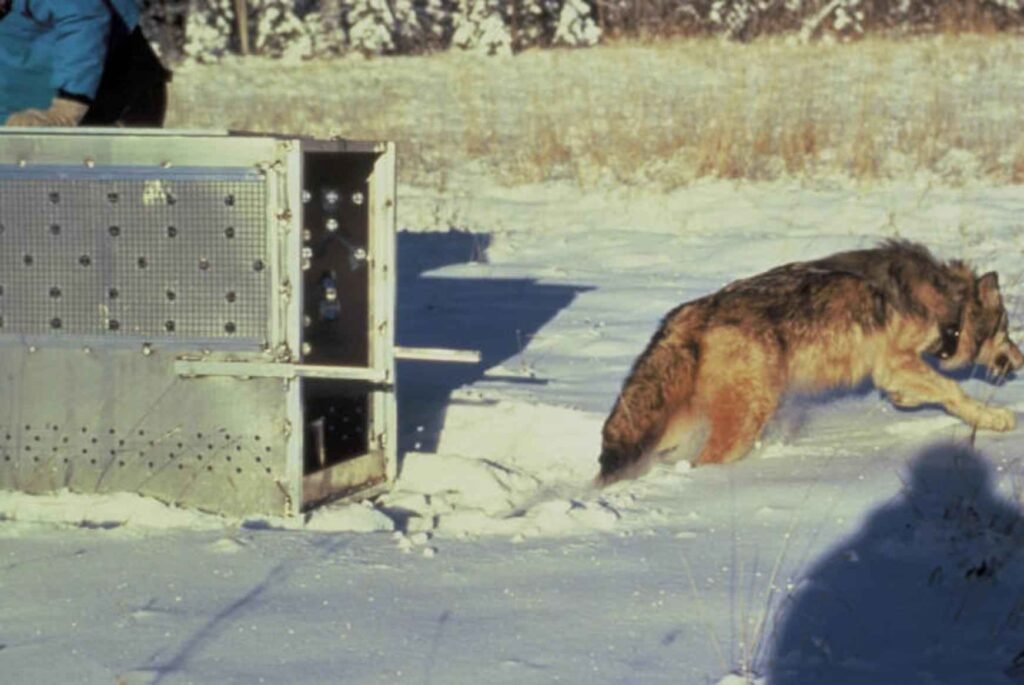
Rewilding is an approach to large-scale nature restoration that aims to let natural processes, rather than ongoing human management, shape a landscape or seascape over time. It can range from simply stepping back and letting vegetation regenerate on its own to actively reintroducing species that once performed key ecological roles in an area, with the underlying goal of restoring a wilder, more self-sustaining, and more biodiverse system.
History of rewilding
Early rewilding thinking in the 1990s focused narrowly on reintroducing missing keystone predators. Conservation biologists Michael Soule and Reed Noss expanded this into what became known as the “3C” approach: establishing large core wild areas free from intensive human interference, connecting those cores with corridors so wildlife can move between them, and reintroducing regionally extinct keystone carnivores to restore natural population checks. The term has broadened considerably since then. Rewilding projects across Europe today describe themselves as working toward ten shared principles, including letting natural processes lead without a fixed end state, acting at a scale large enough for nature to drive real change, and building long-term, nature-based local economies rather than treating restoration as a short, finished project. Acceptance of the approach has grown steadily over the past two decades, though practitioners and researchers still debate exactly how much active management, if any, a given project should involve.
Types of rewilding
Rewilding projects generally fall somewhere between two ends of a spectrum. Passive rewilding removes a specific human pressure, such as grazing, river dykes, or dams, and then leaves the land or water largely alone to recover on its own schedule. Active rewilding goes further by reintroducing species that disappeared because of human activity, such as large herbivores or top predators, on the understanding that these species perform jobs, like grazing patterns or keystone species predation, that the ecosystem cannot easily replace on its own.
How rewilding works
In practice, rewilding projects often combine several techniques: removing invasive species that compete with native ones, ending damaging land uses such as draining wetlands, restoring natural river channels and floodplains, and reintroducing species that had disappeared from a region. The gray wolf’s return to Yellowstone National Park in 1995, after decades of absence, is one of the most studied examples of active reintroduction, and it illustrates both rewilding’s promise and its genuine scientific complications. Elk browsing had suppressed willow and aspen growth along many streams for much of the twentieth century, and some of these plants recovered after wolves returned. Researchers broadly agree on that pattern but still debate why it happened, pointing to a mix of factors including changed elk behavior, reduced elk numbers, local water availability, and the independent return of beavers, so the wolf’s role is best described as one contributing factor within a larger, still-studied recovery rather than a single proven cause.
Applications and examples of rewilding
Rewilding is increasingly framed as a tool against climate change as well as biodiversity loss. Allowing former grazing land to develop back into forest or scrub, restoring peatlands and wetlands so they shift toward storing rather than releasing carbon, and rebuilding saltmarshes and seagrass beds can all increase an area’s capacity to hold carbon, though researchers caution that how much carbon different rewilding approaches actually sequester is still only loosely quantified. For climate adaptation, a more ecologically complex, rewilded landscape may carry less wildfire risk, and restoring wetlands, rivers, and beaver populations has been linked to reduced flood risk downstream. Because projects need enough land to let natural processes operate at a meaningful scale, many rewilding efforts are anchored around existing protected areas, using them as secure cores from which recovering wildlife and vegetation can expand outward.
The European bison illustrates how far a rewilding project can go. By 1927, fewer than 50 remained anywhere, all in zoos, after hunting and habitat loss wiped out every wild population; the last bison in the wild in Poland had been killed in 1919. Conservationists began releasing captive-bred herds back into the wild starting in 1951, and the species now numbers roughly 8,500 animals, about 6,200 of them free-ranging, across Belarus, Poland, Russia, Lithuania, Ukraine, and more recently Romania, where releases in the Southern Carpathians since 2014 have built a population of more than 60 animals. The International Union for Conservation of Nature has since moved the species from Vulnerable to the less severe Near Threatened category, a rare example of a large mammal’s conservation status genuinely improving.
Why rewilding matters, and its limits
Supporters argue that rewilding restores ecological functions, such as natural grazing, predation, and flooding cycles, that conventional conservation, which often focuses on protecting a fixed habitat state, can struggle to recreate. Critics and cautious researchers counter that rewilding’s goals and methods remain genuinely debated: there is no fixed definition of how “wild” a successful project should become, how large an area needs to be before natural processes can really take over, or how to weigh rewilding against the practical and cultural ties that local communities often have to a working landscape. Most researchers in the field now treat these as open, actively studied questions rather than settled criticisms of the approach itself.
FAQs
Is rewilding the same as simply not managing land at all? Not quite. Passive rewilding does step back from intensive management, but most projects still make deliberate decisions, such as which invasive species to remove or which native species to reintroduce, before letting natural processes take over from there.
Does rewilding always mean reintroducing large predators? No. While predator reintroductions like Yellowstone’s wolves draw the most attention, many rewilding projects focus on less dramatic steps, such as restoring wetlands, removing river barriers, or letting forests regenerate naturally, none of which require bringing back a single animal.
Key facts
- Conservation biologists Michael Soule and Reed Noss proposed the "3C" (cores, corridors, carnivores) approach in the 1990s.
- Rewilding ranges from passive recovery after removing a human pressure to active reintroduction of missing species.
- The 1995 gray wolf reintroduction to Yellowstone is the most studied example, though its exact ecological effects remain actively debated.
- Rewilding is increasingly promoted as a tool against both biodiversity loss and climate change, through carbon storage in restored peatlands and wetlands.
- Many projects anchor around existing protected areas to secure enough land for natural processes to operate at a meaningful scale.
Related concepts
Quick checkDo scientists agree that wolves alone caused Yellowstone's willow and aspen recovery?Show answer
No. Researchers agree the plants recovered in some areas but still debate the cause, citing changed elk behavior, lower elk numbers, water availability, and returning beavers as contributing factors alongside wolves.
Sources
- Rewilding Europe. What is rewilding?. 2024 (accessed 2026-11-01)
- LSE Grantham Research Institute on Climate Change and the Environment. What is rewilding and how is it relevant to climate change?. 2023 (accessed 2026-11-01)
- National Park Service. The Big Scientific Debate: Trophic Cascades. 2024 (accessed 2026-11-01)
- Rewilding Europe. Back from the brink: the European bison is a living legend. 2024 (accessed 2026-11-01)
Editorially reviewed by Specialty Digest Editorial TeamLast reviewed November 1, 2026Researched and drafted with AI assistanceReport an issue