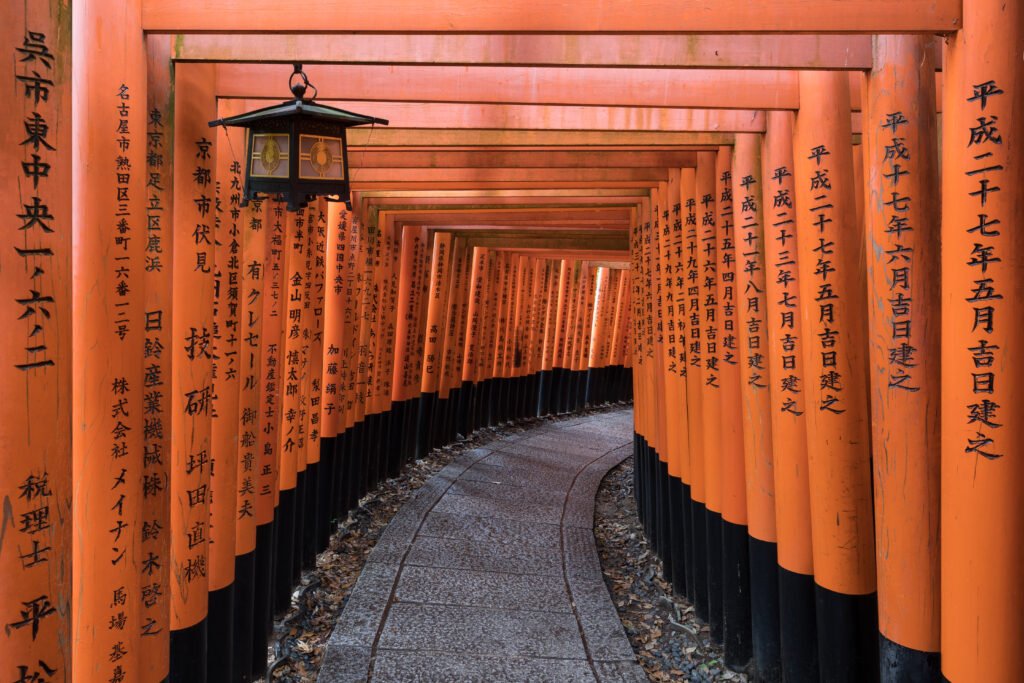
Shinto is the indigenous religious tradition of Japan, a term that can be translated roughly as “the way of the kami.” The name came into use specifically to distinguish Japan’s native beliefs from Buddhism, which arrived from the Asian mainland in the 6th century CE. Unlike many major world religions, Shinto has no single founder, no fixed body of scripture, and no official system of dogma, making it less a codified doctrine than an evolving set of practices, shrines, and attitudes toward the sacred built up over many centuries.
Origins and history
Shinto’s roots trace back to the Yayoi culture of roughly the 3rd or 2nd century BCE, whose agricultural rites and shamanistic practices are directly linked to later Shinto tradition. Early Shinto was polytheistic and decentralized, with individual clans worshipping their own tutelary deities, known as ujigami, rather than following any single unified religious authority.
From around the 5th century CE, Chinese philosophical influences, including Confucianism, Taoism, and yin-yang cosmology, began shaping Shinto’s ethical outlook. Two early 8th-century texts, the Kojiki, completed in 712, and the Nihon shoki, completed in 720, compiled the ancient myths that would come to define Japan’s religious imagination, centered on the sun goddess Amaterasu and her connection to the imperial line. Later intellectual movements, including Neo-Confucian Shinto and the National Learning (Fukko Shinto) movement, along with a cluster of 19th-century Sect Shinto groups, further reshaped Shinto thought over the centuries.
Core beliefs
At the center of Shinto belief are the kami, divine beings found in natural phenomena, in outstanding people, and in abstract ideas and forces. Kami are understood to possess a kind of divine personality and to respond to sincere, heartfelt prayer, rather than functioning as distant, impersonal powers.
Shinto emphasizes musubi, the creating and harmonizing power of the kami, and makoto, their truthful and sincere will. Sincerity of heart, known as magokoro, is considered essential to a well-lived life, and both physical and spiritual purification practices are used to help practitioners approach that sincerity. Shinto teaches that human beings are, in a sense, the children of kami and are therefore basically sacred by nature; notably, the tradition includes no concept comparable to original sin. People are also understood as part of an unbroken chain connecting ancestors and descendants, called tsunagari, and Shinto’s view of history tends to be cyclical rather than linear, without any single, final day of judgment.
Shrines and practices
Shrine worship, known as Shrine Shinto, has existed continuously from the earliest periods of recorded Japanese history to the present day. Local parishioners, called ujiko, worship at neighborhood shrines, and many practitioners of organized Shinto sects also maintain ties to a local shrine community. Alongside this, Folk Shinto centers on smaller roadside images and rural agricultural rites that have persisted for generations, often outside the structure of larger, officially recognized shrines.
Shinto’s ritual calendar historically included a spring festival praying for a successful harvest and a corresponding autumn ceremony giving thanks for the harvest gathered. Divination, water purification, and lustration rites, aimed at removing spiritual impurity, have long been common elements of Shinto ceremonial life, reflecting the tradition’s deep emphasis on ritual purity as a path toward sincerity of heart.
Relationship with Buddhism
Buddhism was officially introduced to Japan in 552 CE, and by the 8th century, Shinto and Buddhism had become deeply intertwined. Kami were frequently reinterpreted as protectors of Buddhism or as local manifestations, or avatars, of buddhas and bodhisattvas. Shrines were built within Buddhist temple grounds, and Buddhist statues in turn appeared within Shinto shrines, producing a genuinely syncretic religious landscape rather than two cleanly separated traditions.
During the Kamakura period, from 1192 to 1333, this blending produced distinct syncretic schools, including Ryobu Shinto and Sanno Shinto, which formally integrated Buddhist and Shinto cosmology. A countercurrent emerged in the 13th century with Watarai, or Ise, Shinto, which deliberately sought to remove Buddhist elements and restore a more independent Shinto identity, foreshadowing later nationalist efforts to separate the two traditions.
State Shinto
A distinct strand known as State Shinto, or Kokka Shinto, was built on the idea of a total identity between religion and the Japanese state, centered on the Imperial Household. Systematic imperial offerings to shrines date back to reforms around 645 CE, and by the early 10th century, roughly 3,000 shrines received regular state support. This system gradually declined after the 13th century but was deliberately revived following the Meiji Restoration of 1868, as part of a broader modernization and centralization of Japanese government.
In the decades that followed, Japanese authorities used State Shinto to help unify the population during a series of wars, tying religious observance closely to national and imperial identity. State Shinto was formally dismantled after World War II and is now defunct, though Shrine Shinto and Japan’s many local and sectarian Shinto traditions continue to be widely practiced today.
FAQs
- What is a kami? A kami is a divine being or sacred force found in nature, in exceptional people, or in certain ideas, believed to have a personality capable of responding to sincere prayer.
- Does Shinto have a founder or holy book? No. Shinto developed gradually out of ancient Japanese practices rather than originating from a single founder or a fixed scripture, though texts like the Kojiki and Nihon shoki preserve its central myths.
- What is a torii gate? A torii is the distinctive freestanding gateway, traditionally built of wood or stone, that marks the entrance to a Shinto shrine and symbolically separates ordinary space from the sacred ground where kami are enshrined.
Key facts
- Roots trace to the Yayoi culture, c. 3rd-2nd century BCE
- Core texts: Kojiki (712 CE) and Nihon shoki (720 CE)
- Central deity figure: Amaterasu, the sun goddess, linked to Japan's imperial line
- No founder, no fixed scripture, no central dogma
- State Shinto (Kokka Shinto) was revived after the 1868 Meiji Restoration and is now defunct
Quick checkWhat is a kami in Shinto belief?Show answer
A kami is a divine being or sacred force found in nature, exceptional people, or ideas, believed to respond to sincere prayer.
Sources
- Britannica, 'Shinto', https://www.britannica.com/topic/Shinto
Editorially reviewed by Specialty Digest Editorial TeamLast reviewed November 2, 2026Researched and drafted with AI assistanceReport an issue