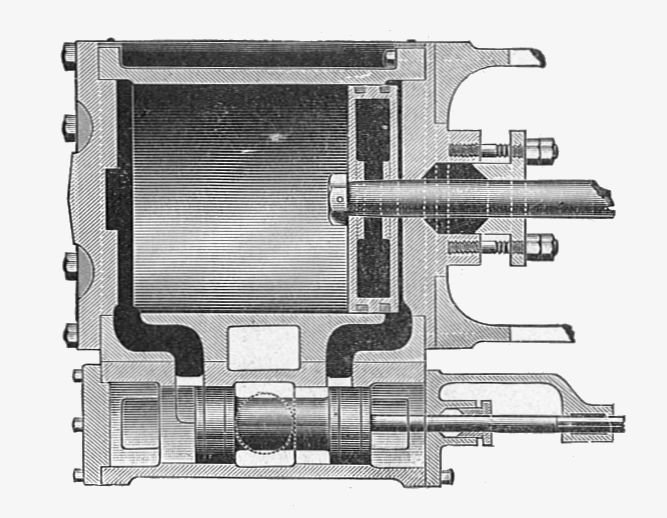
Thermodynamics is the branch of physics and mechanical engineering that studies heat, energy, and how they convert into mechanical work. Engineers rely on thermodynamics to design and analyze engines, power plants, refrigeration systems, and countless other devices that depend on moving or converting energy, making it one of the foundational subjects underlying nearly all of mechanical engineering practice.
Key Thermodynamic Concepts
Thermodynamics centers on a handful of core concepts: temperature, a measure of the average energy of particles within a substance; heat, energy transferred between objects at different temperatures; and work, energy transferred through mechanical force acting over distance, such as a piston moving within a cylinder. A system’s internal energy describes the total energy contained within it, and thermodynamics tracks how that internal energy changes as heat and work move into or out of a system during any process.
The Laws of Thermodynamics
The first law of thermodynamics states that energy cannot be created or destroyed, only converted from one form to another or transferred between systems, meaning any energy added to a system as heat or work must show up somewhere as a change in internal energy or output. The second law introduces the concept of entropy, a measure of disorder, and states that natural processes tend to increase the total entropy of an isolated system, which explains why heat flows spontaneously from hot objects to cold ones and never the reverse without additional energy input. The third law describes behavior as temperature approaches absolute zero, where entropy approaches a minimum value.
Thermodynamic Cycles and Engines
Many practical machines operate using repeating thermodynamic cycles, sequences of processes that return a working fluid to its starting condition after producing useful work or moving heat. The Carnot cycle, an idealized cycle, defines the theoretical maximum efficiency possible for converting heat into work between two temperatures, serving as a benchmark real engines can approach but never exceed. Internal combustion engines, steam turbines, and refrigeration systems each rely on different practical cycles, such as the Otto cycle for gasoline engines or the Rankine cycle for steam power plants, each suited to the specific working fluid and application involved.
Heat Transfer Mechanisms
Heat moves between objects and environments through three distinct mechanisms: conduction, which transfers heat through direct contact between materials; convection, which transfers heat through the movement of fluids such as air or water; and radiation, which transfers heat through electromagnetic waves even across a vacuum, as with heat arriving from the sun. Engineers must account for all three mechanisms when designing systems ranging from building insulation to spacecraft thermal protection, since the dominant mechanism and its intensity can vary enormously depending on the specific materials and environment involved.
Entropy and Efficiency Limits
Because the second law of thermodynamics guarantees that some energy is always lost as unusable heat during any real energy conversion process, no engine or power plant can ever achieve one hundred percent efficiency in converting fuel energy into useful work. This fundamental limit shapes engineering decisions across industries, pushing designers to seek incremental efficiency improvements, recover otherwise wasted heat through techniques such as cogeneration, and accept that some energy loss is an unavoidable feature of converting energy from one form to another rather than a solvable engineering flaw.
History of the Field
Thermodynamics developed during the nineteenth century, driven largely by the practical need to understand and improve steam engines that powered the Industrial Revolution. Scientists including Sadi Carnot, Rudolf Clausius, and William Thomson, later known as Lord Kelvin, established the theoretical laws that explained why engines behaved as they did and what limits governed their performance, transforming engine design from an empirical craft into a rigorous engineering science grounded in physical law.
Thermodynamics in Refrigeration and Cooling
Refrigeration and air conditioning systems rely on thermodynamics in a sense opposite to engines: rather than converting heat into useful work, they use work input, typically from an electric compressor, to move heat from a cooler space to a warmer one, which is why a refrigerator feels warm on the outside while keeping its interior cold. The refrigeration cycle exploits the fact that fluids absorb heat as they evaporate and release heat as they condense, circulating a refrigerant through evaporator and condenser coils to continuously pull heat out of a cold space and dump it into the surrounding warmer environment.
Thermodynamics Beyond Mechanical Engineering
Although thermodynamics is central to mechanical engineering, its principles apply far more broadly, informing fields such as chemistry, where thermodynamics predicts whether and how readily chemical reactions will occur, biology, where living organisms are understood as systems that constantly manage energy and entropy to maintain order, and even economics and information theory, where researchers have drawn loose analogies to entropy and irreversibility. This breadth reflects the fact that thermodynamics describes some of the most fundamental constraints on how energy behaves in any physical system, not merely how engines and power plants operate.
Practical Applications in Engineering Design
Mechanical engineers apply thermodynamic analysis constantly in practice, from sizing the cooling system of a data center to selecting the most efficient compressor for an industrial process to evaluating whether a proposed power plant design can meet its promised efficiency targets. Software tools now allow engineers to simulate complex thermodynamic cycles involving multiple components and varying operating conditions, but the underlying laws governing those simulations remain exactly the ones established nearly two centuries ago, a testament to how fundamental and enduring those early theoretical insights proved to be.
FAQs
Why can no engine be one hundred percent efficient?
The second law of thermodynamics guarantees that some energy is always lost as unusable heat during any real energy conversion process, making perfect efficiency physically impossible regardless of how well an engine is engineered.
What is the difference between heat and temperature?
Temperature measures the average energy of particles within a substance, while heat is energy that transfers between objects or systems because they are at different temperatures.
Quick checkWhat is the difference between heat and temperature?Show answer
Temperature measures the average energy of particles within a substance, while heat is energy that transfers between objects because they are at different temperatures.
Editorially reviewed by Specialty Digest Editorial TeamLast reviewed November 2, 2026Researched and drafted with AI assistanceReport an issue