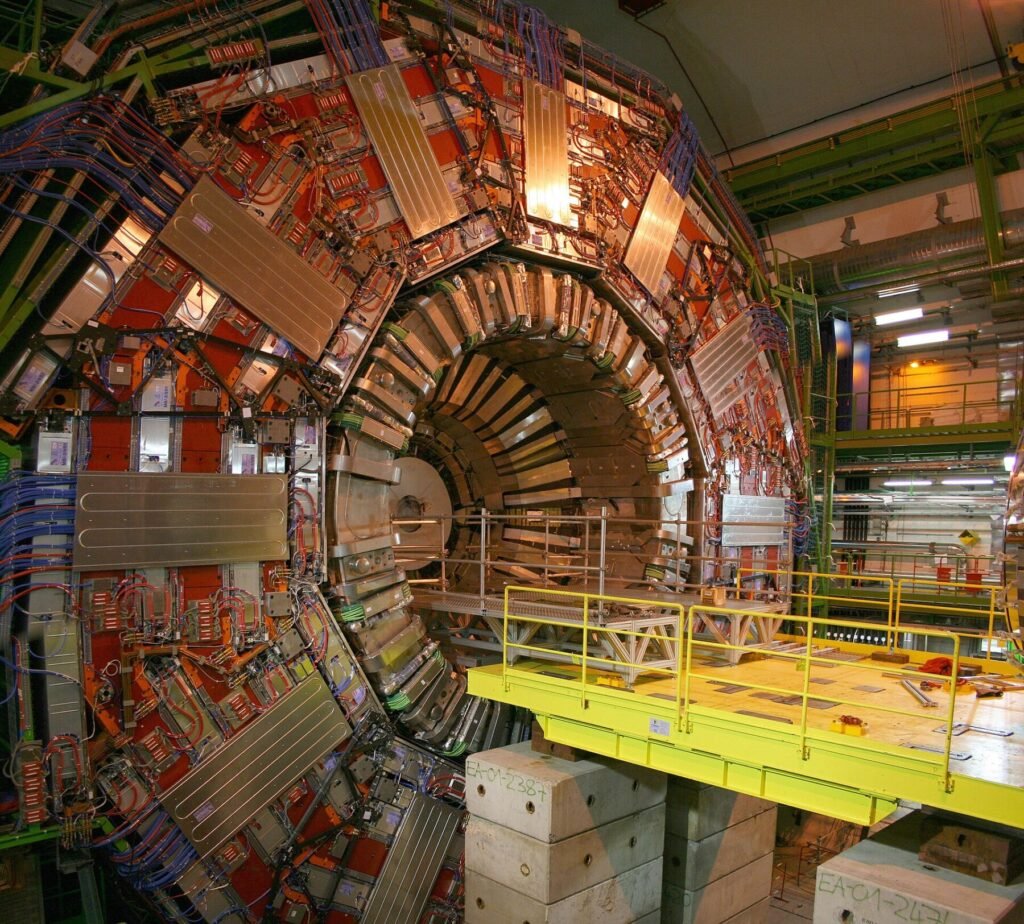
The Large Hadron Collider (LHC), the world’s most powerful particle accelerator, collected its last data before a major rebuild in 2026. CERN, the European laboratory near Geneva that operates it, scheduled the final collisions of the current machine for the end of June 2026. After that, four years of work begin to turn it into the High-Luminosity LHC, which CERN says will start operating in 2030. This article summarizes what CERN has published about the final run and the upgrade.
What was the 2026 run?
CERN reported that the first proton collisions of 2026 were recorded on Saturday, March 7, at 15:58, after a restart that the head of LHC operations, Matteo Solfaroli Camillocci, said was completed in record time. The run was planned to last four months, with collisions continuing until the end of June. Its schedule had nine weeks of proton collisions, three weeks of lead-ion operation and two weeks of high-intensity proton tests. By our own arithmetic, that adds up to 14 weeks of beam time within the roughly 16 weeks between March 7 and June 29, which leaves room for stops and setup.
What changed in the machine’s beams?
CERN’s accelerator report said the LHC restarted with just four bunches circulating per beam, and that intensity would rise in steps to more than 2,400 bunches per beam. By our own arithmetic, that is a rise of about 600 times. Each step requires checks on beam stability, beam losses, electron cloud and equipment heating. In the final two weeks, CERN planned to test bunches with 40% more protons than standard, using fewer bunches because the current accelerator and experiments cannot handle a higher load. Those tests prepare for routine operation of the upgraded machine.
How much data did Run 3 collect?
CERN’s January 2026 accelerator report said the official Run 3 target of 500 inverse femtobarns of integrated luminosity had already been reached by the end of 2025. Luminosity measures how many collisions an accelerator produces, and integrated luminosity is the total over time. An inverse femtobarn is a unit for that total, and the definition is general rather than quoted from CERN. The report did not state a 2026 target, so we do not give one.
What is the High-Luminosity LHC?
CERN says work to transform the LHC into the High-Luminosity LHC, also called HiLumi, begins on June 29, 2026. Part of the machine will be dismantled and replaced with new equipment that is in production. CERN says HiLumi will produce a significantly higher number of collisions than the current LHC and will start operating in 2030. The same January report said the injectors’ own shutdown starts on August 31, 2026 and that this phase, called Long Shutdown 3, is dedicated to the upgrade. Reports in July said the shutdown had begun, but we relied on CERN’s published schedule and readers should check CERN for the current status.
How big is the machine?
CERN gives these facts: the LHC has a 27 kilometer circumference and lies about 100 meters underground. It has more than 9,000 superconducting magnets and operates at minus 271 degrees Celsius, using the world’s largest cryogenic system. It had run at high energy for 11 years by 2026. The ring crosses the border between France and Switzerland, and our entry on Geneva covers the nearby city that hosts CERN.
What do colliders look for?
A collider accelerates particles close to the speed of light and brings them together so that the energy of the collision can form new particles. Detectors record what comes out. The LHC collides protons, which are made of smaller particles, and sometimes lead nuclei. These are general descriptions of how colliders work and are not quoted from the CERN pages. Our entry on the atom explains the building blocks involved.
Why does the upgrade matter?
More collisions mean more data on rare processes, and physics results improve as the number of recorded events grows. That is a general statistical point and is not stated in the CERN pages we used. CERN itself describes the aim in simple terms: a significantly higher number of collisions than the current machine produces. The new equipment now in production will be installed during the shutdown, and the tests in autumn 2025 and in the final weeks of 2026 studied the high-intensity beams that will be part of routine operation afterward.
How to read the schedule
Several dates appear in CERN’s reports and should not be confused. March 7 is the first physics collisions of 2026. June 29 is the end of LHC physics and the start of the major work. August 31 is the start of the injectors’ shutdown. 2030 is the target start of HiLumi operation. The gap between mid-2026 and 2030 is the building period, and CERN’s pages do not describe it in detail. The March report said the work lasts four years, which by our own arithmetic matches the span from June 2026 to 2030.
Glossary
- Luminosity: a measure of how many collisions a collider produces
- Integrated luminosity: the total amount of collision data collected over a period
- Bunch: a clump of particles that travels in the beam
- Superconducting magnet: a magnet that carries current without resistance when kept very cold
- Long Shutdown 3: the CERN period devoted to the HL-LHC upgrade
The luminosity, bunch and magnet entries are general definitions and are not quoted from CERN.
What is not covered here?
The CERN pages we opened did not give collision energy figures or the results of the 2026 physics runs. We have not filled those from memory. Readers who want the physics results should consult CERN and the experiments directly.
Key facts at a glance
- First 2026 collisions: March 7
- End of LHC physics and start of upgrade work: June 29, 2026
- Planned HiLumi start: 2030
- Circumference: 27 kilometers
- Superconducting magnets: more than 9,000
Frequently asked questions
Is the LHC closing for good?
No. It is being rebuilt as the High-Luminosity LHC, which CERN says will operate from 2030.
When did the final run of the current machine end?
CERN scheduled the end of collisions for the end of June 2026, with major work starting June 29.
What does high luminosity mean?
A higher number of collisions, according to CERN.