The James Webb Space Telescope is the largest space telescope ever launched and one of the most searched science topics. It observes the universe in infrared light from a point about 1.5 million kilometers from Earth. This article uses the European Space Agency (ESA) fact sheet to explain what the telescope is, how it is built and what its instruments do.
What is the James Webb Space Telescope?
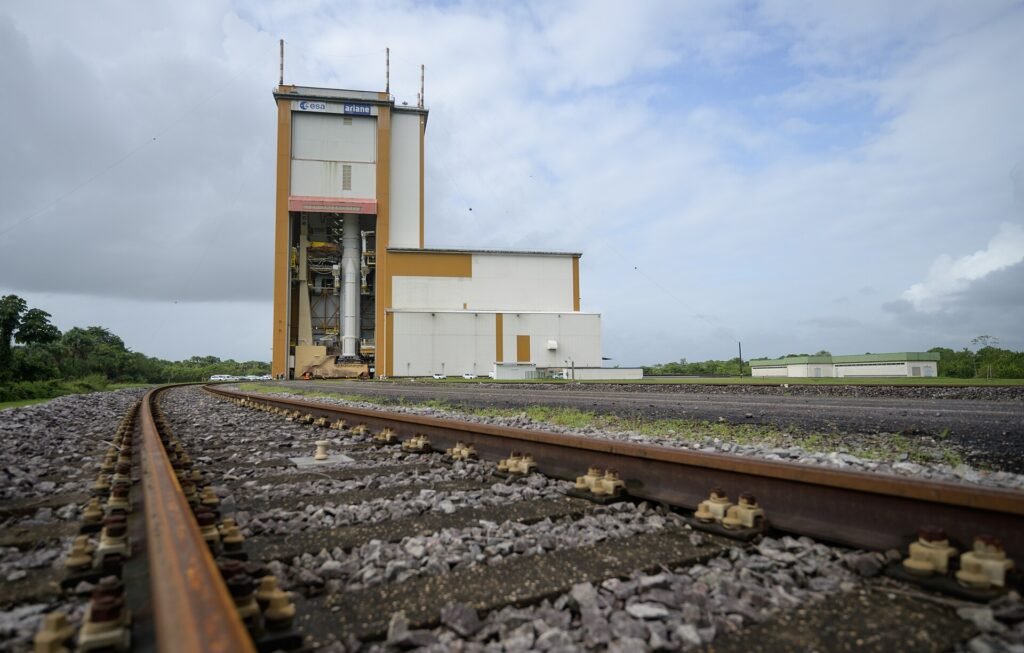
ESA describes Webb as an international mission of NASA, ESA and the Canadian Space Agency (CSA). It launched on December 25, 2021, on an Ariane 5 ECA rocket from Europe’s Spaceport in French Guiana. Its primary mirror is segmented and 6.5 meters across. ESA says it collects almost six times more light than the Hubble Space Telescope. The fact sheet does not give the number of mirror segments, so we leave that out.
Where is Webb?
Webb orbits the Sun-Earth system’s second Lagrange point, called L2, about 1.5 million kilometers from Earth. By our own arithmetic, and using the general figure of 384,400 kilometers for the average Earth-Moon distance, that is about four times as far as the Moon. A Lagrange point is a position where the gravity of two large bodies and the motion of a small one balance so that the small object can stay in step with them. The definition is general and is not quoted from ESA.
Why does Webb need a sunshield?
Infrared telescopes detect heat, so the telescope must be kept very cold. ESA says the sunshield has five layers and measures 22 by 12 meters, roughly the size of a tennis court. By our own arithmetic, those dimensions give an area of about 264 square meters. The telescope and its instruments cool to minus 233 degrees Celsius, and the Mid-Infrared Instrument (MIRI) cools further, to minus 266 degrees Celsius. Converting with the general rule that zero kelvin is minus 273.15 degrees Celsius, these are about 40 kelvin and 7 kelvin.
What instruments does it carry?
ESA lists four instruments:
- MIRI: the Mid-Infrared Instrument
- NIRSpec: the Near-Infrared Spectrograph
- NIRCam: the Near-Infrared Camera
- FGS-NIRISS: the Fine Guidance Sensor and Near-Infrared Imager and Slitless Spectrograph
Together they cover wavelengths from about 0.6 micrometers to 28 micrometers, from visible light through the mid-infrared. A spectrograph splits light into its component wavelengths, which lets astronomers study what an object is made of. That explanation is general and is not quoted from ESA.
Why observe in infrared?
The fact sheet gives the wavelength range but does not explain why infrared matters. In general, light from very distant objects is stretched to longer wavelengths as the universe expands, and dust clouds block visible light but let infrared through. Those are general principles and not statements from the ESA page. Our entry on the speed of light covers the basics of light, and our article on the Copernican principle covers how astronomy changed ideas about humanity’s place in the universe.
What science does it support?
ESA’s fact sheet focuses on the hardware. Webb is also used to study planets beyond the solar system, which our entry on the exoplanet introduces. We do not describe individual discoveries here because we did not open the original science releases. For another mission built to look for signs of habitability in the outer solar system, see our article on Europa Clipper.
How to read the numbers
Three conversions help. First, a micrometer is one millionth of a meter, so 28 micrometers is longer than visible light, which spans roughly 0.4 to 0.7 micrometers (a general range). That is why Webb counts as an infrared observatory even though it reaches into the visible at its short end. Second, a mirror that is 6.5 meters across has a much larger collecting area than one that is a fraction of that size, because area grows with the square of the width. Third, ESA’s claim of almost six times more light than Hubble is a statement about light collected, not about image sharpness.
Why is the mirror made of segments?
The ESA fact sheet says the mirror is segmented but does not say why. In general, a mirror this wide would be too large to fit inside a rocket in one piece, so the pieces are launched folded and then arranged into one reflecting surface in space. The same logic applies to the sunshield, which must unfold after launch. These are general engineering explanations and are not stated on the ESA page. What the page does confirm is the finished geometry: a 6.5 meter mirror, a five-layer sunshield and an orbit far beyond the Moon.
Glossary
- Lagrange point: a position where a small object can stay in step with two larger bodies
- Infrared: light with wavelengths longer than visible red light
- Spectrograph: an instrument that separates light into wavelengths
- Sunshield: the layered screen that blocks heat from the Sun, Earth and Moon
- Segmented mirror: a large mirror made of smaller pieces working together
These definitions are general explanations and are not quoted from ESA.
What is not on the ESA fact sheet?
The page does not state the mission lifetime, the cost or the number of mirror segments. We have not supplied them from memory. Readers who need those details should consult ESA, NASA or CSA directly.
Key facts at a glance
- Launch: December 25, 2021, on Ariane 5 ECA
- Mirror: 6.5 meters, segmented
- Orbit: L2, about 1.5 million kilometers from Earth
- Wavelength range: about 0.6 to 28 micrometers
- Partners: NASA, ESA and CSA
Frequently asked questions
How big is Webb’s mirror?
6.5 meters across, according to ESA.
Where is the telescope?
At the second Sun-Earth Lagrange point, about 1.5 million kilometers from Earth.
Who built it?
Webb is a mission of NASA, ESA and the Canadian Space Agency.
Why is it so cold?
It observes infrared light, so it must stay cold enough that its own heat does not swamp faint signals. That is a general explanation.