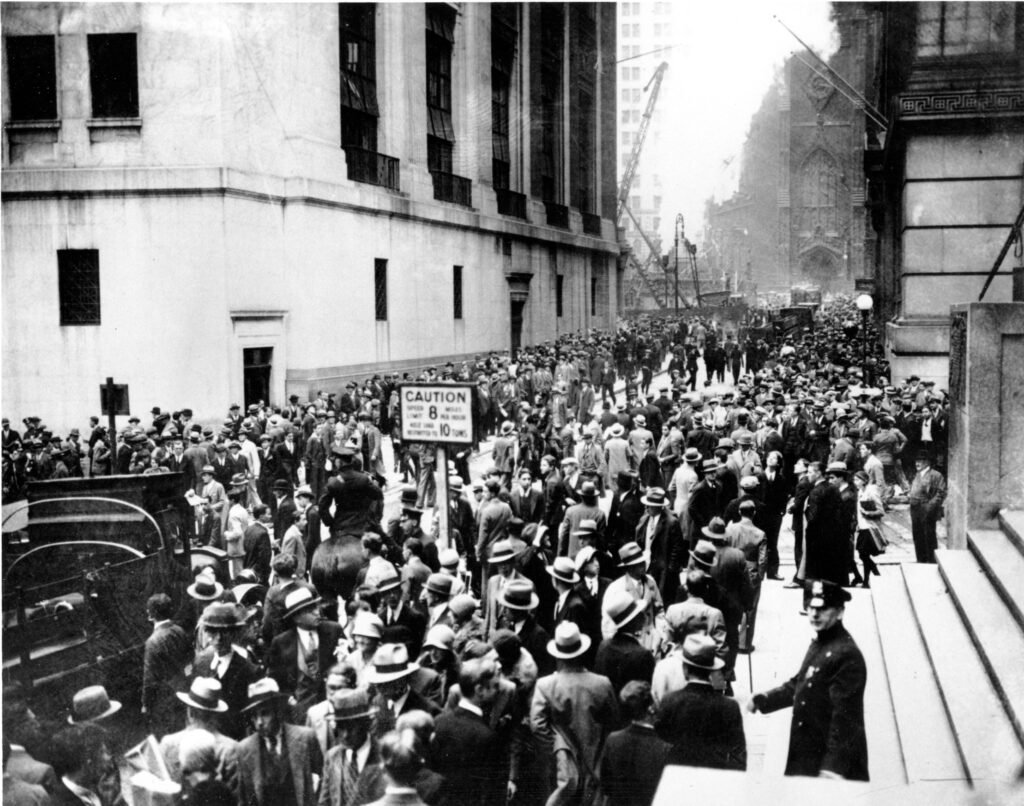
Black Tuesday gets all the credit, but the stock market crash of October 1929 did not, by itself, cause the Great Depression. It was the spark that exposed a financial system already riddled with weaknesses — and it was the policy response that followed, not the crash itself, that turned a sharp recession into a decade-long catastrophe that put a quarter of America out of work.
The Crash: October 1929
Throughout the 1920s, stock prices climbed on a wave of speculation, much of it fueled by investors buying shares “on margin” — borrowing most of the purchase price. When prices began to slip in October 1929, margin calls forced a wave of selling. Between late October and mid-November, the market fell roughly 33 percent, and by its ultimate low point in July 1932, it had lost nearly 90 percent of its 1929 peak value. The crash wiped out savings, shattered confidence, and caused consumers and businesses alike to sharply cut spending, especially on big-ticket items like cars and appliances.
A Wave of Bank Failures
The crash alone did not sink the economy; the banking collapse that followed did far more damage. Between 1930 and 1933, the United States endured four separate waves of banking panics, as depositors, fearing insolvency, rushed to pull their money out all at once. By 1933, roughly one in five banks that had existed in 1930 had failed. Because there was no deposit insurance at the time, failures meant families lost their life savings outright, and surviving banks, badly shaken, pulled back sharply on lending — choking off credit to businesses and consumers just when it was needed most.
The Federal Reserve Made It Worse
Rather than pumping money into the economy to fight the collapse, the Federal Reserve tightened it. Bound by the gold standard, which required the U.S. to hold enough gold reserves to back its currency, the Fed raised interest rates to prevent gold from flowing out of the country, deliberately contracting the money supply. That decision deepened deflation — falling prices that made it harder for businesses and households to repay debt — and discouraged the very lending and investment the economy needed to recover. Because major economies were tied to the same gold standard, the contraction spread internationally, dragging down output and employment well beyond U.S. borders.
The Smoot-Hawley Tariff Backfired
In June 1930, President Herbert Hoover signed the Smoot-Hawley Tariff Act, raising import duties on thousands of goods to an average of roughly 20 percent, despite an open letter of objection signed by over a thousand economists. Other nations retaliated with tariffs of their own, and global trade collapsed — falling from about $3 billion in 1929 to under $1 billion by 1933, roughly a two-thirds decline. The policy, intended to protect American jobs, instead throttled the export markets American farmers and manufacturers depended on.
Slow, Uneven Recovery
Unemployment peaked at roughly 25 percent in 1933, the year Franklin D. Roosevelt took office and began the New Deal, a sweeping set of relief, recovery and reform programs, including deposit insurance through the newly created FDIC and a departure from the strict gold standard. Those measures stabilized the banking system and eased the deflationary spiral, but full recovery was gradual and uneven; many economists mark the country’s decisive exit from the Depression only with the surge in production and employment driven by mobilization for World War II in the early 1940s.